AI Automation Workflow: Eliminate Meeting Note Chaos and Reclaim 5 Hours Every Week

An AI automation workflow that turns meeting recordings into structured tasks, saving around five hours of admin work per week.
This article introduces an AI automation workflow that addresses the pain points of traditional meeting documentation. The workflow covers three stages: automatic transcription of meeting recordings, intelligent detection and structuring of action items, and automatic write-through of tasks to project management tools with zero manual entry. The approach claims to save five hours per week by freeing knowledge workers from fragmented administrative tasks. The article also honestly addresses limitations — action item detection accuracy, integration depth across different tools, and the ability to handle complex conversational contexts — recommending that a human review step be kept in place even when automatic task creation is enabled.
Does the pile of scattered notes after every meeting give you a headache? Having to rewind an entire recording just to track down a deadline someone mentioned in passing — this is a frustratingly familiar experience for many knowledge workers. A video from the YouTube channel Tech Vibe Lab proposes a solution: use an AI automation workflow to fully automate these repetitive, low-value tasks.
Why Meeting Notes Are Always a Mess
Traditional meeting documentation has a few fundamental flaws. Manual note-taking can't keep pace with the flow of conversation, which means action items get missed. After the meeting wraps up, someone still has to manually organize everything, assign tasks, and set deadlines. The whole process is both time-consuming and error-prone.
The source material puts it bluntly: "rewinding a call to find a deadline is a nightmare." That kind of back-and-forth scrubbing through recordings is exactly the sort of "busy work" that AI automation is designed to eliminate.
How the AI Automation Workflow Actually Works
According to Tech Vibe Lab, the core logic of this workflow breaks down into three stages:
1. Automatic Transcription
Meeting recordings are automatically transcribed into text. This step eliminates the time cost of listening back to audio and converts spoken content into something searchable and processable.
2. Smart Identification and Classification
The system doesn't just generate a transcript — it goes further by "sorting" the content into a structured format and identifying every action item. This means the AI needs to understand who is responsible for what and by when, not simply transcribe words mechanically.
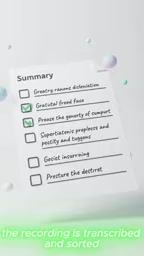
3. Automatic Write-Through to Project Management Tools
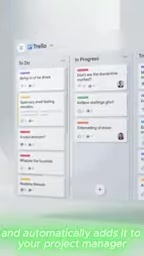
The identified tasks are "automatically added to your project manager," flowing directly into your project management system with zero manual entry. This is the highest-value step in the entire workflow: the path from meeting to task execution is fully connected, with no need for anyone to manually move information from one place to another.
Workflows like this are typically built on a trigger-and-action automation model, commonly implemented by chaining tools together through platforms like Zapier, Make (formerly Integromat), or n8n. A typical pipeline looks like this: a meeting recording uploaded to cloud storage (such as Google Drive or Zoom cloud recordings) automatically triggers a transcription service (such as AssemblyAI, the Whisper API, or Otter.ai); the transcript is then passed to a large language model (LLM) for action item extraction; and finally, the results are written into your target tool via its API. The entire process requires no human intervention — it's a fully end-to-end, unattended pipeline. Understanding this chain helps you identify which step is most likely to fail and where it makes the most sense to insert a human review checkpoint.
The Real Payoff: 5 Hours Back Every Week
The quantified benefit cited in the source material is "save five hours a week." But the significance of that number goes beyond the time itself — it's about freeing people from repetitive busywork so they can invest their energy in the deep work that actually requires focus.
For knowledge workers, fragmented administrative tasks are the single biggest enemy of deep work. Being constantly interrupted throughout the day to clean up notes and update task statuses doesn't just eat time — it destroys the mental state needed to concentrate. The true value of AI automation is reclaiming that fractured attention.
Real-World Value and Limitations
From an industry perspective, meeting note automation is becoming one of the most mature use cases for AI agents in production. Transcription, summarization, and task extraction happen to cover the everyday needs of a huge number of teams, and the technical barrier is relatively manageable.
That said, it's worth keeping a realistic perspective. The source material is a promotional short video, so it naturally presents the ideal outcome. In real deployments, the accuracy of AI action item detection, the depth of integration with specific project management tools (such as Notion, Asana, or Jira), and the system's ability to handle multiple languages, accents, and domain-specific terminology will all directly affect the actual experience. Automatic task creation is convenient, but it's still advisable to keep a human review step in the loop to prevent erroneous tasks from entering your system.

Action item detection is the technically hardest step in the entire chain. Unlike simple transcription, it requires the model to have a degree of pragmatic language understanding — the ability to extract three structured fields (responsible party, task description, and deadline) from a natural utterance like "Let's get the proposal out to the client before next Friday." The current mainstream approach is to feed a carefully crafted system prompt to a large model like GPT-4o or Claude, instructing it to output structured JSON, which a downstream script then parses and writes to the destination tool. This approach performs reasonably well in general scenarios, but accuracy drops noticeably when dealing with implied commitments (e.g., "You'll follow up on this"), conditional tasks (e.g., "Kick this off if the client agrees"), or situations where responsibility is shared across multiple people — which is the primary reason a human review step is recommended.
Closing Thoughts
Meeting note automation is one of the most immediately rewarding entry points into AI automation workflows. It doesn't require complex technical overhauls, yet it delivers real, tangible relief from the burden of manual documentation and task entry. If your team is spending significant energy every week on post-meeting follow-up, this type of workflow is worth prioritizing — even if you start with just the transcription and summarization step.
Related articles

A Single Prompt Triggers a Global PHP Security Storm: Is AI a Savior or a Hidden Risk?
A single AI prompt triggered a global PHP security crisis affecting Wikipedia and the Internet Archive. This article reviews the incident, analyzes the OpenAI-Amazon controversy, and explores the security paradox of lowered vulnerability discovery barriers in the AI era and developer response strategies.

When AI Is Taken Away: How Reliance on Shortcuts Undermines Your Problem-Solving Resilience
A study of 1,222 people found that after using AI to answer questions, once AI was removed, people gave up on more problems than a control group that never used AI. The article analyzes the impact of AI reliance on learning resilience and metacognition, and explores design implications for AI learning tools.

Carta and NewView Partner to Let Startup Employees Cash Out Equity Early
Carta and NewView Capital partner to simplify startup tender offers, helping employees sell equity early. Analysis of the mechanism, liquidity pain points, and impact.