AI-CAD: An Open-Source Multi-Agent CAD Framework for Mechanical Engineering

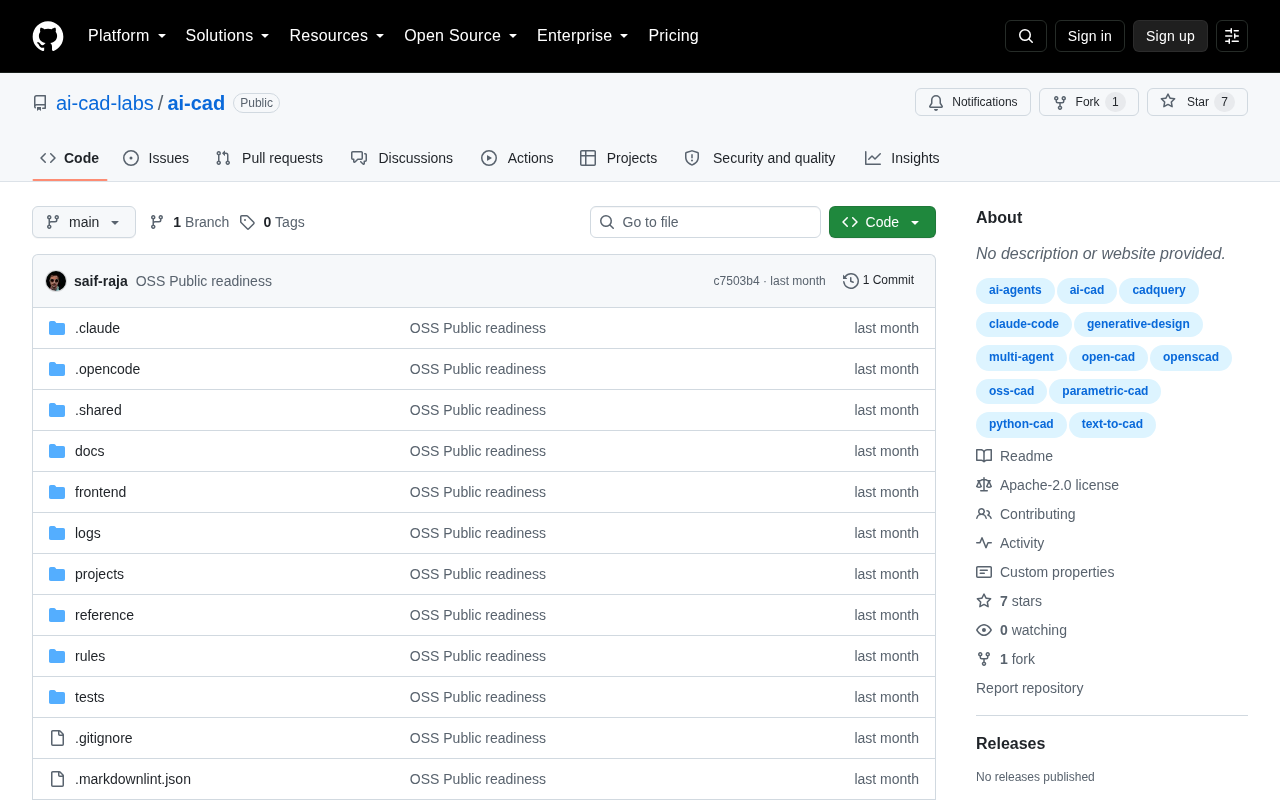
AI-CAD is an open-source multi-agent framework that brings LLM-powered agents into mechanical engineering CAD workflows.
AI-CAD is an open-source multi-agent framework for mechanical engineering CAD that decomposes the design workflow into subtasks — requirement parsing, geometric modeling, constraint validation — handled by specialized agents, addressing the geometric precision and constraint-reasoning limitations of monolithic LLMs. Its open-source release helps break the commercial software dominance in CAD tooling. However, production deployment remains challenging: engineering design demands extreme precision, manufacturability, and standards compliance, and inter-agent information handoffs can accumulate errors. Near-term, AI-CAD is best positioned as a design assistant, but the multi-agent approach to vertical engineering domains holds significant long-term potential.
What Is AI-CAD
AI-CAD is an open-source multi-agent harness designed specifically for CAD (Computer-Aided Design) tasks in the mechanical engineering domain. It aims to bring today's increasingly popular multi-agent architecture into a design workflow that has traditionally relied heavily on human expertise — enabling multiple specialized AI agents to collaborate in assisting or partially automating CAD modeling, design reasoning, and related processes.
Three keywords define this project: open-source, multi-agent, and mechanical engineering CAD. Their combination points to a compelling direction: grounding LLM-powered agent capabilities in a highly specialized, low-error-tolerance vertical domain like engineering design.
Why Multi-Agent Architecture Suits CAD
Mechanical design has never been a single-step process. A complete design workflow typically spans requirement parsing, geometric modeling, constraint solving, tolerance analysis, manufacturability evaluation, and more — each requiring distinct expertise. This maps naturally onto the philosophy behind multi-agent architecture.
A "harness," at its core, is an orchestration mechanism that enables multiple agents to divide labor and collaborate. In AI-CAD's model, different agents can each own a specific role: one interprets design intent, another generates parametric models, and another validates whether the design satisfies engineering constraints. Compared to a single monolithic model doing everything end-to-end, this division of labor reduces single-point failure risk and makes each subtask's output more controllable and debuggable.
The Limits of Monolithic LLMs
Asking a general-purpose LLM to handle CAD modeling directly tends to run into two problems: first, geometric precision and engineering constraints are hard to guarantee — models tend to confidently generate physically unreasonable structures; second, there's no traceable reasoning chain, making it difficult to pinpoint where things went wrong. Multi-agent frameworks address these pain points by decomposing complex tasks and passing structured information between agents.
Parametric modeling is the core paradigm of modern CAD: designers describe parts by defining dimensional parameters, geometric constraints, and feature operations — not by directly manipulating vertex coordinates. This means the output of a CAD task isn't an image or natural language, but a sequence of operations to be parsed and executed by a CAD kernel (such as OpenCASCADE BRep operations or Fusion 360 Timeline scripts). General-purpose LLMs have seen very limited parametric scripting in their pretraining data, and lack an intrinsic understanding of constraint solver behavior. As a result, the code they generate tends to be syntactically valid but geometrically broken — over-constrained, under-constrained, or topologically flawed. The value of a multi-agent framework lies in its ability to introduce agents fine-tuned specifically for such structured outputs and to embed symbolic constraint checks into the pipeline, compensating for general models' gaps in engineering-semantic understanding.
The Value of Being Open-Source
AI-CAD's choice to release as open-source carries real value for the broader engineering AI community. CAD and mechanical engineering have long been dominated by commercial, closed-source software, and most exploration of AI-CAD integration has stayed within vendor walls. An open-source multi-agent framework means researchers and engineers can build on it, swap out underlying models, and connect their own CAD kernels — accelerating iteration in this cross-disciplinary space.
For developers interested in how AI understands and generates engineering geometry, the open-source code itself is the best learning material. It exposes the engineering details of how agents communicate, how they're orchestrated, and how they interact with CAD toolchains — far more instructive than the black box of a closed product.
The Real Challenges of Production Deployment
Despite the promising direction, actually deploying a multi-agent framework for production-grade mechanical design faces significant hurdles. Engineering CAD demands extremely high precision, manufacturability, and standards compliance — a single geometric or tolerance error can cause parts to fail assembly or even create safety hazards. AI-generated designs require rigorous human review and simulation validation, making "design assistant" a far more realistic near-term role than "autonomous designer."
Multi-agent systems also introduce their own complexity: information handoffs between agents can accumulate errors, orchestration logic requires careful design, and multiple model calls translate to higher computational costs. These are the engineering challenges any project like AI-CAD must confront on the path to practical use.
The "low error tolerance" of engineering isn't just a figure of speech — there's an entire validation stack behind it. At the geometric level, FEA (Finite Element Analysis) is required to verify structural integrity. At the manufacturing level, DFM (Design for Manufacturability) checks are needed to confirm machining feasibility. At the compliance level, designs must meet ISO, ASME, and other standards for tolerance annotation and material specification. For AI-generated designs to reach production, they must integrate with these downstream verification tools — and most agent frameworks today have very limited depth on this front. Another often-overlooked challenge is long-range dependency in engineering context: a modification to a single sub-component in a complex assembly can cascade through dozens of mating relationships and BOM (Bill of Materials) entries. This places far greater demands on agents' state management and cross-step consistency than typical software tasks.
A Direction Worth Watching
AI-CAD hasn't attracted huge attention on Hacker News yet, but the approach it represents — multi-agent systems applied to vertical engineering domains — is one of the more imaginative threads in current AI application research. As agent orchestration matures and domain-specific models improve, AI-assisted engineering design has real potential to evolve from concept to practical tooling. For readers tracking AI deployment, open-source tooling, and agent architecture, this project is worth adding to your watchlist.
Note: Due to limited source material, this article makes reasonable inferences about AI-CAD's implementation details, supported CAD kernels, and agent division of labor based on the project's stated positioning. Refer to the project's official documentation for specifics.
Related articles

Multi-Agent Voice Command Center in Practice: Deconstructing the VAPI + Supabase Architecture
Deconstructing the Load Bearing Empire multi-agent voice command center: VAPI voice pipeline, Supabase Edge Functions for Webhooks, 8 Postgres tables tracking agent state, and Vercel-managed frontend design.

Astro 7 Rewrote Every Page, So IndexNow Now Hashes What a Crawler Reads
NeuraGrowth documents how an Astro 7 upgrade caused 273 pages to be misjudged as updated, and switched IndexNow hashing from file bytes to crawler-readable content—text, links, title, meta, and JSON-LD only.

From Python to AI Agents: A Full-Stack Learning Path with 488 Lessons and 23 Projects
A Udemy course covering Python, machine learning, deep learning, LLMs, RAG, and AI Agents, with 488 lessons and 23 real-world projects. This article analyzes the logic of this full-stack AI learning path, who it suits, and self-study advice.