AI Clones Everything in Rust: Adobe, Office, Outlook, and ElevenLabs All Get Open-Source Replicas

Community uses Rust and AI swarm model to lightning-fast replicate commercial software, raising industry paradigm and quality concerns.
The remade.wiki project is using Rust combined with AI-assisted development to quickly clean-room rewrite commercial software such as the Adobe suite, Microsoft 365, Outlook, ElevenLabs, and Fusion 360, with over 160,000 GitHub stars accumulated. PdfCraft was tested to start in 2 seconds and repair a corrupted 2,744-page PDF, demonstrating practical value. The AI swarm model allows issues and PRs to be automatically processed within minutes, with iteration speed far exceeding traditional reverse engineering. However, security audits for brand-new browser engines, long-term project sustainability, legal clean-room compliance, and plugin ecosystem completeness remain key challenges. This trend could force commercial software companies to rethink pricing and moats, accelerating the democratization of software development.
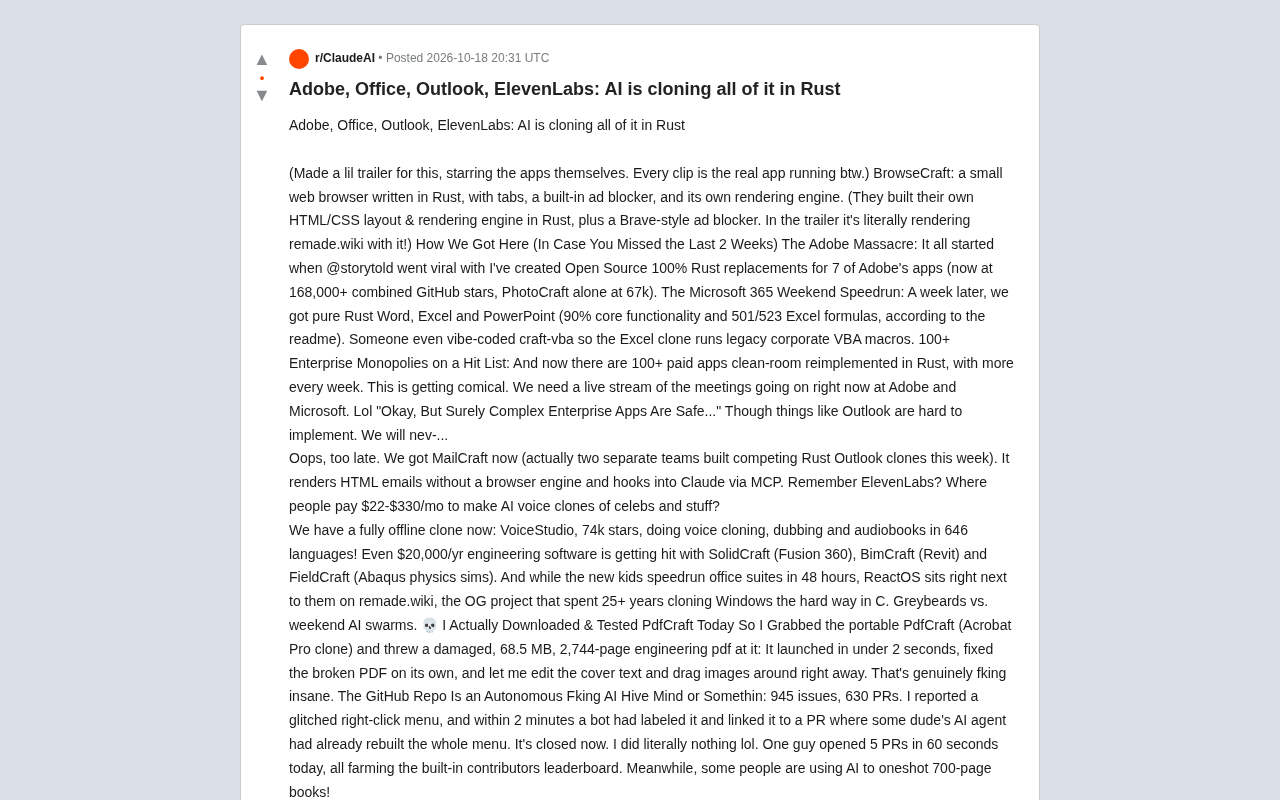
A project called remade.wiki is rewriting commercial software in the Rust language at an astonishing pace. From the entire Adobe suite to Microsoft 365, from Outlook to ElevenLabs, and even professional engineering software like Fusion 360 and Abaqus, community members are reimplementing them with AI assistance. This discussion, initiated by a Reddit user, showcases a trend that could reshape the software industry.
From Adobe to Office: The Blitzkrieg of Open-Source Replicas
It all started with a post by @storytold on social media: he created open-source alternatives to 7 Adobe apps in Rust, and these projects have collectively garnered over 168,000 stars on GitHub. PhotoCraft alone has 67k stars.
A week later, pure Rust implementations of Word, Excel, and PowerPoint appeared. According to the project readme, they cover 90% of core functionality, and the Excel clone supports 501 out of 523 formulas. Even more surprising, someone quickly generated the craft-vba project with AI, enabling this Excel clone to run legacy enterprise VBA macros.
Now, remade.wiki lists over 100 paid apps that have been clean-room reimplemented, and the number grows every week. This speed makes traditional software reverse engineering look like slow motion.
Clean-room reimplementation is a legally relatively safe reverse engineering method: the development team is completely isolated from the original software's source code and rewrites the implementation based solely on public interface documentation, behavioral observations, or functional specifications. Its core principle is "contact isolation"—those involved in the replica must not view the original software's proprietary code to avoid being deemed a derivative work. Historically, the IBM PC's BIOS-compatible chips and ReactOS's reimplementation of Windows NT have taken this path. AI-assisted clean-room implementation further reduces costs: AI can quickly generate behaviorally equivalent but code-independent modules, but the legal boundary still depends on whether protected expression (such as specific algorithm implementations or interface layouts) has been copied, rather than the functionality itself.
Complex Enterprise Applications Are Not Spared Either
Some might think that complex enterprise applications like Outlook are difficult to replicate. But this week, two independent teams built competing Rust Outlook clones, collectively called MailCraft. It renders HTML emails without a browser engine and connects to Claude via the MCP protocol.
The ElevenLabs clone VoiceStudio has already gained 74k stars, supporting voice cloning, dubbing, and audiobook production across 646 languages, running entirely offline. Meanwhile, ElevenLabs subscriptions cost $22 to $330 per month.
Professional engineering software is also affected: SolidCraft (a Fusion 360 alternative), BimCraft (a Revit alternative), and FieldCraft (an Abaqus physics simulation alternative) have appeared, and these software typically cost up to $20,000 per year.
MCP (Model Context Protocol) is an open protocol proposed by Anthropic to enable AI models to connect to external tools and data sources in a standardized way. In the MailCraft example, MCP acts as a bridge between the email client and Claude: the client exposes context such as email content, attachments, and calendars to the model, and the model can invoke operations like "write email" or "search inbox" through the protocol. Compared to traditional plugins or proprietary APIs, MCP provides a unified tool description and invocation format, allowing the same AI agent to be reused across applications. This design enables open-source clones to gain intelligent capabilities at low cost without building their own large model infrastructure.
Hands-On Experience: PdfCraft Is Astonishing
The poster downloaded the portable version of PdfCraft (an Acrobat Pro clone) and tested it with a corrupted 68.5 MB, 2,744-page engineering PDF. The result: startup time under 2 seconds, automatic repair of the corrupted file, and immediate ability to edit cover text and drag images.
This experience shows that these AI-assisted applications already have practical value. However, for a brand-new browser engine like BrowseCraft, the poster is cautious, believing there may be security vulnerabilities.
The AI Swarm Model of Open-Source Projects
The PdfCraft GitHub repository showcases a new paradigm of AI-driven development: 945 issues and 630 PRs. The poster reported a right-click menu bug, and within two minutes, a bot tagged it and linked it to a PR where a developer's AI agent had already rebuilt the entire menu. The poster did nothing throughout the process.
Someone even submitted 5 PRs in 60 seconds, all to game the contributor leaderboard. This "AI swarm" model drives project iteration speed to unprecedented levels.
Agentic IDE refers to a development environment with a built-in AI agent that can autonomously read the codebase, modify files, and run tests, such as Claude Code and Cursor. Unlike traditional code completion, an agentic IDE receives a goal (e.g., "fix this issue") and then plans the steps itself: locating relevant files, generating patches, running tests, and submitting PRs. In the remade.wiki case, contributors only need to hand the project link and issue number to the agent, and the AI can complete the loop from diagnosis to submission. This model shifts human effort from "writing code" to "reviewing code," but it also brings governance challenges such as PR flooding and contribution score gaming, requiring repository maintainers to establish stricter automated review and reputation mechanisms.
Hidden Concerns Behind the Speed
This development model raises several key questions. First, can quality be guaranteed? A brand-new browser engine needs security audits, otherwise it could become an attack vector. Second, sustainability is questionable: when the initial hype fades, can these projects be maintained? The ReactOS project took 25 years to clone Windows, while today's AI swarms might accomplish similar work in 48 hours, but long-term maintenance remains a challenge.
On the other hand, the low barrier to AI-assisted development means more people can contribute. The poster even encourages readers to use their remaining tokens and input the project link into agentic IDEs like claude.ai/code, and the AI will automatically start processing issues and PRs.
A Paradigm Shift in the Software Industry
This phenomenon is not just a technical demo. It shows how AI can drastically reduce the cost of software replication, potentially forcing commercial software companies to rethink pricing and moats. When software with $20,000 annual fees is challenged by free open-source alternatives, the market landscape will undergo profound changes.
Of course, legal risks (whether clean-room implementations infringe patents or copyrights) and ecosystem completeness (plugins, support, documentation) remain challenges these projects must face. But regardless, the democratization of software development has accelerated, and the combination of Rust and AI is becoming the core driving force behind this process.
One-line Summary
Community uses Rust and AI swarm model to lightning-fast replicate commercial software, raising industry paradigm and quality concerns.
Paragraph Summary
The remade.wiki project is using Rust combined with AI-assisted development to quickly clean-room rewrite commercial software such as the Adobe suite, Microsoft 365, Outlook, ElevenLabs, and Fusion 360, with over 160,000 GitHub stars accumulated. PdfCraft was tested to start in 2 seconds and repair a corrupted 2,744-page PDF, demonstrating practical value. The AI swarm model allows issues and PRs to be automatically processed within minutes, with iteration speed far exceeding traditional reverse engineering. However, security audits for brand-new browser engines, long-term project sustainability, legal clean-room compliance, and plugin ecosystem completeness remain key challenges. This trend could force commercial software companies to rethink pricing and moats, accelerating the democratization of software development.
Related articles

Why Does the Tesla Roadster Need to Fly? A Deep Dive into Musk's Wild Demo
Tesla's Roadster launch showed wall-climbing, upside-down driving, and flying stunts—but The Vergecast notes the demo car may lack a battery, the Rocket version is invite-only and not street-legal, and the website terms don't guarantee delivery. After nine years of delays, why does this car still need to exist?

AI Is Not a Replacement: Human-AI Collaboration Through the Lens of Factory Root Cause Analysis
Starting from factory root cause analysis, this article explains how AI accelerates evidence chain construction rather than replacing human experts, exploring the pragmatic implementation logic and business value of 'AI supporting people rather than replacing them.'

AI Agent Decision Auditing: Building an Evidence Chain in Regulated Workflows
Starting from a Reddit discussion, this article analyzes three core issues in AI agent decision auditing within regulated workflows: what fields audit records should contain, how to handle feedback latency for erroneous decisions, and how to continuously calibrate LLM judge consistency with human judgment.