AI Coding Burning Through Tokens Too Fast? 5 Practical Strategies to Cut Costs by 80%

Why AI coding tools burn tokens fast and 5 strategies to dramatically reduce costs
AI coding tools consume tokens extremely fast due to the stateless nature of LLMs — each conversation turn must carry the full history context, and coding scenarios involve large text volumes with frequent modifications. Key strategies to save tokens include: describing requirements completely upfront, keeping context clean (clearing after 3-4 rounds of back-and-forth), planning before coding, and optimizing input/output by avoiding conversational language, using images, and specifying exact file paths.
Why Does AI Coding Burn Through Tokens So Fast?
Many developers using AI coding tools (like Cursor, Claude, etc.) share the same frustration: they burn through a month's quota in just 10 days. Token consumption far exceeds expectations, and the underlying reasons are closely tied to how large language models work.
The Stateless Nature of LLMs
Large language models are fundamentally stateless — they don't remember what was said before. This characteristic stems from the design principles of the Transformer architecture: during each inference, the model can only see the current input token sequence with no persistent "memory" storage. To maintain coherence across multi-turn conversations, the engineering solution is to concatenate the conversation history into a complete text sequence and feed it to the model as a whole. The maximum length of this sequence is the "Context Window," which currently ranges from 32K to 200K tokens across mainstream models.
Here's a simple example:
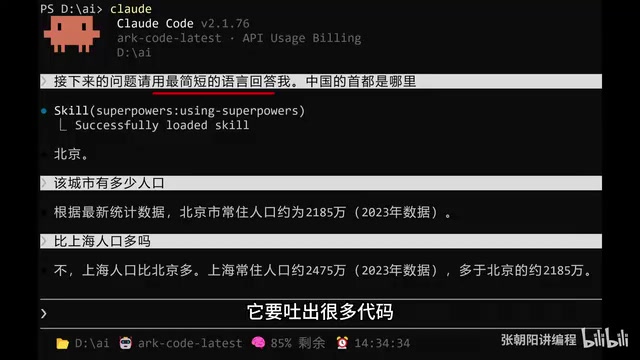
- First question: "What's the capital of China?" → "Beijing"
- Second question: "What's the population of that city?" → "21.85 million"
- Third question: "Is it more than Shanghai?" → "No"
What appears to be three simple Q&A pairs actually works differently under the hood. When the second question is sent, the system submits the first round's question and answer along with it (otherwise the model wouldn't know "that city" refers to Beijing). When the third question is sent, the complete conversation from both previous rounds gets packaged and sent together.
This means: The more turns you have in a conversation window, the more tokens each subsequent turn consumes. A larger context window can hold more conversation history, but computational costs grow linearly or even super-linearly — this is the fundamental reason token consumption balloons so rapidly.
When the interface shows "85% context remaining," it doesn't mean the entire conversation has cumulatively used 15%. It means your last single query consumed 15% of the context window.
Why Coding Scenarios Are Especially Token-Hungry
Tokens are the basic units LLMs use to process text — they're neither characters nor words. In English, one token corresponds to roughly 4 characters or 0.75 words; in Chinese, typically 1-2 characters map to 1 token. In code, variable names, brackets, and indentation spaces are each counted as separate tokens — this is one reason code is more "token-expensive" than regular text.
In coding scenarios, the token consumption problem is even more severe:
- Entire files or even entire project codebases need to be submitted to the LLM
- The LLM outputs large amounts of code after modifications
- Each subsequent Q&A round rolls all the previous code into the context
This is the fundamental reason why Coding Plans are so token-intensive — large code volumes, frequent modifications, and rapidly expanding context.
Core Strategies to Reduce Token Consumption
Strategy 1: Describe Your Requirements Completely in One Go
Avoid this inefficient pattern: submit a vague requirement → AI writes code → discover you need more features → AI rescans all code and modifies → need yet another feature → repeat the cycle.
With each iteration, the AI has to reprocess all previous code and conversation history. The correct approach is to think through and write out your complete requirements before starting, communicating all expectations in a single pass.
Strategy 2: Keep a Clean Context Environment
When the AI writes buggy code, you correct it, it fixes it but introduces new bugs, you correct it again — after three or four rounds of this back-and-forth, the context is cluttered with erroneous code. This not only wastes tokens but also confuses the LLM, since it fundamentally predicts output based on the context.
Recommendation: After 3-4 rounds of back-and-forth, clear the context and start fresh. Based on the mistakes the AI tends to make, reorganize your requirements with more precise descriptions.
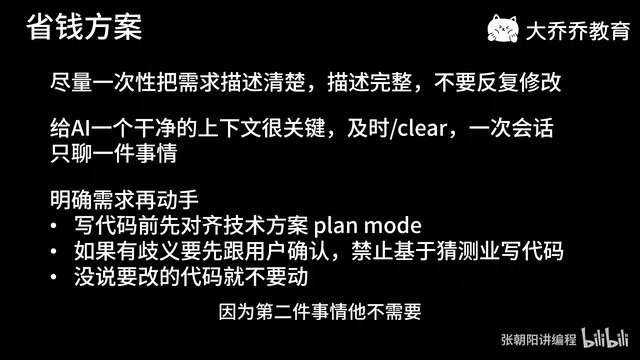
For unrelated tasks, they should absolutely be handled in separate conversations. Finish one task, run clear, then start the second task — the second task has no need to know the background of the first.
Strategy 3: Plan Before You Code
Before starting project development, have the AI create a plan first. Review and confirm the plan point by point, then let it start writing code. Explicitly tell the AI:
- If there's any ambiguity, it must stop and ask — don't write code based on assumptions
- Do not modify anything that wasn't explicitly requested
Otherwise, it fixes one thing here but breaks another there, requiring more back-and-forth rounds that waste tokens for nothing.
Tips for Reducing Input and Output Token Costs
Understanding Token Pricing Differences
Output tokens are much more expensive than input tokens for any LLM. For example, with one model: input costs 0.0032 yuan per 1,000 tokens, while output costs 0.016 yuan per 1,000 tokens — output is 5x more expensive than input. Output tokens cost more because the generation process requires autoregressive inference token by token, with each generated token requiring a complete forward pass. This computational load far exceeds the one-time encoding of the input sequence. Therefore, controlling output volume is especially important.
Input Optimization Methods
- Avoid conversational language: Use professional terminology and be concise
- Use images to convey information: Flowcharts, code structure diagrams, and example screenshots are more concise than pure text descriptions and easier for LLMs to understand
- Specify exact file paths: If you know which file has the problem, tell the LLM the exact path — don't make it scan the entire codebase
Output Optimization Methods
Constrain the AI through rules to avoid outputting low-value information:
- Prohibit phrases like "Sure, I understand"
Related articles
 Tutorials
ChatGPT Plus Subscription Guide: Are GPT-5.5, image-2, and Codex Worth the Upgrade?
A detailed look at ChatGPT Plus features — GPT-5.5, image-2, and Codex — with a Plus vs Pro comparison and a complete step-by-step subscription guide for users outside the US.
 Tutorials
Harness AI Engineering in Practice: Using Claude Code to Master Enterprise-Level E-Commerce Development
Deep dive into Harness AI Engineering: master enterprise e-commerce development with Claude Code using the Rules, Skills, Wiki, and Changes framework.
 Tutorials
Cursor + Codex Dual-IDE Collaboration: A Practical Methodology for Open-Source Project Customization
A complete methodology for open-source project customization based on real-world experience, detailing the Cursor+Codex dual-IDE workflow, seven-stage process, MVP validation, and AI source code reading techniques.