AI Coding Token Crisis? How Mixing Open-Source Models Cuts Costs by 4x

Use powerful models for planning and cheap open-source models for coding to cut AI coding costs by 75%.
As rate limits on frontier models like Claude and GPT tighten, the core bottleneck in AI coding has shifted from model capability to token availability. A developer blogger found that in the standard planning→implementing→validating→reviewing workflow, only the planning phase demands top-tier models — implementation, the most token-intensive step, can be handled by smaller open-source models. His hybrid approach using GPT-6 Astra for planning and GLM 5.3 Flash for all code writing costs just one quarter of a pure Claude setup with near-identical output quality, validated across multiple applications.
The Real Bottleneck in AI Coding Has Shifted from Capability to Tokens
A developer blogger recently noticed that even without a heavier workload, his Claude Code $200/month Max plan was burning through faster than ever — and to make things worse, his other $200/month Codex Pro subscription was nearly depleted too, with both resetting in three or four days. His conclusion: this isn't a personal problem, it's an industry-wide trend.
He points out that rate limits have been tightening throughout the past year, and have now reached a critical point where "improving token efficiency alone isn't enough." When teams start adopting harness engineering, loop engineering, and software factory workflows, the biggest constraint on output is no longer model capability — it's how many tokens you can actually spend.
This has transformed "saving money with open-source models" from an experiment into an indispensable core of his daily workflow.
Rate Limit refers to the cap that API providers place on the amount of resources a single user or account can consume within a given time window — typically measured in tokens, request counts, or a combination of both. For frontier models like Claude and GPT, even users on paid monthly subscriptions face dual constraints: a "total token quota" and a "requests per minute/hour" limit. When a workflow scales up from manual prompting to automated loops or concurrent multi-agent calls, token consumption can run tens of times faster than human usage, draining expensive plans within days. This is why rate limits become a more pressing bottleneck than model capability in harness engineering and software factory scenarios — throughput is no longer limited by "how smart the model is," but by "how many tokens are left."
Core Strategy: Expensive Models for Planning, Cheap Models for Coding
The blogger spent this week running in-depth tests across the four phases of a traditional AI coding workflow — planning, implementing, validating, and reviewing — searching for answers: where do you absolutely need the most powerful model, and where can you swap in something smaller, faster, and cheaper with virtually no quality loss?
His key finding: the planning step is the most critical phase in the entire workflow. Given a well-written plan, even a mediocre implementation model can produce near-optimal results. And implementation (writing code) happens to be the most token-intensive part of the process — swapping this step out for a smaller model is the key to avoiding rapid rate limit depletion.
He divided his test subjects into three camps, using the best available option from each:
- Open-source models: DeepSeekAd v4.1 Flash for planning/reviewing, GLM 5.3 Flash for implementation
- Claude: Fable 5.1 Max Effort
- Codex: GPT-6 Astra Max Effort
Regardless of the combination, the pattern held consistently — use a stronger model for planning and review, use a smaller model for implementation.
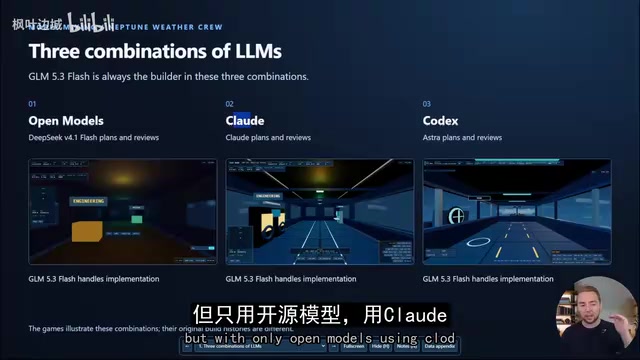
His current favorite combination: GPT-6 Astra for planning and reviewing, GLM 5.3 Flash for fast, cheap implementation. This combination is now the default workflow for everything in his software factory.
Head-to-Head: Three Versions of the Same Game
To illustrate the results, the blogger used the same product requirements document (PRD) to produce three versions of a "Neptune Storm Chase" game (multiplayer online, with players dividing control of various stations).
Pure open-source version (DeepSeek planning, GLM implementation): poor visuals, barely any sense of movement, just a handful of clouds scattered around — not even a passable starting point as a game.
Pure Claude version (Fable 5.1 throughout): noticeably better, with working navigation and clouds that gradually approach as you fly toward them. Quite solid as a proof of concept — though he didn't push it further to keep token usage in check.

Hybrid version (GPT-6 Astra for planning and reviewing + GLM 5.3 Flash writing all the code): this one surprised him the most. The cost and token usage came in at roughly one quarter of the pure Claude version, yet the result was nearly on par — movement was actually smoother. He considers this version genuinely better, despite every line of code being written by an open-source model.
He emphasizes that this result held across nearly every application he tested. Referencing the LiveBench benchmark, Claude Fable 5.1 and GPT-6 Astra are comparable in capability, so the hybrid combination can match pure Claude output — strong evidence that you don't need the most powerful model at every step.
How to Build a Multi-Model Collaborative Workflow
For developers who want to replicate this setup, the blogger outlines a few practical approaches:
The Simplest Manual Approach
Have each coding agent output a "handoff document," manually feed it to the next model or agent, and open new sessions to advance through the stages. It's rudimentary, but has the lowest barrier to entry.
Using a Harness Tool
Tools like Omnigent make it easy to collaborate across models and providers. The blogger himself uses Archon, his own open-source harness builder — all several hundred tests this week were run through it.
Every test followed the same workflow shape: a GitHub Issue describing requirements as input → the strongest model (e.g., GPT-6 Astra) does the planning → the plan is automatically passed to the next node, where GLM 5.3 Flash handles implementation → review → any issues are passed back to GLM for fixes (in a loop with a maximum retry count) → finally, tests run and the build must pass before merging. This is a very traditional AI coding workflow shape.
MCP (Model Context Protocol) is an open protocol launched by Anthropic in late 2024 that provides a standardized interface between AI models and external tools or data sources. With MCP, developers can package code repositories, file systems, API services, and more as "MCP Servers," allowing AI coding tools like Claude Code to read diffs, call external services, or trigger automated tasks through a unified interface — without writing custom adapters for each tool. The blogger's one-command connection of Claude Code to Scrimba mentioned in the article was achieved via MCP. MCP has since gained support from major AI providers including OpenAI and Google, and is on track to become the de facto standard for AI agent tool calls.
Accessing Open-Source Models
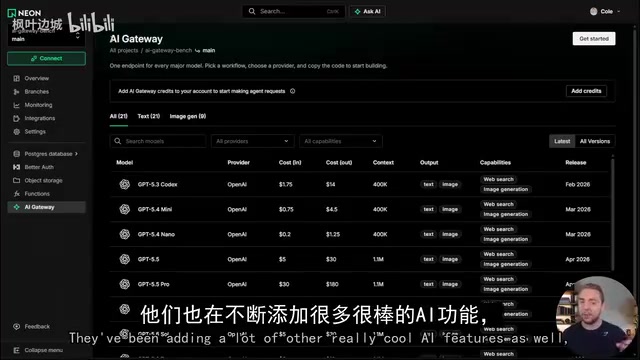
The blogger recommends using Neon's AI gateway to access open-source models — it provides reliable, cost-price access to GLM 5.3 Flash, Kimi K3, and almost all major open-source models. He emphasizes that Archon is free and open-source, but the tooling isn't the point — the core idea is not to take the lazy route of running every step through Astra or Fable. Any toolchain can implement this layered strategy.
Harness (Testing/Orchestration Framework) in the context of AI coding refers to an automated scaffolding system for driving, orchestrating, and managing multiple AI agent or model calls. Analogous to a "test harness" in software testing, it defines input/output formats for each step, controls call sequencing, handles retry logic, and passes context between models or providers. Loop engineering refers to designing conditional loops with maximum retry counts within a workflow — for example, the "implement → review → find issues → pass back for fixes" feedback loop, allowing agents to iterate autonomously until acceptance criteria are met. Software factory is the broader concept: pipelining and automating the entire software development process (from requirements to deployment) so that AI agents produce code at scale like an assembly line. Together, these three concepts describe the architectural path AI coding is taking from "conversational assistance" toward "fully automated production."
A Noteworthy Side Tool: Scrimba Explain
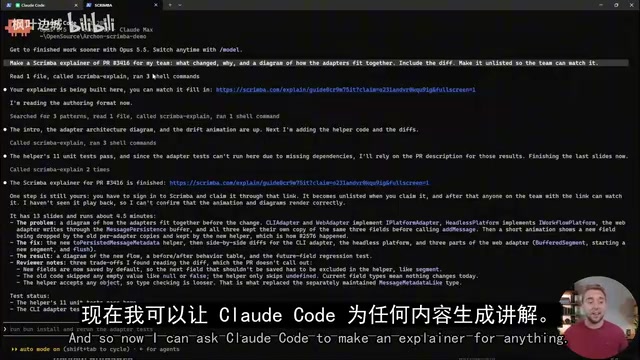
The video also demonstrated a sponsored feature from Scrimba called Explain: within 2–3 seconds of asking a question, it generates a video lesson with full voice-over narration, builds in real time as you watch, and connects directly to Codex and Claude Code. After connecting via MCP with a single command, the blogger had Claude Code generate an explanatory video for a complex PR in his open-source project Archon — Claude read the diff, built the lesson, and streamed it slide by slide into Scrimba. He admitted the final result "genuinely impressed me." The feature also supports ChatGPT and works as a Chrome extension that can parse any article.
Conclusion: Exploring Open-Source Models Is Now Required, Not Optional
This blogger's core message is clear: as rate limits on frontier models continue to tighten, the era of "hand everything to the most powerful model" is coming to an end. What developers actually need to do is understand their AI coding workflows — figure out which steps genuinely require a top-tier model, and which can be fully handled by cheaper open-source alternatives.
For individual developers and teams alike, this layered strategy of "strong models for planning, small models for implementation" can significantly reduce costs and token consumption while maintaining output quality. Given the increasingly constrained quota reality, seriously exploring open-source models is no longer optional — it's a prerequisite.
Related articles

Huberman's Rational Supplement Guide: A Five-Layer Health Framework and Scientific Decision-Making
Stanford neurobiology professor Huberman proposes a rational supplement framework: behavior and nutrition are the foundation, basic combination supplements serve as insurance, and sleep/hormonal/cognitive directions should stick to single-ingredient experiments. Omega-3 is the top single-ingredient choice, and melatonin is not recommended.

The Unsung Painter Behind Gilded Age Manhattan Interior Design
HN discussion highlights the painter behind Gilded Age Manhattan interiors: he created murals and decorative paintings but was long overlooked as his work was seen as architectural appendage.

Can AI Agents Be Socially Engineered? Understanding Prompt Injection and Tool Permission Risks
Through Invariant Lab's GitHub Issue injection and Brave's AI browser attack, this article analyzes how Prompt Injection induces AI Agents to perform unauthorized actions, and offers protection advice across three layers: least privilege, tool validation, and operation auditing.