AI Coding Tool Security Governance: How Policy Enforcement Guardrails Ensure Enterprise Compliance

How policy enforcement guardrails keep AI coding agents like Claude Code and Cursor compliant in enterprise environments.
As AI coding tools evolve from suggestion engines to autonomous agents capable of executing commands and modifying files, enterprises need policy enforcement layers to ensure compliance. This article explores the technical architecture behind unified guardrails for Claude Code, Cursor, and Codex — covering ReAct frameworks, MCP, prompt injection risks, and regulatory drivers like the EU AI Act.
When AI Coding Assistants Need "Rules"
A project called "Policy enforcement for Claude Code, Cursor, and Codex" recently appeared on Hacker News's Show HN section. While it hasn't generated much discussion yet, it touches on a rapidly heating topic: how to establish policy enforcement and security guardrails for AI coding tools.
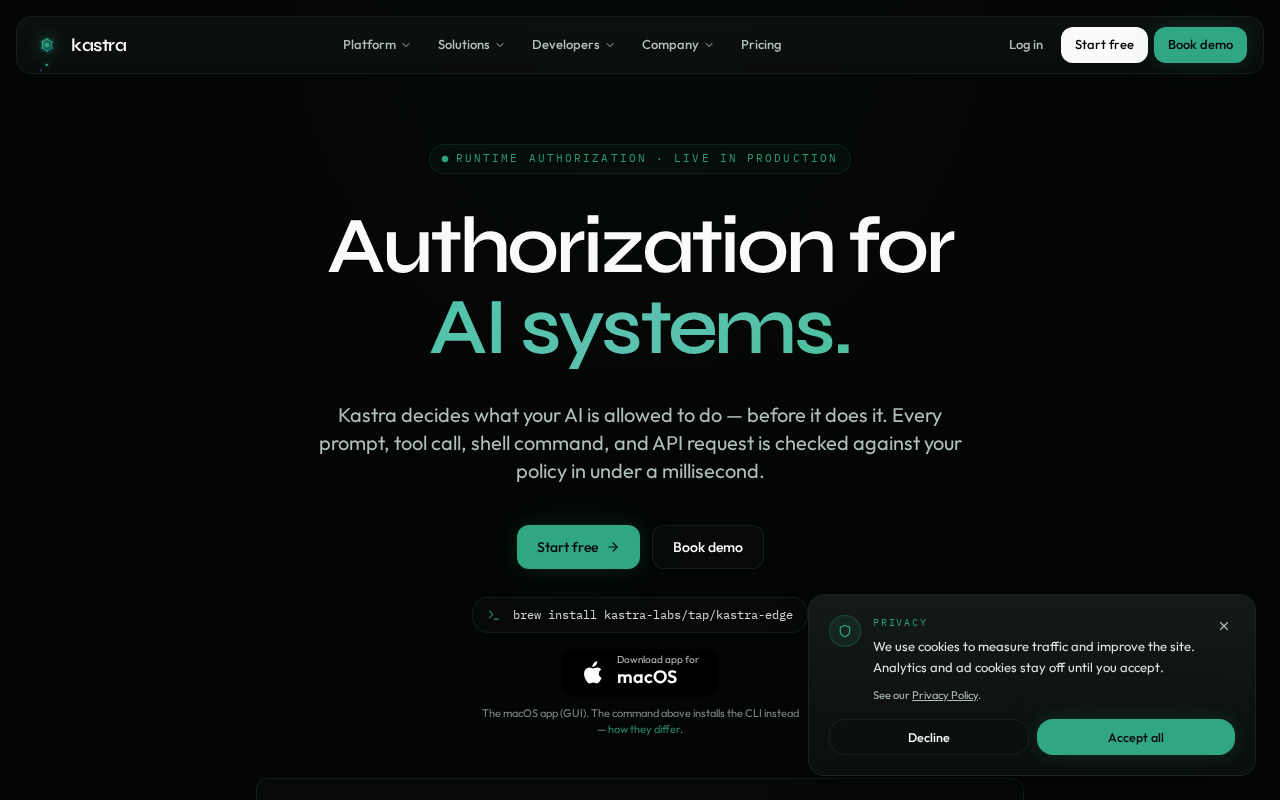
As AI coding assistants like Claude Code, Cursor, and GitHub Copilot (Codex) increasingly enter enterprise development workflows, a previously overlooked question has surfaced: when these tools automatically generate code, execute commands, and access file systems, do they truly comply with an organization's security and compliance standards? This project aims to fill that gap by providing a unified policy enforcement layer for mainstream AI coding tools.
Why AI Coding Needs Policy Enforcement
The Shift from "Suggestions" to "Autonomous Execution"
Early AI coding tools (like the original Copilot) were primarily "suggestion-based" — offering code completions that developers could choose to accept or reject. But the new generation of tools, represented by Claude Code and Cursor Agent, has evolved into Agent mode: they can autonomously read codebases, execute shell commands, modify multiple files, call external APIs, and even directly commit code.
This evolution has deep roots in technical architecture. Early GitHub Copilot was based on OpenAI's Codex model — essentially a code completion engine that predicts the next segment of code from context. The new generation of Agent-mode tools is built on the ReAct (Reasoning + Acting) framework — an architecture proposed by Google Research in 2022 that interweaves the language model's reasoning process with external tool calls.
The introduction of the ReAct framework marked a paradigm shift for LLMs from pure text generation to tool-augmented reasoning. Before ReAct, LLMs were fundamentally limited by knowledge cutoff dates and inability to access real-time information. ReAct addressed this by combining Chain-of-Thought reasoning with external tool calls, enabling models to dynamically retrieve information and correct reasoning paths during execution. This framework directly catalyzed the explosive growth of Agent development frameworks like LangChain and AutoGPT, and ultimately became the technical core of products like Claude Code and Cursor Agent today — it's precisely this "reason-act-observe" loop that transformed AI coding tools from code completion engines into software development collaborators with real execution privileges.
In the ReAct framework, LLMs alternate between "think → act → observe" cycles: the model reasons about the current state, calls external tools (such as file read/write, terminal commands, search engines), then incorporates tool-returned results into the next reasoning round — completing complex multi-step, multi-tool tasks. This mechanism transforms LLMs from mere "advisors" into "executors" with real system permissions, expanding the security boundary from "code review" to "real-time behavior monitoring."
Also worth noting is Anthropic's Model Context Protocol (MCP), released in November 2024, which is becoming the de facto standard for AI agent tool calls. MCP defines a standardized communication interface between LLMs and external tools and data sources — essentially a "USB protocol" for AI — where file systems, databases, code repositories, and external APIs all connect through a unified Server/Client architecture. This standardization trend is highly significant for the policy enforcement layer: when all tool calls flow through a unified protocol, policy interception points can be precisely set at the MCP layer without requiring separate adaptation for each tool. Claude Code, Cursor, and other mainstream tools already support MCP, providing a critical technical foundation for building a cross-tool unified policy enforcement layer.
This autonomy brings a leap in efficiency, but also opens the door to risks. An AI agent might inadvertently:
- Read or leak configuration files containing sensitive information (e.g.,
.env, key files) - Execute high-risk destructive commands (e.g.,
rm -rf) - Send internal code or data to unauthorized external services
- Introduce third-party dependencies that don't meet enterprise security standards
Why Traditional Security Tools Fall Short
SAST (Static Application Security Testing) is an important part of traditional DevSecOps pipelines, with representative tools including SonarQube, Checkmarx, and Semgrep. SAST scans source code after it's committed (or within CI/CD pipelines) to identify potential security vulnerabilities — it's a "post-hoc detection" model.
Policy enforcement for AI agents requires "pre-emptive interception" — completing policy validation at the moment an AI issues a tool call request, not after code has landed. Technically, this is closer to eBPF (Extended Berkeley Packet Filter) kernel-level monitoring or the request interception model of a Web Application Firewall (WAF).
eBPF originated from the 1992 BSD packet filter; the Linux version dramatically expanded its capabilities in 2014, evolving it from a pure network filtering tool into a general-purpose programmable kernel infrastructure. Modern eBPF allows injecting bytecode — strictly safety-checked by a Verifier — into kernel execution paths without restarting the system or loading kernel modules, typically with less than 5% performance overhead. Cloud-native security tools like Cilium and Falco are built on eBPF as their core engine. In the AI agent governance context, eBPF can capture critical syscalls like open(), execve(), and connect() at the system call level, providing harder-to-bypass security guarantees than application-layer hooks — even if application-layer policies are circumvented through prompt injection or similar techniques, kernel-level file system and network access controls can still serve as a last line of defense. This is the core value of policy enforcement: judging whether an action is permitted according to predefined rules before the AI takes it, blocking risks at the source.
Technical Approaches to a Unified Guardrail Layer
A "Middle Layer" Design for Intercepting AI Behavior Boundaries
The core concept of this project is to insert a policy middleware layer between AI coding tools and the underlying system. When Claude Code, Cursor, or Codex attempts to execute an operation, the middleware intercepts the request, validates it against organizational policies, and only allows operations that pass the check.
This is analogous to IAM (Identity and Access Management) mechanisms in cloud-native security — the core idea being the Principle of Least Privilege: every entity (user, service, process) receives only the minimum permissions needed to complete its task. AI agents can be treated as a kind of "non-human principal" that needs a definable, revocable, and auditable permission set.
Notably, the OWASP LLM Top 10 has listed "Excessive Agency" (LLM08) as one of the core security risks in large model applications. OWASP published the first version of the LLM Top 10 security risk list in 2023 and further refined the description of this risk in the 2024 update — breaking it down into three dimensions: excessive functionality (agents can call unnecessary tools), excessive permissions (tool operation permissions exceed business needs), and excessive autonomy (high-impact operations can be executed without human confirmation). Typical attack paths for this risk include: using prompt injection to manipulate an AI into calling dangerous tools within its permission scope, and exploiting the AI's multi-step reasoning capability to bypass single-point permission checks.
Prompt injection is a unique attack vector facing AI agents and one of the core threats that the policy enforcement layer must defend against. Similar to traditional SQL injection, attackers embed malicious instructions in content processed by the AI, attempting to override or bypass the original system prompt. In AI coding scenarios, indirect prompt injection is particularly dangerous: attackers can plant malicious instructions in code comments, README files, dependency documentation, or even crawled code examples. When an AI agent reads this content, hidden instructions could trigger data exfiltration, privilege escalation, or execution of malicious commands. Multiple security studies in 2024 confirmed that mainstream tools including GitHub Copilot have varying degrees of indirect injection vulnerabilities. This means the policy enforcement layer cannot rely solely on intent detection — it must establish independent defense mechanisms at the behavioral level (file access, network connections, command execution), forming a defense-in-depth posture where "even if the AI is deceived, its behavior remains constrained."
This means the policy enforcement layer must be specifically designed to address these indirect attack paths, not merely filter obviously malicious requests. The NIST AI Risk Management Framework (AI RMF) also lists agent permission control as a key governance dimension. Policy rules typically cover:
- File access whitelists/blacklists: restricting directories the AI can read and write
- Command execution filtering: blocking or requiring human confirmation for high-risk shell commands
- Network access control: limiting external endpoints the AI can reach
- Data masking rules: preventing sensitive information from entering the AI's context window
Engineering Challenges of Cross-Tool Unified Governance
This project supports three mainstream tools — Claude Code, Cursor, and Codex — which differ significantly in architecture, integration methods, and extension mechanisms.
Claude Code is Anthropic's terminal-native AI coding tool, whose core architecture injects custom logic at key operation nodes through a "Hooks" mechanism — these Hooks are essentially event-driven callback functions triggered before and after AI operations like file read/write, shell commands, and network requests, similar in design philosophy to Git's pre-commit hooks. Cursor's architecture is more oriented toward the IDE plugin ecosystem, while GitHub Copilot/Codex is deeply tied to the GitHub and VS Code platforms — the extension point designs of all three differ significantly.
Building a unified policy enforcement layer spanning multiple platforms is itself a substantial engineering challenge. This also highlights the unique market value of such tools: enterprises typically don't use just one AI coding tool, and need a consistent cross-tool governance policy to reduce compliance complexity from running multiple tools simultaneously.
AI Coding Governance Is Becoming an Enterprise Necessity
From Personal Productivity Tools to Organizational Compliance Infrastructure
The adoption curve for AI coding tools is moving from "individual developers experimenting" to "enterprise-scale deployment." In this transition, security, compliance, and auditing capabilities have shifted from "nice-to-haves" to prerequisites for deployment.
This transition has a clear regulatory backdrop. In the EU, the AI Act officially took effect in August 2024 as the world's first comprehensive AI regulatory legislation. The Act adopts a risk-based tiered regulatory framework, classifying AI systems into four categories: unacceptable risk, high risk, limited risk, and minimal risk — with risk classification determined by specific use case rather than the tool itself. For AI coding tools, generating code for ordinary web applications falls under minimal risk, but if used to generate code for nuclear power plant control systems, medical device firmware, or financial trading systems, it could trigger the "high-risk system" threshold, facing mandatory log retention requirements (at least 6 months), human oversight obligations, and pre-market compliance assessments. In the US, the SEC has issued guidance on AI use in financial decision-making, and the FDA's regulatory framework for medical AI software continues to evolve. Domestically, China's Interim Measures for the Management of Generative Artificial Intelligence Services also sets clear requirements for data security and content controllability. This means enterprises not only need AI tools that "work" — they need to be able to demonstrate to regulators that every AI operation has logs, authorization basis, and a reproducible decision path. The audit logs and traceability capabilities provided by the policy enforcement layer are being elevated from "engineering best practices" to "legal compliance obligations."
AI agents automatically introducing third-party dependencies also deeply intersects with the software supply chain attacks that have been persistently rising in recent years. The 2020 SolarWinds incident, the 2021 Log4Shell vulnerability, and the 2024 XZ Utils backdoor all demonstrate that the software supply chain has become a core target for attackers. When an AI assistant autonomously executes npm install, pip install, or go get, it is effectively making supply chain trust decisions on behalf of the development team. Malicious package name squatting (typosquatting), dependency confusion attacks, and "phantom package names" hallucinated by AI (models may suggest installing non-existent package names that attackers pre-register) constitute new attack surfaces. Supply chain security standards like SLSA (Supply-chain Levels for Software Artifacts) and SBOM (Software Bill of Materials) are progressively becoming enterprise requirements; the policy enforcement layer needs to integrate with these standards to automatically trigger vulnerability scanning and license compliance checks when AI introduces dependencies.
Highly regulated industries like finance, healthcare, and government especially need to demonstrate that every AI agent operation is controlled, traceable, and compliant. This is also the underlying reason why tools and startups focused on "AI coding governance" have been emerging in large numbers recently — the industry is transitioning from a "capability-first" phase toward a mature stage that balances security and capability.
Balancing Developer Experience with Security Controls
The core challenge for policy enforcement tools is achieving security controls without disrupting developer experience. Overly strict policies frequently interrupt workflows, forcing developers to bypass tools; overly lenient policies render the guardrails meaningless.
The ideal solution should follow the "Secure by Default, Open by Exception" principle — systematically embodied in Zero Trust architecture. The Zero Trust model abandons the traditional "castle-and-moat" security assumption that distinguishes trusted internal networks from untrusted external ones, requiring explicit verification for every access request, regardless of whether it comes from inside or outside the network, from a human or a service account. Applied to AI coding tool governance, this means: AI agents default to a minimal permission set; additional permissions require explicit policy authorization; all operations maintain tamper-proof audit logs; policy changes require an approval process. In practice, excellent policy enforcement tools also need to provide clear audit logs and flexible policy configuration interfaces that both security teams and development teams can accept — security teams need visibility and control, development teams need low-friction daily workflows, and the tension between the two is the core test of whether such products can truly be deployed.
Conclusion: Early Signals in an Emerging Space
Although this Show HN project currently has limited attention, it represents an important and inevitable evolution in the AI coding ecosystem. As AI agents become ever more deeply embedded in the core software development process, the security governance infrastructure surrounding them will inevitably become standard equipment.
For developers and technical decision-makers focused on AI engineering deployment, this space is worth continued tracking. Today's seemingly niche "policy enforcement layer" may well become an indispensable core component of tomorrow's enterprise AI development platforms.
Related articles

Should U.S. College Fraternities Be Banned? A Researcher's Incisive Observations
Why not just ban U.S. college fraternities? A researcher finds the key resistance comes from decision-makers' own fraternity identities and schools' "willful ignorance."

Microsoft Discovery: Accelerating Scientific Discovery with AI Agents
Microsoft's Discovery platform runs specialized AI agents to help researchers screen and prioritize the most promising compounds and experimental paths, reducing experiments and accelerating scientific discovery.

Cambridge Heavy Industries Secretly Develops Desktop-Scale Nuclear Fusion Device
Cambridge Heavy Industries is secretly developing a desktop-scale laser-driven nuclear fusion device, targeting the equipment supply market for fusion power plants. This article analyzes its miniaturization technology path, commercialization logic, and unique positioning in the fusion startup wave.