AI + Content Creator Monetization Guide: A 2025 Beginner's Guide to Making Money from Scratch

Heima Programmer launches free AI content creator course teaching beginners to monetize with AI tools.
Heima Programmer has launched a free "AI + Content Creator Money-Making Series" that systematically teaches how to use AI tools (LLMs, text-to-image, AI editing) to build and monetize content creator accounts from scratch. The course covers 20+ niches with monetization as the core focus, each episode being a standalone battle-tested project. However, users should note that the free model is essentially a training institution's customer acquisition funnel, and the AI content creation space faces intensifying competition with pure AI content under increasing homogenization pressure.
Introduction: In 2025, AI Has Lowered the Barrier to Content Creation to Its Lowest Point
Can't write copy, can't design graphics, and can't edit videos — can you still make money as a content creator? The answer is absolutely yes. In 2025, with the widespread adoption of AI tools, the barrier to entry for content creation has been drastically reduced. This shift is built on multiple technological breakthroughs: Large Language Models (LLMs) like GPT-4, Claude, and domestic options like Doubao and Kimi can now generate high-quality marketing copy, story scripts, and content plans; text-to-image models (such as Midjourney, Jimeng, and Stable Diffusion) enable non-designers to batch-produce professional-grade illustrations; and AI video editing tools (like CapCut's "text-to-video" feature) compress video production from hours to minutes. These tools share common traits: extremely low operational barriers (mostly natural language input) and a complete workflow ecosystem that can be chained together to cover the entire content production pipeline.
Heima Programmer recently launched a course series called "AI + Content Creator Money-Making Series," which systematically breaks down how to use AI tools to build and monetize content creator accounts from scratch.
The core philosophy of this course is clear: Any AI tool tutorial that isn't focused on making money is a waste of time. It doesn't just teach you how to use a specific AI tool — it deeply integrates tools with monetization strategies, covering the complete pipeline from account launch, follower growth, to product sales and advertising revenue.
Proven AI Content Creator Niches
The course lists multiple AI content creator niches that have been validated — account operators in these niches have already earned income exceeding traditional employment through AI tools:
- AI Self-care Vlog Accounts: Using AI to generate storyboard scripts and illustrations for batch-producing lifestyle Vlogs
- AI Republic-era Beauty Story Accounts: AI-written scripts + AI-generated character illustrations for storytelling content
- AI Health & Wellness Accounts: Combining health/wellness content with product recommendations for affiliate revenue
- AI Children's Education Accounts: Children's English, bedtime stories, and other educational content
- AI Emotional Healing Accounts: Content around mindful spending and emotional value
These niches share a common trait: content production can be highly dependent on AI tools while maintaining clear monetization pathways. To understand these niches, you first need to grasp the underlying structure of content creator monetization. There are three main monetization paths: first, platform revenue sharing (like Douyin's mid-length video program or Bilibili's creator incentives), which depends on view counts and follower scale; second, product sales (selling products through storefronts and shopping cart features to earn commissions) — this is currently the most mainstream monetization method, with top affiliate accounts earning tens of thousands in monthly commissions; third, brand advertising partnerships (sponsored content, product placement), which typically requires accounts to have vertical focus and follower loyalty. High-ticket niches like health/wellness and children's education typically have higher conversion rates than general entertainment content — this is the core reason the course recommends these niches.
Six Key Differences Between This Course and Others on the Market
Difference 1: Monetization-Centric, AI Tools Are Just the Means
Most AI tutorials on the market have two problems: they either ride the tool hype for traffic, or they promote AI tools for advertising revenue. This course has a completely different positioning — tools are the means, making money is the goal. Course content revolves around monetization scenarios like "how to use AI for affiliate accounts," "how to use AI for ad-revenue accounts," and "how to use AI for private domain traffic," with every step pointing toward final revenue conversion.
Difference 2: Each Episode Is a Standalone Project, No Tiered Pricing
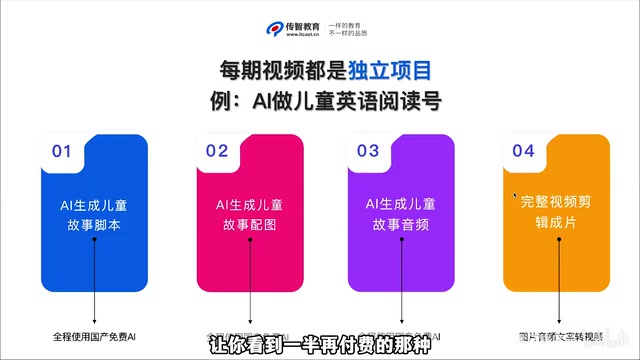
Each video is a complete project methodology, including tool usage, monetization strategy, and the full process from zero to launch. There's no "pay to see the rest" situation. For example, building an AI children's English account completely covers AI script generation, AI illustration creation, AI video editing, AI audio generation, and all other steps.
Difference 3: Everything Is Battle-Tested with Proven Results
The course content on AI-written folk story scripts, AI-generated character illustrations, AI-generated thumbnails, AI video editing, and AI viral topic selection has all been personally tested by instructors and students — shared only after achieving results and learning from pitfalls. This is particularly important in the current environment where AI tutorials are a mixed bag.
Difference 4: Surface-Level Tool Operations + Deep Monetization Thinking
The course doesn't just teach tool operations — it shares underlying monetization logic:
- Comparison of monetization characteristics between short video platforms and image-text platforms
- Methods for screening high-monetization niches (product recommendations, health/wellness, children's English, etc.)
- Platform selection strategies for ordinary people doing content creation
- Practical experience in rapid account launch from 0 to 1
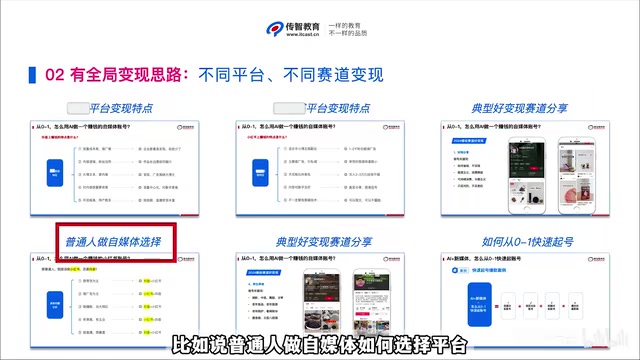
These insights come from hands-on experience running accounts with 100K and 1M+ followers, not armchair theorizing.
Difference 5: Broad Coverage of AI Tools and Resources
Course supplementary materials include: AI image generation, AI Vlog storyboarding, scenario applications for tools like Meitu/Jimeng/Doubao, universal prompt templates, viral copy and topic selection methods, AI storyboard scripts, CapCut auto-generation, AI audio generation, as well as 200+ useful AI website collections and various copywriting prompt templates. Essentially every AI tool relevant to content creation is covered.
Difference 6: Completely Free, No Charges
This is the biggest difference from courses on the market. The instructor explicitly states: it's free now and will remain free in the future. By comparison, some creators on the market price similar content at 600-700 RMB or even 999 RMB, but their content may only provide a rough introduction to basic AI tool usage.

A Sober Assessment: Value and Limitations of Free AI Content Creator Courses
While this course promotes itself as "completely free," we should rationally consider several issues:
First, what's the business logic behind free? Heima Programmer is fundamentally an IT training institution. Its free course strategy is essentially the classic internet "content marketing + acquisition funnel" model: attracting large numbers of potential users through high-value free content (top of funnel), screening users with purchase intent through community operations and live streams (middle of funnel), and ultimately converting them into paying students for Java, Python, big data, and other paid training courses (bottom of funnel). This model is extremely common in the education industry — institutions like Yuanfudao and NetEase Youdao all employ similar tactics. This isn't a bad thing, but users need to understand this logic, soberly assess the necessity of subsequent paid conversions, and avoid making irrational spending decisions driven by emotion.
Second, competition in AI content creation is intensifying. According to public data from platforms like Douyin and Xiaohongshu, the number of AI-generated content (AIGC) accounts has grown exponentially since 2024, with some vertical niches already experiencing severe homogenization. Platforms' algorithmic response is to gradually increase weight on "originality" and "authentic persona" — meaning accounts that purely rely on AI for batch content production will face increasing pressure in traffic distribution. As more and more people master the same AI tools and methodologies, the accounts that truly break through the competition are those that combine AI tools with the creator's personal perspective and vertical domain expertise, forming content moats that cannot be easily replicated.
Third, tools change, but thinking is the core. AI tools iterate extremely fast — today's best tool might be replaced tomorrow. What's truly valuable are the underlying principles about monetization strategies, niche selection, and content strategy covered in the course — these are capabilities that can be reused long-term.
Conclusion: Is an AI Content Creator Side Hustle Worth Pursuing?
For those looking to try AI + content creation as a side hustle in 2025, this course provides a relatively systematic entry path. Its core value lies in: connecting scattered AI tools into a complete monetization pipeline, while providing validated niche selection and account launch methods. The free access barrier is low enough, making it suitable for beginners to test the waters.
But remember: tools can lower barriers, but they cannot replace consistent content output and audience insight. AI is an accelerator, not a money printer.
Key Takeaways
- The course covers 20+ AI content creator niches, including affiliate accounts, advertising accounts, education accounts, etc., with each video being a standalone complete project methodology
- The core philosophy integrates AI tools with monetization strategies
Related articles
 Tutorials
ChatGPT Plus Subscription Guide: Are GPT-5.5, image-2, and Codex Worth the Upgrade?
A detailed look at ChatGPT Plus features — GPT-5.5, image-2, and Codex — with a Plus vs Pro comparison and a complete step-by-step subscription guide for users outside the US.
 Tutorials
Harness AI Engineering in Practice: Using Claude Code to Master Enterprise-Level E-Commerce Development
Deep dive into Harness AI Engineering: master enterprise e-commerce development with Claude Code using the Rules, Skills, Wiki, and Changes framework.
 Tutorials
Cursor + Codex Dual-IDE Collaboration: A Practical Methodology for Open-Source Project Customization
A complete methodology for open-source project customization based on real-world experience, detailing the Cursor+Codex dual-IDE workflow, seven-stage process, MVP validation, and AI source code reading techniques.