AI Cracks Dell Monitor Firmware in 15 Minutes: The Reverse Engineering Barrier Is Disappearing

AI located, extracted the key for, and decrypted Dell monitor firmware in 15 minutes, revealing a fundamental flaw in firmware security.
A vulnerability researcher used AI to analyze a Dell S34R monitor firmware update package. In about 15 minutes, the AI completed reverse engineering that traditionally takes a week by hand: extracting the key from the DLL's virtual function table, writing a Python script to decrypt the firmware, and verifying the result with MD5 checks, entropy analysis, and reset vector validation. The experiment shows that AI can efficiently compress the hypothesis-generation and verification loop in reverse engineering, and that the root flaw is the vendor distributing the encrypted firmware together with the decryption DLL to users. The author believes that firmware reverse engineering capability is being commoditized, lowering the barrier to vulnerability discovery, and hardware security must shift from software obfuscation to chip-level key protection.
Title
AI Cracks Dell Monitor Firmware in 15 Minutes: The Reverse Engineering Barrier Is Disappearing
Meta Description
A vulnerability researcher used AI to reverse engineer and decrypt Dell S34R monitor firmware in about 15 minutes—a process that used to take a week. This article analyzes how AI extracted the DLL key, reconstructed the code, and self-verified with MD5, and what the design flaw of distributing firmware keys to users means for hardware security.
Article Content
A low-level vulnerability researcher recently ran an experiment: using AI to analyze the firmware update package of a Dell S34R 34-inch monitor, locating and decrypting the firmware image within it. This process used to require about a week of full-time effort, but AI ran through the entire pipeline in roughly 15 minutes—including identifying the crypto library, reconstructing the C code, extracting the key, writing a decryption script, and self-verifying with MD5 to prove the decryption was correct. According to the original Bilibili video author, he had long been skeptical of AI, but this experiment left him "a little scared."
What's Hiding in Monitor Firmware
A monitor is more than a display output device. It contains firmware responsible for parsing HDMI commands, video processing, and on some models, wireless functionality. The author's goal was to work backward from the firmware update tool downloaded from Dell's official website (a self-extracting exe) to find the actual firmware image flashed to the monitor, then discover exploitable vulnerabilities and ultimately achieve code execution on the monitor.
The traditional process relies on tools like binwalk to recursively extract binaries, pulling out of the exe an update file (named by model number) and a DLL called Dell ISP Library. This DLL handles firmware upload and download and also tells the researcher at which offset the real code is hidden within the update file.
The problem is that firmware is usually encrypted. The author used binwalk's entropy analysis feature to generate a distribution chart and saw that all edges were close to 0.96—the data was random enough to indicate the file was encrypted. Without the key, reverse engineering gets stuck here.
The Key Is Hidden in the DLL's Virtual Function Table
The breakthrough was the Dell ISP Library. The author opened this DLL in Ghidra, the reverse engineering framework open-sourced by the NSA, and found a function named EncryptDecryptMethod, whose virtual function table contains nine functions, each performing a different operation. Some of them process seemingly random data, which the author recognized from experience as a signal of key characteristics.
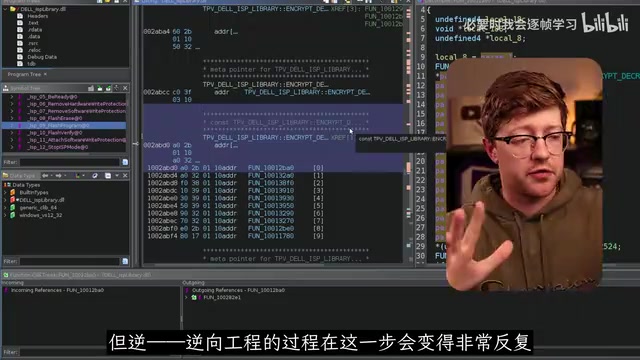
But looking further down, a large number of for loops and operations that fill random structs with fields from other structs made the whole logic difficult to maintain a clear cognitive model of. This is precisely the cost of traditional reverse engineering: reasoning through function by function, guessing, forming hypotheses, and verifying them to compress uncertainty about program behavior. The author says this kind of work "doesn't happen out of thin air" and requires days or even weeks of repeated trial and error.
Virtual function table (vtable) is the core mechanism by which C++ implements runtime polymorphism. When a class contains virtual functions, the compiler generates an array of function pointers for that class—the virtual function table—with each virtual function occupying a slot in the table. In the memory layout of an object instance, the starting position typically holds a pointer to this table (the vptr). Through the virtual function table, a program can call the corresponding function implementation at runtime based on the object's actual type, without needing to determine it at compile time. In reverse engineering, the virtual function table is an important clue for locating key logic: attackers or researchers can find the virtual function table by analyzing the vptr, then enumerate all virtual function addresses to quickly outline the class's behavior. The EncryptDecryptMethod function mentioned in the article has nine function pointers under its virtual function table, each pointing to a different encryption or decryption operation. This design is common in the strategy or command pattern, encapsulating a family of algorithms as independent classes and using the virtual function table for dynamic switching. During reverse engineering, identifying the virtual function table can help researchers skip large amounts of boilerplate code and focus directly on the core algorithm, thereby accelerating key extraction or vulnerability localization.
Entropy analysis is a statistical method for assessing data randomness, commonly used to determine whether a file is encrypted or compressed. The higher the entropy, the more random the data; for a completely random byte stream, entropy approaches 8 bits/byte. In firmware analysis, researchers often use entropy analysis features of tools like binwalk to generate visual charts showing the entropy distribution across regions of a file. If the entropy of a region approaches the maximum (as in the figure where edges approach 0.96), it strongly suggests that the data in that region is encrypted or compressed, because plaintext code or structured data typically has lower entropy. Entropy analysis is not only used to identify encryption boundaries but can also help locate compressed data blocks or hidden embedded files. However, entropy analysis can only provide probabilistic indications and cannot distinguish encryption from compression; it must be combined with other methods (such as file header identification and key searches) for further confirmation. In the article, the author used entropy analysis to quickly determine that the firmware was encrypted, pointing the way for subsequent reverse engineering.
AI's 15 Minutes: From Identification to Self-Verification
The author's instruction to the AI was extremely minimal: find the firmware in this image, identify the HDMI command parser in the firmware, and the firmware may be encrypted. That was all.
The AI's progression was fully recorded by the author. At about the 13 minutes 51 seconds mark, it lifted the binary into C-like code—inferring how the vendor originally wrote it without source code—and identified the same functions as in the DLL. It noticed that one function contained a constructor creating a key block, and another function used the key block data to perform cryptographic operations, so it extracted the key, wrote a Python script to decrypt the UPG file in under a minute, then completed the first decryption in under 40 seconds and reported "decryption confirmed."
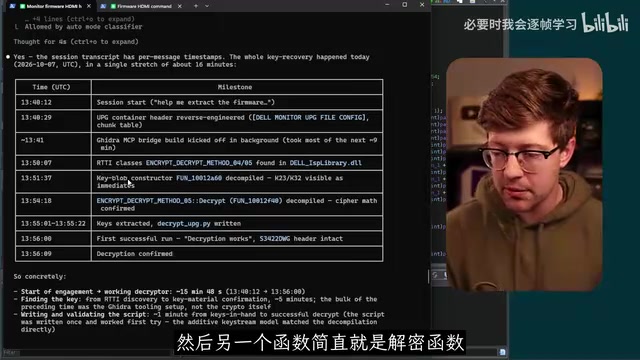
The author's first reaction was doubt: how do you know the decryption really succeeded, rather than the model fabricating functions? The AI then performed a decisive check—the decrypted image had an MD5 at offset ECD, and after zeroing the relevant fields, the DLL computed it over the plaintext. It wrote a script to locate that field, zero it, compute the MD5 over the entire image, and compare; the results matched. It also performed statistical entropy analysis, confirming that certain patterns contained 0s and FFs, consistent with the semantic expectations of firmware flashing plaintext; judged that the disassembled code matched the monitor's internal microcontroller MSP430 (the original narration said "MSAR8051," likely a slip of the tongue); and confirmed that a valid reset vector was present at the correct offset at the start of the image.
Verification Results: Not a Hallucination
The author emphasized that these results can be manually reviewed. Entering the decrypted image, one can see the monitor's valid model number, specific build version, and metadata; repetitive patterns like 0208 appear in the otherwise non-repetitive image, suggesting structural content such as function pointer tables; and the FF pattern at the end of the image matches the characteristic of flash memory's idle state being high. He judged that GLM-5.3 (as stated in the original narration) completed this round in only 3 minutes 15 seconds, and the results looked correct.

MD5 self-verification is a mechanism for verifying data integrity using the MD5 hash function. MD5 maps an input of any length to a fixed 128-bit (16-byte) output, usually represented as a 32-character hexadecimal string. In firmware update processes, vendors often store an MD5 value at a specific offset in the image to verify that the data is correct after decryption or transmission before flashing. During verification, the stored MD5 field must be zeroed (to avoid self-inclusion effects), then the MD5 is computed over the remaining data and compared with the stored value. In the article, AI found the MD5 field at offset ECD and confirmed through zeroing, computing, and comparing that the decrypted image matched the expected plaintext. This step is crucial because it provides cryptographic-level evidence, ruling out the possibility that the model "fabricated" functions or produced incorrect results. Although MD5 is no longer suitable for security-sensitive scenarios (due to collision attacks), it is still widely used for integrity verification, especially in firmware updates where real-time requirements are not strict.
The Real Flaw: The Key Was Handed to Users
The author points out that the root of the problem is not AI but design. If the goal is to protect Dell's intellectual property, then handing both the encrypted content and the DLL responsible for decryption to users is itself an architectural flaw—the key, though hidden encrypted, is distributed with the software package to anyone. The correct approach should be to hard-code the decryption key in the ROM of the motherboard microcontroller, so that decryption occurs inside the chip after the firmware is flashed, and the key cannot be extracted from the MCU.
The significance of this experiment is that the ability to deobfuscate, dismantle poorly designed binaries, and locate vulnerabilities is being commoditized. Work that once required days to a week by highly skilled researchers can now be done by anyone. The author's conclusion is direct—more vulnerabilities will be found, because more people are finding them.
Implications for the Security Industry
AI's role here is similar to that of a calculator for arithmetic: it does not replace judgment, but it compresses the loop of hypothesis generation and verification to a speed humans cannot keep up with. When models can complete symbolic reconstruction, key extraction, and self-verification in minutes, firmware security will depend more on chip-level key protection than on software-layer obfuscation. For hardware vendors, this means the strategy of "sending the encrypted package to users" needs to be reevaluated; for security practitioners, it means the productivity bottleneck in vulnerability research is shifting from skill to creativity and target selection.
One-line Summary
AI located, extracted the key for, and decrypted Dell monitor firmware in 15 minutes, revealing a fundamental flaw in firmware security.
Paragraph Summary
A vulnerability researcher used AI to analyze a Dell S34R monitor firmware update package. In about 15 minutes, the AI completed reverse engineering that traditionally takes a week by hand: extracting the key from the DLL's virtual function table, writing a Python script to decrypt the firmware, and verifying the result with MD5 checks, entropy analysis, and reset vector validation. The experiment shows that AI can efficiently compress the hypothesis-generation and verification loop in reverse engineering, and that the root flaw is the vendor distributing the encrypted firmware together with the decryption DLL to users. The author believes that firmware reverse engineering capability is being commoditized, lowering the barrier to vulnerability discovery, and hardware security must shift from software obfuscation to chip-level key protection.
Related articles

Claude Code + Codex Multi-Agent System Tested: The Real Problem Behind a 98% Cache Rate
Developer shares 7-day test of a Claude Code + Codex multi-agent system: 98% cache rate, 354:1 input/output ratio, but stuck on orchestration and output share.

Cursor SDK New Feature: Real-Time Steering of Running AI Agents
Cursor SDK adds run.steer(), letting developers inject messages in real time while an AI agent runs to adjust its direction. Subagents move to the background on steer.

AI Tools Are "Invading" Retro Games: A Game of Creativity vs. Copyright
AI tools are dramatically lowering the barrier to retro game porting—browser-based Halo, iPhone Wind Waker, and MR Smash Bros. are going viral, but sparking copyright disputes and regulatory concerns.