AI Daily Briefing: Alibaba Open-Sources Qwen3.8 Vision Flagship, Zhipu's GLM-5.3 Tops Coding Benchmarks, SpaceX Acquires Cursor
Alibaba's Qwen3.8 vision model, Zhipu's GLM-5.3 coding crown, SpaceX's Cursor acquisition, and Gemini 3.7 Flash launch.
August 17, 2026 brought major AI updates: Alibaba open-sourced the Qwen3.8-27B vision multimodal model under Apache 2.0, surpassing its closed-source predecessor. Zhipu's GLM-5.3 topped open-source coding benchmarks with a 50% capability boost. SpaceX completed a full acquisition of Cursor to integrate Grok 4.6 into the AI coding editor. Google rolled out Gemini 3.7 Flash with enhanced long-horizon reasoning. Meanwhile, concerns grow over AI-generated content flooding Amazon.
On August 17, 2026, the AI industry saw a wave of blockbuster updates. From Alibaba's Tongyi open-sourcing a vision multimodal flagship model, to Zhipu's GLM-5.3 raising the bar for open-source coding, to the surprising cross-industry acquisition of Cursor by SpaceX, and Google's capability upgrades to a new Gemini model — multiple storylines advanced simultaneously in a single day. This article breaks down each development and offers deeper analysis of the industry logic behind them.
Alibaba Open-Sources Qwen3.8 Vision Flagship: 27B Parameters Surpassing Its Closed-Source Predecessor
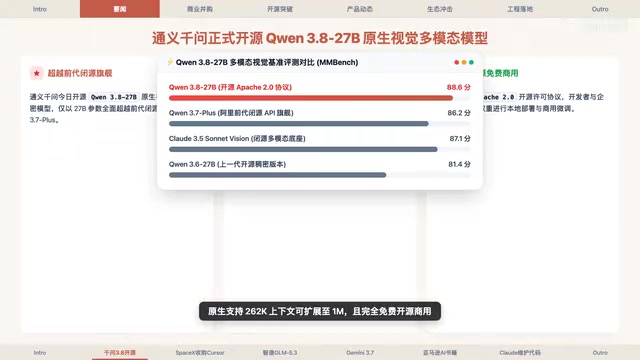
Tongyi Qianwen today officially open-sourced the Qwen3.8-27B vision multimodal model. A vision multimodal model refers to an AI system capable of simultaneously processing multiple input modalities — text, images, video, and more — requiring the alignment and fusion of visual and linguistic information within a unified representational space. Most notably, this model, with only 27B (27 billion) parameters, comprehensively outperforms the previous closed-source version, Qwen3.7 Plus. This means that optimizations in model architecture and training methods continue to compress the ratio between "parameter count" and "performance," enabling smaller models to achieve stronger capabilities. Key technical advances behind this include more efficient attention mechanism designs, improved alignment strategies between the visual encoder and language model, and fine-grained tuning of training data quality and composition — all of which allow the model to achieve higher information density and reasoning efficiency with fewer parameters.
In terms of long context, Qwen3.8 natively supports a 262K context window, extendable to 1 million tokens. A 262K window means the model can process approximately 260,000 tokens in a single pass — roughly equivalent to a 400,000-character book. This capability relies on breakthroughs in long-context technologies such as RoPE (Rotary Position Embedding) extension and sparse attention. Such massive context capacity is crucial for processing long documents, mixed multi-image inputs, and video frame sequence understanding, making it one of the core competitive dimensions for today's multimodal models.
More critically, the licensing terms matter. The model is released under the Apache 2.0 license — fully free for commercial use with no additional restrictions. Apache 2.0 is one of the most permissive open-source licenses available, allowing users to freely modify, distribute, and commercialize the model without being required to open-source derivative works. This stands in stark contrast to the user-count restrictions previously attached to Meta's Llama series. For developers and enterprises looking to directly integrate vision multimodal capabilities into their products, this dramatically lowers compliance and cost barriers while further solidifying Alibaba's influence in the open-source ecosystem.
Zhipu's GLM-5.3 Tops Open-Source Coding Rankings: 50% Improvement in Code Capabilities
Another major piece of news from the open-source camp comes from Zhipu. The newly released flagship GLM-5.3 delivers a 50% improvement in programming and code generation capabilities compared to its predecessor, claiming the top spot among open-source models on the Terminal Bench 3.0 benchmark. Terminal Bench 3.0 is a benchmark designed for real-world software engineering scenarios. Unlike algorithm-competition-style code evaluations such as LeetCode, it simulates a developer's complete workflow in a terminal environment — including project building, debugging, and deployment — making it a better reflection of a model's practical usefulness in actual development.
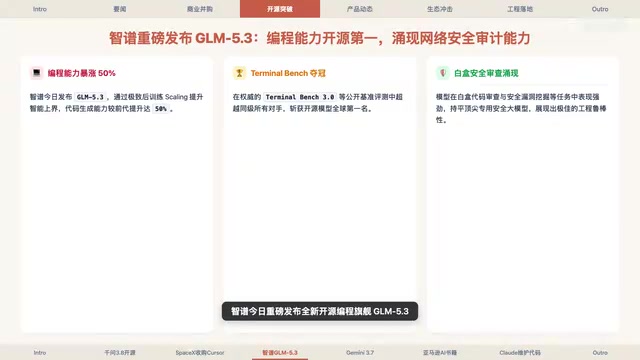
Notably, GLM-5.3 excels not only in the conventional capability of "writing code" but also demonstrates impressive results in white-box code review and security vulnerability discovery. White-box Code Review refers to the systematic examination of code for security, correctness, and quality with full access to the source code. It requires the model to perform cross-function and even cross-file semantic tracing, identifying potential vulnerabilities such as buffer overflows, SQL injection, and privilege escalation. Traditionally, this work relies on a combination of SAST (Static Application Security Testing) tools and human security experts. An AI model's breakthrough in this area suggests that security auditing efficiency could see orders-of-magnitude improvement. This represents the expansion of model capabilities from "code generation" to "code comprehension and security analysis" — the latter demands far higher levels of contextual reasoning, semantic tracing, and logical rigor, and is often the key differentiator of a model's depth.
The Ceiling for Open-Source Coding Models Keeps Rising
GLM-5.3's performance makes it clear that open-source coding models are rapidly approaching — and in some areas surpassing — closed-source alternatives. Benchmarks like Terminal Bench, which focus on real terminal interactions and engineering tasks, are far more indicative of a model's usability in actual development workflows than pure algorithm challenges. An open-source model taking the crown on such a benchmark is great news for the entire developer community.
SpaceX Fully Acquires Cursor: A Cross-Industry Marriage of Compute Power and AI Coding Tools
The most unexpected news from the business world is SpaceX's announcement that it has completed the full acquisition of AI coding tool Cursor. Cursor is an AI-native code editor developed by Anysphere, deeply rebuilt on the VS Code architecture. Known for its powerful code completion, multi-file editing, and agentic programming features, it rapidly gained popularity in the developer community and had already surpassed hundreds of millions of dollars in annualized revenue before the acquisition, with users ranging from independent developers to major tech companies. Leveraging SpaceX's massive compute clusters — infrastructure derived from its Starlink satellite communication data center network and shared ultra-large-scale GPU clusters with xAI (reportedly numbering in the hundreds of thousands of high-end GPUs) — the jointly developed Grok 4.6 model will be deeply integrated into the Cursor editor.
Officially, the move aims to further lower the barrier to advanced AI coding features, benefiting more developers. From a strategic perspective, this represents a direct binding of "compute resources" to a "developer gateway." Cursor, as an extremely popular AI-native editor, controls the daily workflow of a large developer base, while abundant compute power is the foundational requirement for supporting complex agentic features. Together, they could form a more powerful closed loop in the AI coding space. This strategy directly mirrors Microsoft's vertical integration approach (Azure + OpenAI + GitHub Copilot), signaling that Musk's enterprise ecosystem is building a complete chain from foundational compute and base models to end-user developer tools. The competitive landscape of the AI coding tools space is undergoing fundamental change.
Google Gemini 3.7 Flash Fully Available: Long-Horizon Reasoning as the Core Selling Point
On the product front, Google has officially rolled out Gemini 3.7 Flash to all Pro and Ultra users. Pro and Ultra are the two paid tiers of Google's Gemini subscription service, targeting individual power users and enterprise users respectively. The Flash series is Google's Gemini family variant optimized for low latency and high throughput, typically employing techniques such as knowledge distillation and Speculative Decoding to dramatically reduce inference costs while maintaining core reasoning capabilities. The new model significantly strengthens its long-horizon reasoning capabilities — referring to the model's ability to maintain reasoning consistency and accuracy across extensive contextual information when handling complex tasks requiring multi-step logical chains. Unlike simple Q&A or single-step generation, long-horizon reasoning requires the model to establish cross-references across dozens of documents, identify information conflicts, trace causal relationship chains, and ultimately synthesize structured output. Gemini 3.7 Flash achieves a breakthrough on precisely this dimension, effortlessly spanning dozens of documents and long email threads to generate structurally complete master reports.
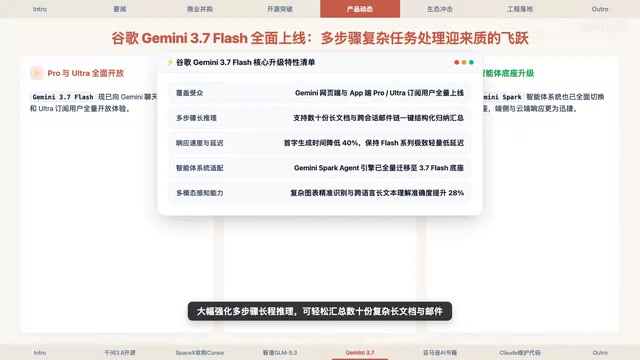
The accompanying Spark intelligent engine has also been upgraded. Spark is the interaction orchestration layer in Google's AI product lineup, responsible for coordinating model invocations, tool usage, and multi-turn conversation management. Its upgrade makes end-to-end interactions faster and more efficient. Long-horizon reasoning and cross-document synthesis are among the most critical requirements for enterprise-grade AI applications — whether for research report writing, compliance review, or knowledge management, they all depend on the model's ability to maintain logical consistency across massive amounts of information.
AI-Generated Content Flooding: Original Authors' Revenue Severely Squeezed
Amid the wave of technological optimism, an ecosystem survey raises a concerning alarm. A new report reveals that AI-generated books are flooding the Amazon platform, with the total number of self-published titles surging 38x over three years, directly causing a severe decline in per-book revenue for human original authors. Amazon Kindle Direct Publishing (KDP) is the world's largest e-book self-publishing channel and has already become a hotspot for AI-generated content. The 38x growth represents not just a surge in volume but a severe "information drowning" effect — when search results and recommendation lists are dominated by large quantities of low-quality AI-generated books, the visibility and sales conversion rates of human original authors are significantly squeezed.
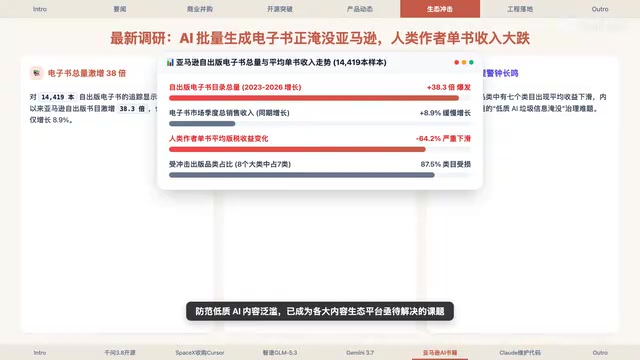
How to prevent low-quality generated content from crowding out quality original work is becoming an urgent challenge for major content platforms. This phenomenon reveals a structural side effect of widespread generative AI adoption: when the cost of content production approaches zero, platform distribution mechanisms, quality filtering, and creator incentive systems all face pressure to be restructured. Currently discussed countermeasures include: mandatory AI content labeling, content provenance tracing technologies (such as the C2PA digital watermark standard), adjusting platform recommendation weights to favor human creators, and using copyright legal frameworks to clearly define the rights boundaries of AI-generated content. The direction of this governance issue will profoundly shape the future landscape of the content industry.
AI Agents Take Over Code Maintenance: An Engineering Practice of 388 PRs
Finally, there's a highly inspiring engineering practice to highlight. Engineer Boris shared the results of having AI agents take over routine code maintenance: over the course of several weeks, the agents autonomously performed fuzz testing and dead code cleanup, cumulatively submitting 388 high-quality PRs, of which 180 were successfully merged into the main branch.
Fuzz Testing is an automated software testing technique that feeds programs large amounts of random or semi-random data to discover potential crashes, memory leaks, and security vulnerabilities. Traditional fuzz testing tools (such as AFL and libFuzzer) are already widely used, but the addition of AI agents enables smarter test case generation and automatic patch writing upon discovering issues. Dead Code Elimination refers to removing code paths that will never be executed in a program — such redundant code increases maintenance burden, slows compilation, and may harbor security risks. PR (Pull Request) is the standard code collaboration mechanism in modern software engineering, where developers submit PRs to request team review and merging of code changes.
This case is highly representative. It demonstrates that current AI agents can already handle the "highly repetitive, relatively rule-based" refactoring and maintenance tasks in software engineering at merge-worthy quality. The approximately 46% merge rate also reminds us that agent output still requires human review — over half of the PRs needed human intervention for modification or rejection, reflecting current agent limitations in handling edge cases and understanding complex business contexts. Nevertheless, the potential for reducing engineers' daily burden and improving codebase health is already substantial, foreshadowing that "human-AI collaboration" will become the new norm in software engineering.
Conclusion
Taken together, the day's developments outline several clear trends: open-source models continue to approach and even surpass closed-source alternatives in multimodal and coding capabilities; compute resources and developer gateways are accelerating their integration; long-horizon reasoning is becoming the new battleground in product competition; and the ecosystem governance challenges brought by the flood of generated content remind the industry that while pursuing capability improvements, it must not neglect the protection of content quality and creator rights. In the midst of technological acceleration, establishing order is equally important.
Related articles

NVIDIA and Hugging Face Deepen Partnership: New Opportunities for the Open-Source AI Ecosystem
NVIDIA and Hugging Face deepen their partnership to boost open-source AI through performance optimization, better toolchains, and ecosystem expansion for developers and enterprises.
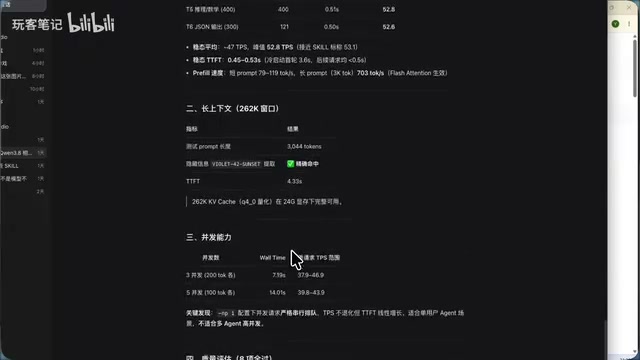
7900XTX Local Deployment of Qwen3 in Practice: 53 TPS Inference Speed Optimization Guide
Complete guide to deploying Qwen3 27B model on AMD RX 7900XTX 24GB: achieve 53 TPS inference through KV Cache Q4 quantization, 262K ultra-long context, and MTP speculative sampling, with installation tutorial and quantization precision comparison.
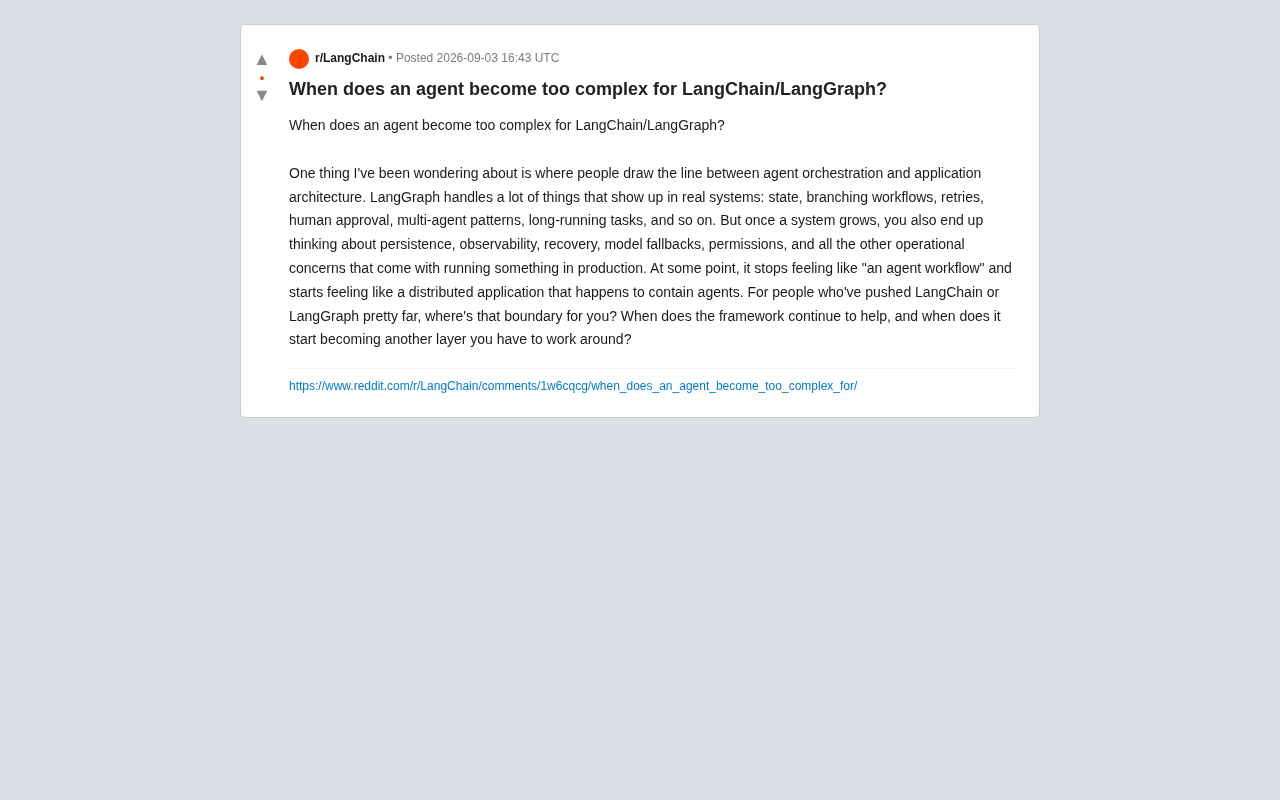
The Boundaries of LangGraph: When Does an Agent Become a Distributed Application?
Explore the capability boundaries of Agent orchestration frameworks like LangGraph, and learn when AI Agent systems cross the line from workflow orchestration into distributed application architecture.