AI Daily Briefing: Kimi K3 Lands on NVIDIA NIM, Google Gemini Live Gets Major Upgrade

Kimi K3 hits NVIDIA NIM, GPT-6 rumors swirl, and open-weight models rapidly displace closed APIs in enterprise use.
Three main threads define this AI Daily Briefing: on the product front, Kimi K3 joins NVIDIA NIM for free access, Gemini Live delivers 97-language real-time multimodal interaction, GPT-6 appears to be in staged rollout, and Apple debuts a 20B-parameter on-device model; on the regulatory front, OpenAI, Anthropic, and Google's plan to form a joint AI standards body draws antitrust criticism from Cohere's CEO, while Texas tightens data center water disclosure rules; on the industry front, enterprises like DoorDash and Siemens are rapidly shifting to Chinese open-weight models, cutting closed-API query share from ~60% to ~25%, while Claude leads Artificial Analysis's professional competency index and OpenAI's voice model tops the voice-to-voice chart.
This edition of the AI Daily Briefing covers the latest across large model product updates, regulatory battles, capability benchmarks, and agent applications. From Kimi K3 going live on NVIDIA's platform with free access, to Google Gemini Live's multilingual real-time understanding, to speculation surrounding GPT-6's staged rollout — the pace of competition among AI players is clearly accelerating.
Flurry of Large Model Product and Service Updates
Moonshot AI's Kimi K3 is now listed in the NVIDIA NIM API catalog. Developers who register on NVIDIA's platform and obtain an API key can call it for free via an OpenAI-compatible interface, with support for multimodal input, streaming output, and reasoning intensity settings. For developers looking to experiment with frontier model capabilities at low cost, this is an access point worth noting.
Google AI Studio has launched a Gemini Live version supporting up to 97 languages and real-time visual understanding. Its Extended Thinking capability enables the model to reason while speaking and invoke tools to complete complex tasks. The feature is being rolled out progressively to developers, enterprises, and Gemini users. This kind of real-time multimodal interaction is fast becoming the new battleground for voice assistant competition.
Rumors surrounding GPT-6 have also attracted attention. Some users reported receiving responses from a higher-model version when selecting a lower-tier configuration, along with model inconsistency warnings. Available information suggests that GPT-6-related versions may be in staged rollout or internal testing, though OpenAI has yet to make an official announcement. In the meantime, OpenAI has announced it will deprecate GPT-5.5 across all ChatGPT, ChatGPT Work, and Codex plans starting October 14, requiring users to migrate to newer versions.
On the Apple front, a new version of iOS introduces an on-device model with a total of 20 billion parameters that dynamically activates approximately 100 to 400 million parameters per request, and has been demonstrated running on the latest iPhone Pro. This sparse dynamic-activation design is a classic approach to balancing performance and power consumption in on-device large models. Meanwhile, TypeSafe AI — founded by a former OpenAI researcher — has launched a decision model called Jave, positioned for rapid judgment scenarios, capable of outputting probabilities and confidence scores, with output tokens offered for free.
Background: What is NVIDIA NIM? NVIDIA NIM (NVIDIA Inference Microservices) is an inference microservice platform designed to help developers rapidly deploy large models as callable API endpoints. The NIM API catalog functions like a model marketplace — developers don't need to build their own inference infrastructure; they simply register and obtain a key to call hosted models via standardized interfaces. Because NIM interfaces are compatible with the OpenAI format, existing code using the OpenAI SDK can switch to third-party models on NIM with minimal modification, dramatically lowering migration costs. Kimi K3's inclusion in the catalog signals NVIDIA ecosystem endorsement and access to a broader developer community through NIM's distribution network.
Background: Apple's Dynamic Activation Technology The "dynamic activation" technique used in Apple's on-device model is essentially a Sparse Mixture-of-Experts (Sparse MoE) or similar conditional computation approach: despite having 20 billion total parameters, only a small fraction (roughly 100–400 million) is activated per inference. This preserves large model capacity without significantly increasing latency or power consumption — a critical engineering trade-off for on-device deployment in compute-constrained environments, fundamentally different from cloud inference that loads all parameters in a data center.
Regulatory and Safety Battles Heat Up
Elon Musk commented that Anthropic invests more in AI safety than OpenAI does, but that the two companies' model capabilities are comparable, and either unilaterally slowing development risks losing competitive advantage. He proposed that companies open API access to competitors and share testing frameworks before model releases — to check for bioweapon risks and deceptive behavior — thereby building a publicly verifiable regulatory consensus backed by legal accountability.
More controversially, OpenAI, Anthropic, and Google are reportedly planning to jointly form an AI standards organization. Cohere CEO Aiden Gomez publicly criticized the arrangement, arguing it could amount to a cartel operating under the guise of safety. The core dispute: who sets the rules, which organizations can participate, and whether smaller labs and open ecosystems will be excluded. This divide reflects a deeper tension in AI governance between leading companies and smaller players.

On resource consumption, Texas is moving to penalize data centers that fail to disclose their water usage, with the governor indicating that concealing such data could constitute civil and criminal violations. As compute expansion drives up water demand, data center resource consumption is becoming a focus of local regulation. Prediction markets show a 64% probability that at least one U.S. state will impose a moratorium on new data center construction before the end of 2026, with energy and water issues shifting from technical topics to public policy matters.
Background: What is a "Cartel" in This Context? In antitrust law, a "cartel" refers to multiple companies that should be competing instead colluding to jointly set rules, divide markets, or manipulate prices — effectively shutting out outside competitors. The core of Cohere CEO's criticism is that when OpenAI, Anthropic, and Google — the world's three most influential AI companies — jointly lead the drafting of industry standards, those standards may be designed to favor their own interests and create barriers to entry for newcomers. This concern isn't unfounded: historically, dominant firms in telecom and finance have used "safety" or "interoperability" frameworks to establish de facto exclusionary standards. For the open-source community and smaller AI labs, being locked out of rule-making could mean facing higher compliance costs and access barriers.
Model Benchmarks and Industry Applications
Several benchmark updates have emerged. Artificial Analysis published a voice-to-voice index, with OpenAI's voice model topping the chart at 81.5 points and a Soul-backend configuration ranking third at 80.1. Artificial Analysis also updated its professional competency index, mapping six categories of real-world job tasks to model benchmarks and adding evaluation dimensions such as tool use and long-context handling. The Claude series leads across all six indices, while open-source models including Kimi, DeepSeek, and GLM also rank near the top in certain occupational scenarios.
A notable industry signal: DoorDash, Siemens, and Airbnb are beginning to adopt lower-cost Chinese open-weight models, with some cases showing the share of queries routed to closed proprietary models dropping from roughly 60% at the start of the year to about one quarter. This indicates that open-source models are rapidly becoming viable for real business workloads, and cost-sensitive enterprises are reassessing their tech stacks.

Periodic Labs unveiled the Neon materials science model, claiming it forms an iterative loop of experiments, data, and re-experimentation. Training used 1,300 H200 GPUs and months of experimental data, and the model reportedly outperforms competitors on internal analysis benchmarks, focusing on superconductors, magnets, and semiconductor materials. The emergence of such vertically specialized science models indicates that large models are moving beyond general capabilities into deep penetration of specialized research domains. Enterprise AI spending data also shows that OpenAI's flagship models account for 13% of enterprise AI expenditure, reflecting that frontier models may still hold meaningful pricing power.
Background: Open-Weight vs. Fully Open-Source Models Open-weight models and fully open-source models carry an important distinction: the former release model weight files, allowing local deployment and fine-tuning, but training data, full code, or commercial licensing terms may not be open; the latter typically require code, data, and weights to all be publicly available. Chinese models like DeepSeek, Kimi, and GLM mostly follow the open-weight approach. For enterprises, open weights mean the model can be deployed on their own infrastructure — avoiding sending sensitive business data to third-party APIs — while inference costs remain under their control, insulated from vendor pricing fluctuations. This is the core motivation driving cost-sensitive companies like DoorDash and Siemens to adopt these models, rather than purely chasing frontier capability.
Agent Development and Product Applications
In the agent space, Salesforce and Anthropic launched a beta of Salesforce in Cloud, integrating customer opportunity and sales pipeline data into a conversational product with 37 built-in sales skills. It can assist with call preparation, deal updates, and CRM record management, with data access still governed by the user's existing permissions. Kimi Code has updated its remote control and plugin management features — remote control is now enabled by default, a plugin panel has been added to the web interface, and users can browse and manage plugins via a marketplace.

On the consumer side, Meta has launched a global subscription service called MetaOne covering Instagram, Facebook, WhatsApp, and Meta AI, with over 50 features in the initial rollout, a focus on AI image and video generation, and pricing starting at $2.99 per month. The service has reached 15 million cumulative subscribers and trial users, while core features of the four apps remain free. Google's Notebook mobile app is set to gain voice mode and audio recording features, allowing users to converse with their notes by voice or record lectures and ideas, with an interactive learning guide planned and a free one-year AI service offer for eligible college students. Grok Imagine has also entered testing, adding the ability to directly edit text on images — users can manually adjust text color, size, font, and alignment — which could reduce the number of regeneration cycles needed for marketing assets.
Takeaways
Several clear through-lines emerge from this edition: frontier model iteration has entered an intensive phase, with GPT-6 staged-rollout rumors and multiple new model launches signaling a new round of capability competition; open-weight models are accelerating their penetration into enterprise deployments, disrupting the market position of closed proprietary models; and tensions around AI governance and resource regulation are becoming increasingly visible, with both the standards organization controversy and data center energy and water monitoring warranting continued attention.
Related articles
Automattic Executives Signed Reciprocal Severance Agreements During Mullenweg's Brief Ouster
Automattic's CFO and General Counsel signed reciprocal severance agreements during Matt Mullenweg's brief ouster, covering one year's salary and accelerated equity vesting, raising corporate governance concerns.
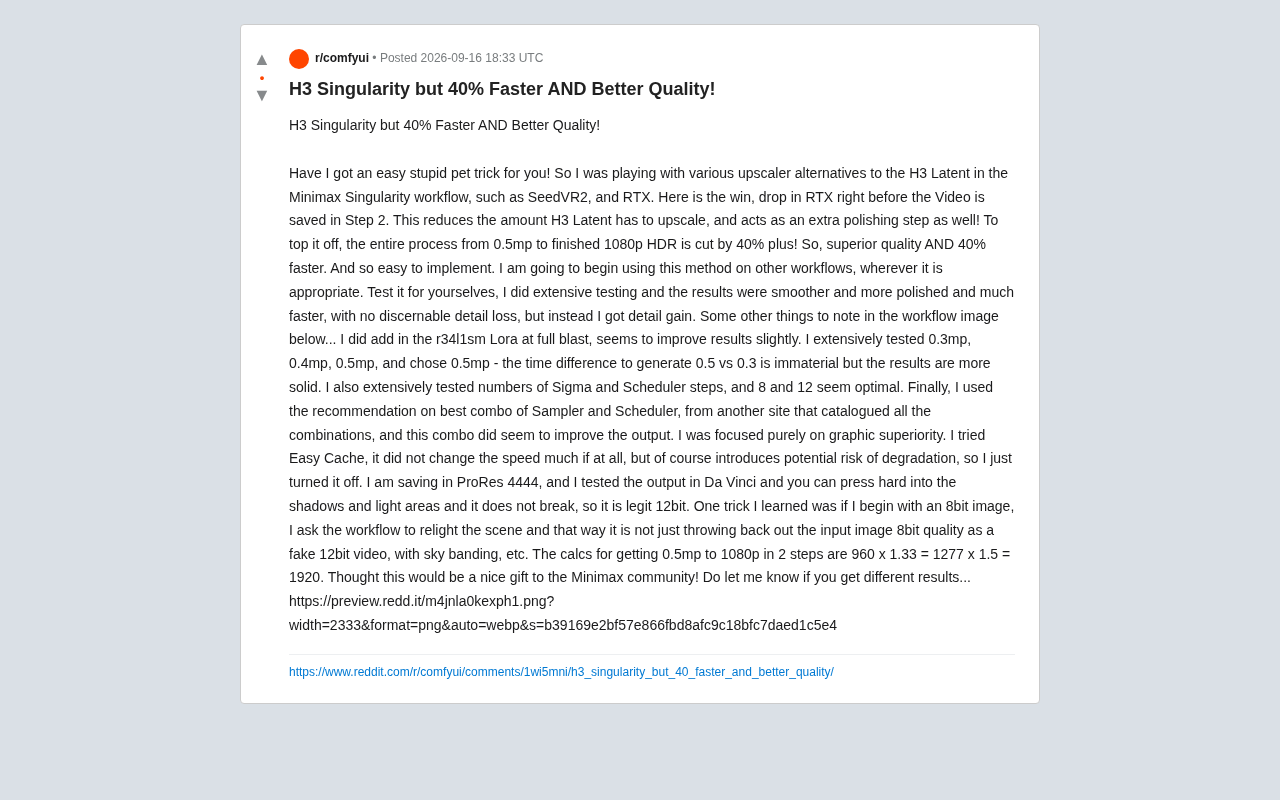
H3 Singularity Optimization: 40% Speed Boost With Better Image Quality
A Reddit user's Minimax Singularity workflow tip: insert an RTX upsampler before H3 Latent for 40%+ speed gains and better quality. Covers parameters, 12-bit output, and more.
Glyph: A Multi-Strategy Agent System for Automated Enterprise Data Catalog Annotation
Glyph is a multi-strategy LLM agent system for enterprise data catalogs that automates column description generation and sensitivity ontology tagging, grounding outputs in pipeline source code to improve accuracy.