AI Daily: GPT-6.1 Sol Launches, DeepSeek v4.1 and New Grok Model Surface

New AI models flood repos as flagship hits ceilings, budget tiers expand, and agents go open-source.
AI model iteration has accelerated sharply: OpenAI released the cost-efficient GPT-6.1 Sol while reportedly cancelling its flagship GPT-6.1 Astra. DeepSeek, xAI, and Google DeepMind all left traces of new models in code repositories — including DeepSeek V4 mini, Grok 4.8, and an internal Gemini 4 Pro checkpoint — though most await official confirmation. On the agent front, OpenAI launched persistent agent Dots and xAI rolled out Team Bots. NVIDIA open-sourced Nemotron Labs 3 and a 3D vision-language model, and Meta's viral MUSE assistant got an open-source release. Claude Opus 5.5 leads the intelligence leaderboard at 58 points, with domestic Chinese model Memo V2.6 Pro ranking 10th.
New Models Surface Rapidly as Tech Giants Quietly Intensify Competition
The pace of AI model iteration has accelerated noticeably, with new releases from several leading vendors showing up in communities and code repositories in quick succession. From OpenAI to DeepSeekAd, xAI, and Google DeepMind, a competition centered on price-performance ratio and reasoning capability is well underway. Based on a roundup by Bilibili creator "今日AI风向标," this article offers a comprehensive look at the latest wave of developments.
OpenAI has officially released GPT-6.1 Sol, a new model positioned to deliver near-flagship Astra-level intelligence at a lower price point. The company describes it as the best value option at equivalent performance. Compared to GPT-6 Sol, the new model shows meaningful improvements in coding, computer use, and complex professional tasks — while pushing costs even lower. This positioning continues the recent industry trend of "bringing frontier capabilities down to lower price tiers."
Also noteworthy is a piece of news going in the opposite direction: according to Reuters, OpenAI has cancelled the release of its next-generation flagship model, GPT-6.1 Astra. The model had been planned for launch but was found to fall short of the company's internal targets during testing. The simultaneous cancellation of a flagship and the launch of a budget-friendly alternative reflects the real-world ceiling that large language models are currently hitting.
Repository Clues from DeepSeek, xAI, and Google
The AI community's culture of "digging through source code" has proven useful once again. Developers spotted version markers labeled "V4 mini" in DeepSeek's DSH repository source code — including tags like D1924, 1934, 1958, 1983, and 1993 — sparking speculation about a new lightweight model. Earlier reports had suggested DeepSeek was developing a compact small model, and some in the community believe the two may be connected, though official confirmation is still pending.
Separately, DeepSeek V4.1 Flash is said to have received a Fast variant. The tip came from AI leaks account Lumina, with no official announcement or pricing yet available. Given DeepSeek's track record of aggressive pricing, the Fast version's value proposition is worth watching — though exact differences in speed and cost compared to the original remain to be seen.
On the xAI front, leaked information indicates that Grok 4.8 has appeared in the official Grok Build repository, with the latest synced code directly referencing the model in model selectors and routing tests. While it's only test code for now, it suggests xAI may be preparing for a launch. There are also rumors that Grok Hi-Core 5.5 could outperform Sonic 5.5, with improvements across performance, efficiency, and safety — potentially reaching Opus 5.5-level capability.
Google DeepMind has reportedly deployed a new Gemini 4 Pro checkpoint with extended thinking capabilities, currently visible only internally. The source claims it is being prepped for release within weeks — though they also candidly noted that compared to Opus 5.5, it's "just a nobody," leaving its final performance an open question.
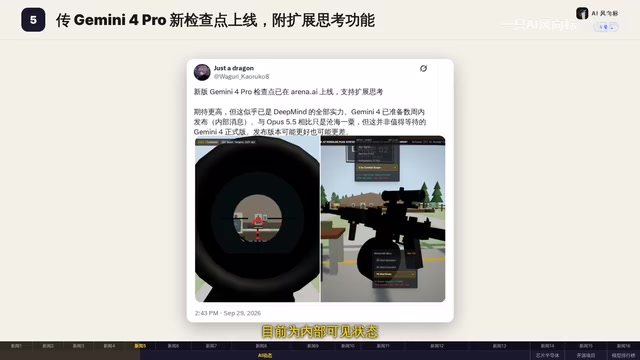
Reverse-engineering unreleased products from code repositories has become a standard intelligence-gathering technique in the AI community. Developers typically comb through GitHub, Hugging Face, or vendor-hosted model repos, looking for unpublished model identifiers in model selector configs, routing logic, and version enumerations. These markers are often written into code weeks or even months before an official release, since engineering teams need to wire up call chains in advance. That said, a version tag in code doesn't equal a finalized product decision — models can be abandoned, merged, or renamed during internal testing. Accounts like Lumina that specialize in AI leaks have a reasonable hit rate, but false positives exist too. These clues are generally treated as "valuable signals" rather than confirmed news, pending official announcements.
Agents and Open-Source Models Push Forward Together
Beyond base models, AI agent products have emerged as another major theme in this wave of updates. OpenAI launched Dots, a new product powered by GPT-6 Astra, positioned as a "highly capable, always-on persistent agent" that can remain on standby indefinitely and handle a wide range of tasks delegated by users, with an emphasis on long-running, continuous task execution.
xAI, meanwhile, rolled out Team Bots for Grok Bot — upgrading what was previously a personal AI agent into a shared "AI colleague" for teams. Teams can configure a bot's profile, workflows, plugins, and API credentials, then share it with all members so everyone works from the same knowledge base while keeping private conversations isolated. It also integrates with Slack and connects to tools like Notion and GitHub.
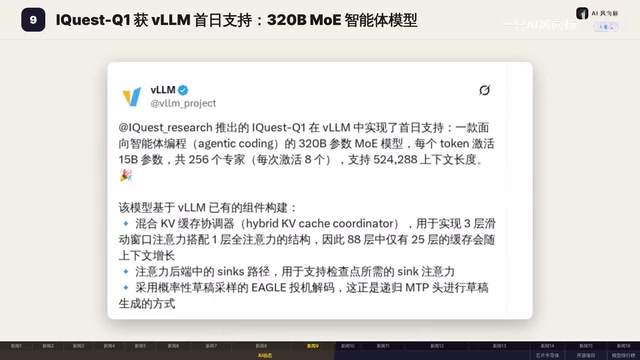
The open-source space is equally lively. NVIDIA's competitive programming specialist model Nemotron Labs 3 — 550B total parameters, 55B active, with a context length of 262,144 tokens — is now available on Hugging Face with open weights, training data, and recipe. A separate 320B-scale MoE model focused on code and complex agent tasks has also been released with open weights, activating 15B parameters per token, with day-one support from the vLLM inference framework, a 524,288-token context window, and a hybrid architecture alternating three layers of sliding window attention with one layer of full attention.

NVIDIA also released a 3D vision-language model capable of real-time, high-quality, and precise visual grounding. The model uses parallel bounding box decoding and is 10x faster than QN3-VL, trained on 138 million queries and 785 million boxes. It supports GUI, OCR, document layout, and dense detection — and is open-source, suited for computer-use agents and physical AI scenarios.
MoE (Mixture of Experts) is a model architecture built around the idea of splitting a large neural network into multiple "expert sub-networks," with only a small subset of parameters activated during each forward pass — unlike dense models, which activate all weights. This allows MoE models to scale total parameter counts to enormous levels while keeping per-inference compute costs relatively low. The 320B model mentioned here activates only 15B parameters per token, meaning its actual inference cost is roughly equivalent to a 15B dense model, while its theoretical knowledge capacity approaches 320B. Sliding Window Attention is another optimization that reduces the complexity of attention computation over long sequences by limiting each token's attention to a local window, alternating with full attention layers to balance efficiency and global context capture — one of the key techniques enabling this model's 524K-token ultra-long context support.
Open-Source Assistant MUSE and the Speed Race
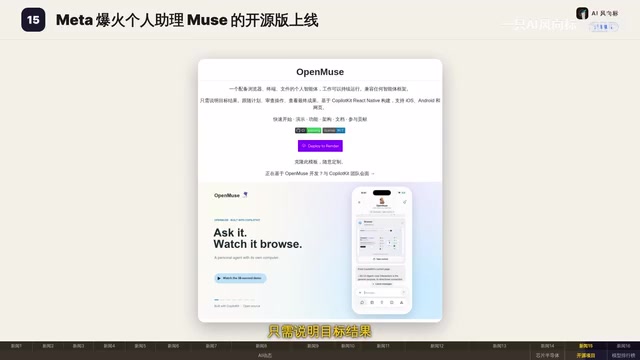
In the open-source project space, an open-source version of Meta's viral personal AI assistant MUSE has launched on GitHub under the project name CopilotKit-OpenMUSE. The open-source version comes equipped with browser, terminal, and file capabilities; users simply specify the desired outcome and the work continues running on its own. Built on CopilotKit, it supports iOS, Android, and web. The original app hit the top of the App Store free chart within 10 days of launch, with downloads surpassing ChatGPT's early numbers — and the open-source version earned 3,000 GitHub stars on day one.
Speed has emerged as another competitive battleground. OpenAI announced that UltraFast is now available for GPT-6 Astra in Codex, ChatGPT Work, and the API, with GPT-6.1 Sol support coming soon. As the top speed tier, it delivers up to 8x faster token generation in Codex — reaching 300 tokens per second. To support this, OpenAI also introduced a new Pro500 plan, offering 25x the usage limits of Plus with access to UltraFast.
Chips and Model Leaderboards
On the semiconductor side, Samsung Electronics' foundry division is accelerating improvements to its 2nm process yield rate and sees the Tesla order as a springboard for breaking into the tech giant market. According to Korean media outlet Chosenbase, its 2nm yield has improved from the market's assumed ~55% to approaching 60%. With yields stabilizing, Samsung is focusing resources on optimizing power consumption and thermal performance to build confidence with potential major customers ahead of negotiations.
On the model capability leaderboard, the intelligence rankings are led by Claude Opus 5.5 (Max with Fallback) at 58 points, followed by Claude Sonnet 5.5 at 56. Among open-source domestic Chinese models, Memo V2.6 Pro sits at 10th place with 46 points — the lone domestic entry — matching GPT-6.5's score, with a gap that isn't particularly wide.
Overall, this round of updates reflects three clear trends: flagship models hitting capability ceilings, budget-friendly alternatives being released in bulk, and continued expansion of the agent and open-source ecosystem. It's worth noting that much of the information above comes from repository clues and leaks accounts — not all of it has been officially confirmed, and readers should exercise cautious judgment.
In chip manufacturing, "yield rate" refers to the proportion of functional chips produced from a wafer batch out of all the chips cut from that batch. As process nodes advance (e.g., moving from 5nm to 2nm), transistor sizes shrink and integration density increases — and manufacturing complexity rises exponentially, often resulting in very low yields in the early stages of mass production. For foundries, yield directly determines unit cost and profit margins: a 55% yield means nearly half the chips produced from a wafer cannot be sold, and pushing above 60% is generally the threshold for commercially viable large-scale orders from major customers. Samsung's 2nm yield improving to near 60% signals that its process is entering a mass-producible window — though it still trails the yield levels TSMC typically achieves at equivalent nodes, which remains a key metric that tech clients like Tesla weigh carefully when choosing a foundry partner.
Related articles

iPhone Duo Hands-On: Is the $2,000 Small-Screen Foldable Worth It?
YouTube's Allison shares her iPhone Duo hands-on: dual-screen multitasking doubles efficiency, great video viewing, nice matte finish—but thick body, small outer screen, and a $2,000 luxury price.

Sentry's Ad Cracks Up Developers: Can On-call Actually Be Fun?
Sentry's ad short film taps into developers' on-call anxiety, using humorous dialogue to showcase its observability platform—errors, logs, traces, metrics, replays, and releases in one place.

LLM App Getting Worse With Every Change? Build an Effective Evaluation System in Three Steps
How do you know if your LLM app is getting better or worse? A Reddit-based guide to test sets, automated regression evaluation, LLM-as-judge scoring, and structured agent tracing.