AI Daily: Kling 4.0 Strikes Back, Manus 2.0 Reborn, Claude Sonnet 5.5 Launches

Kling 4.0, Manus 2.0, and Claude Sonnet 5.5 all update on the same day, shifting AI competition toward efficiency and value.
Three AI tracks saw major updates on the same day. Kling 4.0 challenges Seedance with expanded multimodal references, 30-second native video, and 4K/HDR output. Manus 2.0 introduces Cascade architecture for dynamic skill loading, cutting token use by 23.2% and task time by 28.2%, while launching personal agents with real accounts and payment capabilities. Claude Sonnet 5.5 matches flagship Opus 5.5 performance at half the price and 30%+ faster generation. All three signal the same trend: AI competition is moving from raw capability to efficient, affordable execution.
Several long-established players in the AI space made a collective return on the same day, with major updates landing simultaneously across three tracks: video generation, AI agents, and large language models. Kling dropped a 4.0 preview to challenge Seedance's recent dominance, Manus 2.0 underwent a complete architectural overhaul, and Anthropic's Claude Sonnet 5.5 positioned itself as the go-to model for everyday work at half the price. This wave of dense, coordinated releases reflects each company's distinct competitive strategy within its own niche.
Kling 4.0: Multimodal References and Native 30-Second Video
Facing Seedance's aggressive momentum in video generation, Kling responded with a major version upgrade. According to a breakdown by Bilibili creator Ever AI, Kling 4.0 supports up to 15 multimodal references and 10 keyframe inputs, while extending native video length to 30 seconds — a significant leap from previous versions.
On the quality front, 4.0 natively supports 4K resolution and 10-bit HDR output, a meaningful upgrade for creators targeting professional-grade results. Perhaps more impactful is the expansion of prompt length to 8,000 tokens, allowing users to describe camera moves, lighting, and action details with far greater precision — no more trimming prompts to fit an arbitrary character limit.
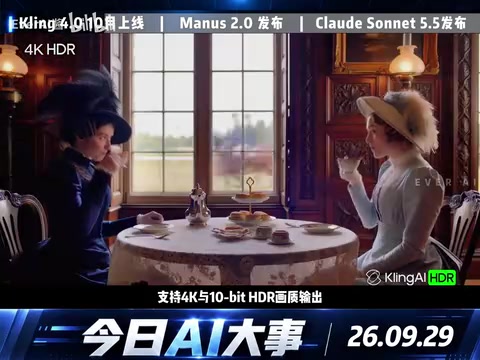
For the rollout strategy, Kling is taking a phased approach: the lightweight Flash version is already live, with the full version slated for October. This staggered release lets the team quickly capture mindshare while buying time to polish the complete feature set. Judging by the scale of the spec bump, Kling clearly has no intention of conceding ground in the video generation race.
Manus 2.0: Cascade Architecture and Dynamic Skill Loading
Where Kling's update is about stacking specs, Manus 2.0's headline is a fundamental rethink of its underlying logic. The new version introduces the Cascade architecture, whose core idea is to stop front-loading agents with every available skill from the start — instead, specialized capabilities are loaded dynamically as a project progresses.
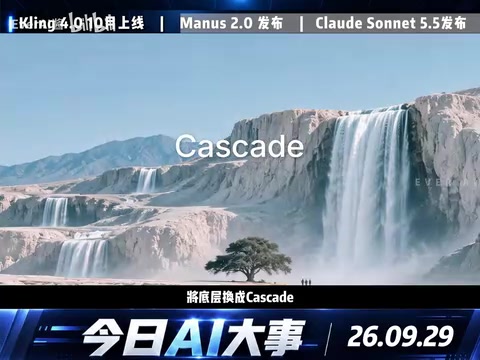
This on-demand design delivers measurable efficiency gains: official figures show a 23.2% reduction in token consumption and a 28.2% reduction in task completion time. For complex, multi-step workflows, avoiding a bulk upfront skill load saves compute and cuts latency — a noteworthy optimization direction in production-grade agent engineering.
Launching alongside 2.0 is a line of personal Agent products. Each agent comes with its own email address, phone number, wallet, and cloud computer, and can make calls, send messages, and handle payments within a set budget. Even more interesting: multiple agents can form a "work group" and autonomously divide tasks among themselves.
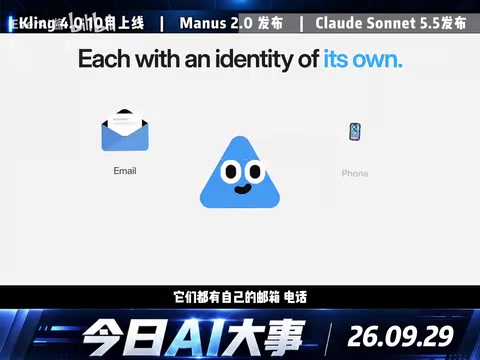
Equipping agents with real identity accounts and payment capabilities marks a significant step from "content-generating tool" toward "autonomous task executor." While this dramatically increases practical utility, it also puts permission management, budget controls, and safety boundaries front and center — ensuring agents don't overstep will be a defining challenge for this category of product.
A closer look at Cascade: The architecture shares its core philosophy with the software engineering concept of lazy loading. In traditional agent design, all tools and skill descriptions are injected into the context window at startup, consuming a large portion of the token budget — even for capabilities that will never be used in a given task. Cascade instead breaks skills into independent modules and pulls them dynamically based on what the current step actually requires, much like a microservices architecture calling sub-services on demand. This approach is especially critical for long-horizon agents: the more steps involved and the more domains touched, the more wasteful front-loading the full skill set becomes. The 23.2% token reduction isn't just about cost savings — in a world where model context windows are finite, it means agents can handle more complex, longer-running tasks within the same window without suffering degraded reasoning quality from a stuffed context.
Claude Sonnet 5.5: The Everyday Workhorse Built for Value
Anthropic's update takes a distinctly pragmatic angle. Claude Sonnet 5.5 is positioned as the model "best suited for everyday work," covering use cases like debugging code, creating documents and presentations, and reportedly delivering solid performance on design aesthetics as well.
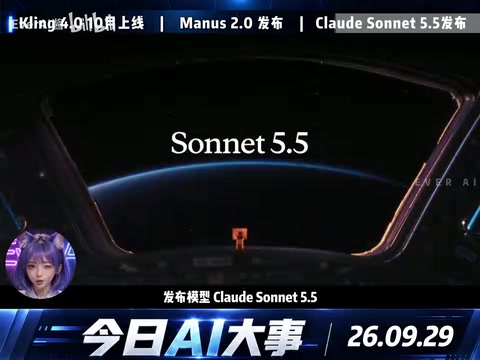
The most compelling number is the price-to-performance ratio: Sonnet 5.5 reportedly matches the more premium Opus 5.5 on performance while costing half as much, and it generates output more than 30% faster than the previous Sonnet 5. For high-frequency, cost-conscious use cases in daily development and office workflows, this "near-flagship performance at half the price" combination is hard to ignore.
From a product strategy standpoint, using a mid-tier model to approach flagship-level performance is becoming a go-to playbook for LLM providers to drive adoption. It puts near-top-tier capability within reach of budget-constrained developers and teams, while quietly raising the industry's overall price-performance baseline.
On LLM pricing: Large models are typically billed per million input/output tokens, and flagship models like the Opus series can cost several times — sometimes ten times — more than mid-tier alternatives. For developers or enterprises making high-frequency API calls, model pricing directly determines the viability ceiling of a project. By setting Sonnet 5.5 at half the price of Opus 5.5, Anthropic effectively doubles the call volume achievable within the same budget — a material difference for batch-processing workloads like code review and document automation. Worth noting: "matching performance" typically refers to mainstream benchmark scores; on extreme reasoning tasks or very long-context workloads, a gap may still exist. Users should evaluate whether Sonnet is the right Opus replacement based on their own real-world scenarios.
The Common Signal Across Three Tracks
Read together, these three updates reveal a shared undercurrent. Kling continues to compete in video generation through raw specs and image quality; Manus is doubling down on engineering efficiency and real-world execution in the agent space; Claude is finding the sweet spot between performance and price.
Whether it's Kling's dynamic multimodal support, Manus's on-demand skill loading, or Claude's speed and cost optimizations, all three point in the same direction — moving beyond pure capability accumulation toward making those capabilities faster, more practical, and more affordable for end users. The competitive battleground is shifting, step by step, from "can it do this?" to "can it do this well, quickly, and cost-effectively?"
Related articles

iPhone Duo Battery Life Tested: One Charge a Day Is Unavoidable, and the Large Screen Is the Culprit
iPhone Duo battery test: heavy use needs at least one charge a day, and about 30% remains after 6.5 hours of screen-on time. How often the large screen is unfolded is key; a MagSafe battery pack helps, and long-term degradation is also worth watching.

Kimi K3.1 Pro Open-Sourced: 2.8 Trillion Parameters Close In on Opus
Moonshot releases the open-source MoE model Kimi K3.1 Pro, with 2.8T total parameters and 104B activated, trailing Opus 5.5 by under 1 point on Terminal Bench 4.0.

Costco Tech Price Guessing: Are Monitors, Keyboards, Mice, and Bose Speakers Worth It?
A YouTube blogger guesses prices of Costco tech products: 2K 180Hz monitor, Logitech keyboard and mouse, Bose speaker, and CyberPower UPS, revealing warehouse-store selection and brand premium.