AI Daily Report March 20: Gemini CLI Restricts Free Users, Xiaomi Launches Three MiMo Models Simultaneously

March 20 AI roundup: Google tightens free tier, Xiaomi drops three models, Baidu OCR goes open source
March 20 saw multiple major AI announcements: Google Gemini CLI will cut Pro model access for free users, retaining only Flash; Xiaomi simultaneously launched MiMo VL Pro (1T-parameter reasoning), MiMo VL Omni (omni-modal), and MiMo VL TTS (speech synthesis); Trae IDE launched on Linux for full platform coverage; Tencent Hunyuan 3.0 is expected in April; and Baidu Qianfan released and open-sourced a 4B-parameter end-to-end OCR model. The industry shows clear trends toward tiered commercialization, intensive domestic releases, and tool platformization.
On March 20, multiple major announcements hit the AI space simultaneously. Google's Gemini CLI strategy adjustment for free users drew widespread attention, Xiaomi launched three MiMo large models in one go, Tencent's Hunyuan 3.0 is gearing up for release, and Baidu's Qianfan introduced a document-intelligent OCR model. This article covers the day's core developments with detailed analysis.
Gemini CLI Tightens Free Tier: Pro Model No Longer Available to Free Users
Google's terminal AI tool Gemini CLI announced a service strategy adjustment. Gemini CLI is Google's command-line AI tool that allows developers to directly invoke Gemini series large models for code generation, text processing, and reasoning tasks within the terminal environment, enabling efficient AI-assisted development without a graphical interface. To prioritize the experience for high-trust and paying users, free users will lose access to the Gemini Pro model in one week, with only the Flash model remaining available.
The core difference between the Pro and Flash models lies in this: the Pro model has a larger parameter scale and stronger complex reasoning capabilities, suitable for multi-step logical deduction, long-text analysis, and high-quality code generation; the Flash model is designed for low latency and high throughput, with a smaller parameter scale suited for lightweight tasks requiring quick responses. This tiered architecture is extremely common in large model services—OpenAI's GPT-4o vs. GPT-4o mini, and Anthropic's Claude Sonnet vs. Haiku all employ similar high-low pairing strategies.
This adjustment means developers who previously relied on Gemini CLI's free quota to use the Pro model will need to rethink their workflows. Google expressed sincere apologies and suggested users migrate to AI Studio or Vertex AI platforms for direct control over their quotas and spending. AI Studio is Google's developer-facing platform for model debugging and prototyping, offering a visual model invocation and testing environment; Vertex AI is an enterprise-grade fully managed machine learning platform supporting more granular quota management, billing control, and production-level deployment capabilities.
From a strategic perspective, this is another move in Google's AI tool commercialization journey. Free models attract entry-level users while premium models drive paid conversion—this tiered strategy has become industry standard. For individual developers, the Flash model remains sufficient for daily lightweight tasks, but scenarios involving complex reasoning and code generation may require considering paid plans or alternative tools.
Trae IDE Launches Linux Version, Achieving Full Three-Platform Coverage
AI programming IDE Trae announced the launch of its Linux version today, with both the China and international editions going live simultaneously, offering DEB and RPM installation package formats. DEB is for Debian and its derivatives (such as Ubuntu), RPM is for the Red Hat family (such as Fedora, CentOS)—providing both formats means covering the vast majority of Linux users. This version offers full feature parity with the Mac and Windows versions, including Solo mode, code completion, and other core features, requiring no additional configuration—download and go.
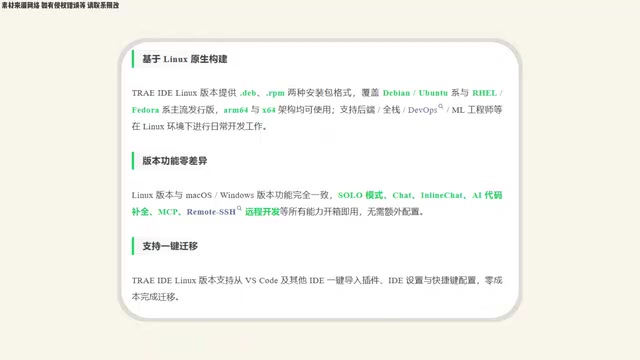
Trae IDE is an AI-native integrated development environment from ByteDance. Its core design philosophy is to deeply embed large model capabilities into the programming workflow, rather than simply layering AI plugins on top of a traditional IDE. Solo mode is one of Trae's signature features, allowing AI to complete the entire process from requirement understanding to code generation with higher autonomy—developers only need to describe their goal, and the AI autonomously plans the implementation path and generates runnable code, rather than merely offering fragmented code completion suggestions.
With this release, Trae achieves full platform coverage across macOS, Windows, and Linux. For the Linux user community—especially server-side developers and the open-source community—this is a noteworthy option. The AI programming tool space is fiercely competitive, with Cursor, GitHub Copilot, Windsurf, and others each having their own focus. Competition among AI programming tools is expanding from feature comparisons to platform coverage and ecosystem building. Trae's strategy of completing its Linux version for full-platform coverage holds significant importance for capturing server-side developers and DevOps engineers, demonstrating its determination to compete for the developer market.
Xiaomi Launches Three MiMo Models Simultaneously, Covering Reasoning, Multimodal, and Voice
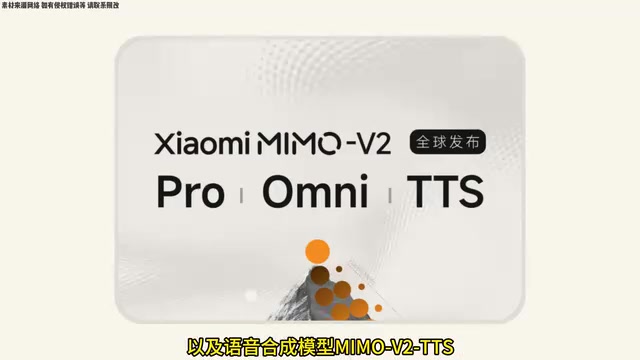
This morning, Xiaomi simultaneously released three models in the MiMo series: the flagship reasoning model MiMo VL Pro, the native omni-modal model MiMo VL Omni, and the speech synthesis model MiMo VL TTS. This represents a concentrated debut for Xiaomi in the large model space.
MiMo VL Pro: Flagship Reasoning Model
MiMo VL Pro has a total parameter count of 1T with 42B activated parameters, supports a 1-million context window, and excels in code and reasoning domains. The combination of 1T total parameters and 42B activated parameters indicates the model uses a Mixture of Experts (MoE) architecture. The core concept of MoE is splitting the model into multiple "expert" sub-networks, activating only a subset of experts to process input during each inference pass rather than having all parameters participate in computation. This preserves the knowledge capacity advantages of large parameter counts while keeping actual computational overhead within acceptable bounds—well-known industry models like DeepSeekAd-V3 and Mixtral employ similar architectures. A 1-million context window means the model can process approximately 750,000 English words or even more Chinese characters in a single pass, which is critical for long document analysis, large codebase comprehension, and similar scenarios.
In benchmark tests, it shows significant improvement over the previous MiMo VL Flash, but still trails some top-tier closed-source models.
However, Xiaomi states that after continuous optimization of the model's early test version Hunter Alpha, the actual user experience of MiMo VL Pro approaches GPT-4.6 level. Pricing adopts a tiered strategy—setting different unit price brackets based on call volume, with higher volumes yielding lower unit prices—accommodating users at different usage levels. This model helps attract both small-scale trial users and large enterprise clients simultaneously.
MiMo VL Omni: Omni-Modal Foundation Model
MiMo VL Omni supports 256K context and builds a comprehensive omni-modal foundation for text, vision, and voice from the ground up, deeply binding perception with action. The "omni-modal" capability here means the model natively supports input and output across multiple modalities including text, images, and audio from the pre-training stage, rather than achieving this through post-hoc assembly of different modal modules. The advantage of this native multimodal architecture is that the model can establish deeper semantic associations across different modalities—for example, understanding text content within an image and explaining it via voice, achieving true cross-modal fusion understanding.
"Deeply binding perception with action" points to the agent paradigm—the model not only understands environmental information (perception) but can also make decisions and execute operations accordingly (action), such as browsing web pages, operating software interfaces, and calling APIs to complete complex tasks. Agent capabilities are widely considered the key direction for large models evolving from "conversational tools" to "digital assistants," and represent a major technology track that all major vendors are investing heavily in for 2025.
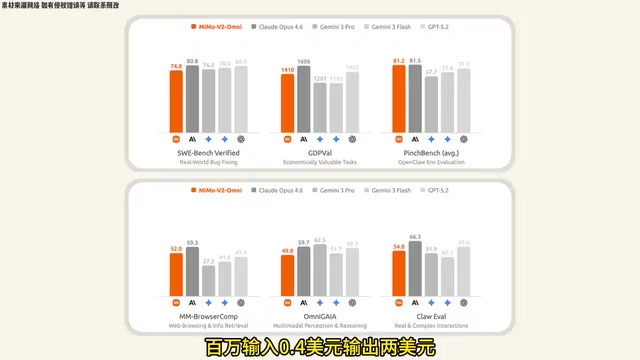
In multiple tests, MiMo VL Omni achieves leading performance, with comprehensive capabilities surpassing Gemini 3 Pro. Its performance on agent tasks is also noteworthy, with overall scores below GPT-5.2.

A detail worth noting on cost-effectiveness: input costs just $0.4 per million tokens, with output at $2—this pricing is quite competitive among models at the same level. For developers who need multimodal capabilities but have limited budgets, MiMo VL Omni offers a pragmatic choice.
MiMo VL TTS: Highly Controllable Speech Synthesis
MiMo VL TTS was pre-trained on hundreds of millions of hours of speech data, achieving highly controllable voice style control. Traditional Text-to-Speech (TTS) systems typically employ concatenative synthesis or parametric synthesis methods—the generated speech is clear but lacks natural prosody and emotional expression. In recent years, neural network-based TTS technology powered by large models has achieved breakthrough advances, with representative work including OpenAI's voice mode and products like ElevenLabs. MiMo VL TTS's pre-training on hundreds of millions of hours of speech data far exceeds traditional TTS systems in scale, enabling the model to learn extremely rich speech patterns and emotional expressions.
It supports precise adjustment from overall style setting to local emotional expression, capable of completing tone shifts and emotional transitions within a single sentence, faithfully reproducing the natural prosody of human speech. "Precise adjustment of local emotional expression" and "completing tone shifts within a single sentence" are current technical challenges in the TTS field, as human speech prosody changes often occur within extremely short time windows, requiring the model to possess fine-grained temporal control capabilities. It can even accurately express pitch and rhythm in singing scenarios, further demonstrating that the model's control precision over pitch and rhythm has reached a high level.
Currently, APIs for all three models are open, and MiMo VL Pro can also be experienced online through Xiaomi's MiMo Studio. Xiaomi's strategy of releasing three models simultaneously showcases its ambitions in AI infrastructure—not just making terminal devices, but establishing a presence at the model layer.
Tencent Hunyuan 3.0 Coming in April, Baidu Qianfan OCR Goes Open Source
Tencent Hunyuan HY3.0 Gearing Up
Tencent announced at a media briefing that the Hunyuan large model HY3.0 is currently undergoing internal business testing and will officially launch in April. Officials stated the new model shows significant advances in reasoning and agent capabilities. Whether Hunyuan 3.0 can stand out in the fierce domestic large model competition is worth continued attention.
Baidu Qianfan OCR: End-to-End Document Intelligence Model
Baidu Qianfan released an end-to-end document intelligence model called Qianfan OCR, with 4B parameters, suitable for document parsing, layout analysis, text recognition, and semantic understanding. Traditional OCR (Optical Character Recognition) pipelines typically consist of multiple independent stages: first performing layout analysis to determine document structure, then executing text detection and recognition separately for each region, and finally post-processing and semantic understanding. The problem with this pipeline architecture is that errors accumulate at each stage, and there's a lack of information exchange between modules. Qianfan OCR's "end-to-end" architecture uses a single unified large model to directly output structured recognition results from raw document images, eliminating information loss in intermediate steps and significantly improving overall accuracy and processing efficiency.
It achieves leading performance in multiple benchmark tests, slightly outperforming DeepSeek OCR2 while also leading Gemini 3 Pro.
The model is now available on the Baidu Qianfan platform and has been simultaneously released as open source. The 4B parameter count is lightweight by current large model standards, meaning it can run on consumer-grade GPUs or even some edge devices, significantly lowering the hardware barrier for enterprises deploying document intelligence systems. The open-source release allows enterprises to deploy and fine-tune the model in private environments, which is particularly important for industries handling sensitive documents such as finance, law, and healthcare—enjoying AI technology benefits without needing to upload data to third-party cloud platforms.
Summary
The AI developments on March 20 reveal several clear trends: first, leading companies are becoming more deliberate in their commercialization paths, with Google's Gemini CLI tiered strategy being a prime example; second, domestic large model competition has entered an intensive release period, with Xiaomi MiMo, Tencent Hunyuan, and Baidu Qianfan all making moves; third, platform coverage and usability of AI tools are becoming new competitive dimensions, as exemplified by Trae IDE's full-platform launch. For developers and practitioners, choices are multiplying, but making optimal decisions among numerous models and tools is increasingly testing one's judgment.
Related articles
 Tech Frontiers
A Rare Quiet Day in AI: Recursive Self-Improvement Stirs Beneath the Surface
A rare quiet day in AI sees multiple sources go silent simultaneously. Behind the calm, Recursive Self-Improvement (RSI) research continues. What this means for the industry.
 Tech Frontiers
Reve 2 vs. Ideogram 4: A Deep Dive into Layout Control in AI Image Generation
A deep comparison of Reve 2 and Ideogram 4's layout control capabilities, covering technical approaches, real-world use cases, and industry trends for designers and creators.
 Tech Frontiers
In the Weights: Check Your Influence Score in the AI World
In the Weights is an AI influence search engine that quantifies your presence in the AI world with a score. Explore how it evaluates practitioners and what it means for digital identity.