AI-Generated Code and Technical Debt: Is Your Codebase Becoming Fragile?

AI-generated code does bring risks of superficial tests and over-engineering, but understanding erosion and insufficient review depend more on team choices.
The article examines a viral article on AI-generated code and technical debt. It notes that "superficial testing" and "unnecessary complexity" have strong support: AI tends to verify that code runs rather than that boundaries are correct, and AI-generated code often introduces abstractions not needed for current requirements. However, "developer understanding erosion" and "no time to review" lack quantitative evidence and depend more on team management choices. The article distills four actionable checks: sample-review AI test assertions, count the frequency of useless abstractions, track the distribution of contributors to core modules, and measure the commit-to-review time interval. The conclusion is that the root of technical debt isn't AI itself, but whether the rhythm of quality maintenance has kept pace with code production speed.
Reflections Sparked by a Viral Article
Recently, an article discussing AI-generated code and technical debt spread widely across developer communities. The author's core argument is that AI-written code is making codebases fragile—tests are superficial, unnecessary complexity increases, developers' understanding of the code erodes, and teams simply don't have enough time for code review.
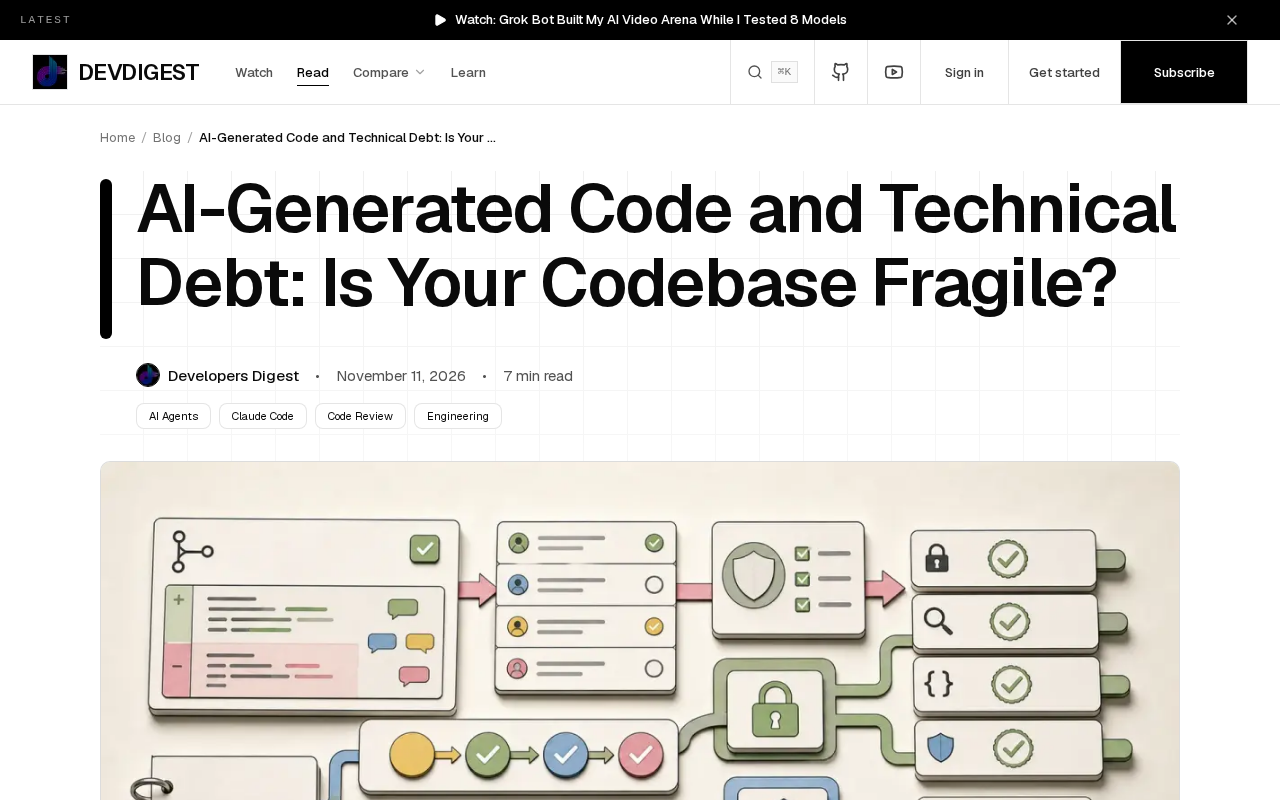
This argument hits a pain point many engineering teams are feeling today. As AI coding assistants move from experimentation to daily use, code production speed has increased significantly, but the mechanisms for maintaining code quality seem not to have evolved in step. However, not all claims in the article hold up to scrutiny: some are observations backed by data, while others are anecdotes based on individual cases. We need to distinguish between the two and extract actionable checks from them.
Which Claims Hold Up
Superficial Testing Is a Real Risk
When AI rapidly generates large amounts of code, the accompanying tests are often written by the same model in passing. The problem is that when AI writes tests, it tends to verify "the code runs" rather than "the code is correct under boundary conditions." This means test coverage numbers may look good, but few assertions actually catch regressions.
This isn't a problem of insufficient model capability but of workflow design: if the prompt only asks to "write tests for this code," the model will naturally produce the most direct tests that pass. To get meaningful tests, you need to explicitly require coverage of exception paths, boundary values, and failure modes, and manually review the quality of assertions.
Test coverage is the ratio of lines of code executed by tests to total lines of code, often used by teams as a quality metric. But coverage only shows that code was executed, not that the execution results were correctly asserted. High coverage paired with weak assertions is technically called "coverage inflation." A more reliable alternative metric is mutation testing: tools automatically inject small errors (mutants) into the code, and if the tests don't fail, it means the assertions failed to catch the error. Mutation testing directly exposes the problem of "superficial testing," but it is computationally expensive and is typically used for sampled verification of core modules.
Unnecessary Complexity Does Increase
When generating code, AI models have a tendency toward "over-engineering": they introduce design patterns, abstraction layers, and configuration items even when the current requirements don't need them at all. The reason is that high-quality open-source projects in the training data often contain these structures, and the model learns the form without necessarily understanding the applicable scenarios.
The result is a codebase cluttered with "just in case" abstractions. A single file looks reasonable, but overall complexity quietly rises. New developers need to understand more concepts to change a single line of code, which directly slows down iteration.
In software engineering, the YAGNI (You Aren't Gonna Need It) principle advocates implementing only what is explicitly needed now, without building abstractions in advance for hypothetical future requirements. Its opposite is over-engineering, which introduces interfaces, base classes, and configuration items that aren't currently used, all in the name of "extensibility." To judge whether an abstraction is necessary, you can ask three questions: Are there at least two concrete implementations that need it right now? Would removing it significantly increase code duplication? Does its presence make it harder for new developers to understand the call chain? If the answer is no, the abstraction is likely a "just in case" burden introduced by AI.
Which Claims Are More Like Anecdotes
The claim that "developers' understanding of code erodes" is hard to generalize. For simple modules, you can safely maintain them without understanding them line by line; for core business logic, losing understanding is indeed dangerous. The original article generalizes this into a universal phenomenon without quantitative evidence.
"No time to review" also varies by team. Some teams raise the review bar higher for AI-generated code, while others relax their gatekeeping because of the fast output. This is more a management choice than an inevitable consequence of AI programming. The cases cited in the original article don't explain what these teams' prior review culture was like, so it's hard to blame AI entirely.
Four Checks: Determine Whether Your Codebase Is Becoming Fragile
The original article proposes four actionable directions for checking, worth every team using AI programming to perform regularly:
First, sample-review AI-generated tests. Randomly select recent test files produced with AI assistance and check whether assertions cover failure paths and boundary conditions. If most tests only verify the normal flow, test quality needs intervention.
Second, count the frequency of abstraction layer introduction. Look at recently merged code and see how much of it introduced new interfaces, base classes, or configuration items that aren't used in the current requirements. An excessively high proportion means over-engineering is accumulating.
Third, track the distribution of contributors to core modules. If changes to a critical module are increasingly concentrated among a few people—or no one can explain its design intent—the risk of understanding erosion is rising.
Fourth, measure the time interval from commit to review. If AI-generated code is merged significantly faster than human-written code, and the number of review comments hasn't increased accordingly, the gatekeeping step may be being compressed.
These four checks don't require complex tools; version history and code review records are enough. The key is to perform them regularly and treat the results as early warning signals of technical debt.
Code review is the practice of having others examine code changes before merging, and its quality depends on the time and expertise reviewers invest. When AI multiplies code output speed, the review step often becomes a bottleneck: if review time doesn't increase accordingly, the review attention each change receives is diluted. To measure whether review is being compressed, besides the commit-to-review time interval, you can also look at comment density per review (number of comments / lines changed) and the distribution of reviewer counts. When these metrics decline, it usually means gatekeeping is completed in form but weakened in substance.
How to Control Technical Debt While Using AI Programming
The root cause isn't AI-generated code itself, but whether the team's engineering practices have kept pace with the change in code production speed. A few practices worth considering:
Set the same review standards for AI-generated tests as for production code, and explicitly require coverage of exception paths. In prompts, directly ask the model to explain its design choices, forcing it to expose unnecessary abstractions. Include review time for AI-generated code in schedule estimates, rather than assuming it "should be quick."
The efficiency gains from AI coding assistants are real, but the accumulation of technical debt is also real. The two aren't contradictory—the key is whether teams are willing to reinvest some of the time saved into gatekeeping code quality. The value of that viral article isn't in how rigorous its conclusions are, but in reminding us: code production speed has changed, and the rhythm of quality maintenance must change with it.
Related articles

Gemini 4 Neon Leak: A Potential Strong Contender Against Opus 5.5
A Hacker News thread suggests Gemini 4 Neon looks like an Opus 5.5 competitor. This article unpacks the product positioning behind this community signal, shifts in the top-model competitive landscape, and what it means for developers' model selection strategy.

Claude Fable 5.2's Self-Authored Short Film 'Fable' Sparks Discussion
A short film 'Fable,' credited to Claude Fable 5.2 for script, visuals, and directing, appears on Hacker News. This article analyzes the significance of full-pipeline AI creation, community reactions, and what it means for content creators.

Anthropic IPO Pricing: A Signal of AI Giants Going Public
Anthropic's IPO pricing draws attention. This article analyzes its potential impact on AI industry valuation, commercialization paths, and the competitive landscape, and highlights public-market expectations and challenges for AI companies.