AI-Generated Code + Modular Design: The ESP32 Kit That Makes Hardware Development Accessible to Everyone

The Axiometa Genesis Mini combines modular ESP32 hardware with AI code generation to make electronics projects beginner-friendly.
The Axiometa Genesis Mini is a modular ESP32 development kit paired with the Genesis Studio AI environment, powered by Axi AI. It lets users describe projects in natural language and receive hardware-ready code instantly. With plug-and-play modules, no breadboard required, and a $35 price tag, it aims to democratize embedded hardware development.
Is the Era of the Breadboard Finally Over?
For anyone who has tackled an electronics project, the breadboard is a bittersweet memory — a tangle of jumper wires, loose connections, and the eternal debugging question of "why isn't it lighting up?"
The breadboard gets its name from early electronics hobbyists who literally pinned components into wooden cutting boards to prototype circuits. Modern solderless breadboards are made from ABS plastic with internal metal spring clips for electrical connections, allowing users to rapidly prototype circuits without soldering. However, breadboards have inherent limitations: contact resistance can reach several ohms, connections are unstable (especially under vibration), wiring becomes difficult to maintain, and at high frequencies, parasitic capacitance and inductance introduce significant interference. For beginners, the "ghost fault" — where circuit logic is correct but random failures occur due to poor contact — is one of the biggest reasons newcomers give up.
A modular ESP32 development kit called the Axiometa Genesis Mini is trying to fundamentally change that.
According to a review by the HackMakeMod channel, the product's creator thinks so highly of it that they "made a significant investment in the company." That shift from reviewer to investor alone speaks volumes about the product's impact.
At first glance, the Genesis Mini looks like a small accessory for some other device — but it's actually a complete ESP32 development board with four built-in module slots.
The ESP32 is a low-cost, low-power system-on-chip (SoC) introduced in 2016 by Chinese chip company Espressif Systems. It integrates a dual-core Xtensa LX6 processor (up to 240MHz), Wi-Fi, Bluetooth 4.2/BLE wireless connectivity, and a rich set of peripherals including GPIO, SPI, I2C, and UART. Compared to its predecessor the ESP8266, the ESP32 offers substantially more computing power, memory, and peripheral options. At just a few dollars, it delivers performance comparable to mid-range MCUs, making it one of the most popular platforms in the global maker community — widely used in smart home devices, IoT sensors, wearables, and more. The core philosophy behind the Genesis Mini is straightforward: bring hardware projects back to the idea itself, rather than getting bogged down in wiring and low-level debugging.
Plug and Play: The Modular Hardware Design
The starter kit ships with eight freely interchangeable modules, covering the most common needs for beginner projects:
- Infrared transceiver
- Tactile button with light
- LDR light sensor
- High-quality buzzer
- Color IPS display
- Rotary encoder
- NeoPixel LED matrix
- Temperature and humidity sensor
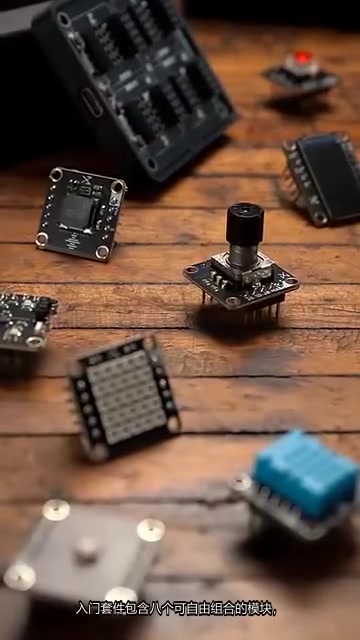
Two of the display-oriented components in the kit deserve special mention. NeoPixel is Adafruit's commercial name for the WS2812B series of addressable RGB LEDs — each LED has a built-in control chip and can be individually controlled for color and brightness via a single-wire serial protocol. Multiple LEDs can be chained together to create complex lighting animations, making them one of the most popular visual feedback components in maker projects. IPS (In-Plane Switching) displays offer wider viewing angles (close to 178°) and more accurate color reproduction compared to standard TN screens, and have become the quality standard for small embedded displays. Including both types of components in the starter kit shows that Axiometa has designed with "visual output" in mind — a dimension that's especially motivating for beginners.
The entire workflow is streamlined to its essence: no breadboard needed — just insert the required modules, write your code, upload, and you're done. The platform currently offers over 50 modules, with more on the way.
Axiometa's modular design doesn't exist in a vacuum — it builds on a mature ecosystem. As early as 2010, Seeed Studio's Grove system pioneered standardized 4-pin connectors, packaging sensors and actuators as plug-and-play modules. SparkFun's Qwiic (I2C-based 1mm JST connector) and Adafruit's STEMMA QT followed. The shared logic across these systems: eliminate uncertainty in hardware integration through standardized physical interfaces and communication protocols. Axiometa's differentiator is embedding module awareness directly into the AI model, achieving a new level of hardware-software synergy — the AI doesn't just know how to write code; it knows which module is in which slot. This "LEGO-style" hardware composition dramatically reduces the cost of hardware trial and error, letting creators focus on building functionality.
Genesis Studio: Driving AI Code Generation with Natural Language
What truly sets this product apart is the companion development environment, Genesis Studio, powered by Axi AI.

It fundamentally lowers the barrier to traditional embedded development: simply describe in natural language what you want to achieve, and the AI automatically generates the corresponding code. Crucially, this AI has complete knowledge of every Axiometa module — including pin definitions, interface specifications, and usage patterns — so the generated code can be flashed directly to the hardware without manually consulting datasheets or configuring pins.
Getting AI to understand a specific hardware platform and generate directly runnable code requires solving a "domain specialization" problem. General-purpose large language models (like the GPT series) are trained on large amounts of open-source Arduino and MicroPython code, giving them some embedded programming capability — but they often produce incorrect pin numbers or hallucinated library functions. Axi AI's approach resembles RAG (Retrieval-Augmented Generation) or fine-tuning: it injects all of Axiometa's module datasheets, pin mappings, and example code as authoritative knowledge, transforming "general code generation" into "verifiable hardware-specific code generation." This "closed-domain AI" strategy sacrifices generality in exchange for near-100% code accuracy within its specific context.
Once generated, code can be uploaded directly to the board from the browser. More importantly, the full code is always visible in the window: you can save it, edit it, modify variables, even deliberately break it — and at any point ask Axi to fix or optimize it. This "AI-generated + visible and editable code" model lowers the barrier to entry while still preserving room for deeper learning.
Vibe Coding: The Debate and the Nuance
"Vibe Coding" — using natural language intent to have AI generate code — has drawn considerable criticism lately. The core concern: users may have no understanding of the underlying principles, blindly copying and pasting AI output.
The term "Vibe Coding" was coined by OpenAI co-founder Andrej Karpathy in early 2025 on social media, describing a mode of programming where you "fully surrender to expressing intent, delegating all implementation to AI, without even reading the generated code." The concept quickly split the tech community: supporters see it as democratizing programming and enabling billions of non-programmers to build software; critics worry it produces "black box systems" — code that developers can't maintain, debug, or audit, creating hidden risks around security and reliability. The classic software engineering view holds that true programming understanding comes from wrestling with bugs — a process Vibe Coding bypasses entirely.
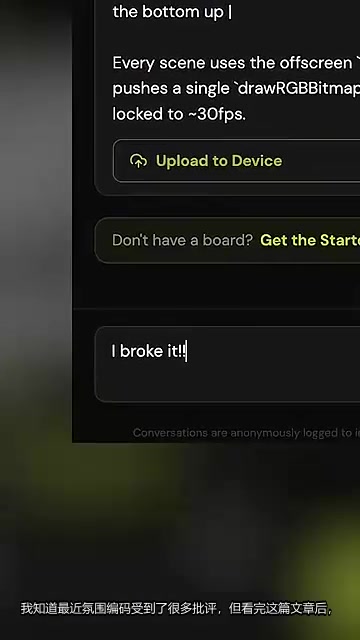
Interestingly, the reviewer was initially skeptical of Vibe Coding — but after experiencing the Genesis Mini, became "a firm convert." His reasoning is worth reflecting on:
It lets ordinary people validate an idea in seconds, and then go back and study the code to understand exactly how it works.
This is the product's unique educational insight. The Genesis Mini's approach tries to walk a middle path: AI doesn't replace learning — it removes the first barrier between idea and working prototype, letting beginners experience the satisfaction of success before working backwards to understand the principles. The "get it running first, understand why later" learning path is actually more intuitive for many people.
Learning Value: Not Just for Beginners
The reviewer mentioned making a Flappy Bird game in five minutes. But he admitted that the more interesting challenge was implementing simple things — like making a lit button fade in and out when toggled.
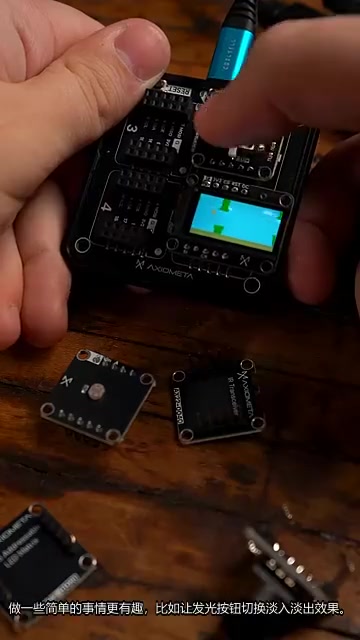
His observation is insightful: even for developers with existing experience, watching how AI implements the same functionality in different ways is itself a form of learning. This means the Genesis Mini isn't just for complete beginners — it also offers value to experienced developers as a sandbox for quickly comparing different implementation approaches.
Pricing and Availability
The reviewer's conclusion is direct: "At $35, I can't imagine a better learning experience." He called it "one of the most impressive products I've seen in a long time."
The first batch of Genesis Mini starter kits is now available on the HackMakeMod website.
Democratizing Hardware Development: A New Trend in the AI Era
The significance of the Genesis Mini may go beyond being a great ESP32 development board. It represents a clear trend: AI is turning embedded hardware development — once a high-barrier discipline — into a creative tool accessible to everyone.
Modular design eliminates the complexity of hardware wiring. AI code generation lowers the barrier to software programming. Visible, editable code preserves the path to deeper learning. Together, these three elements turn "have an idea, build it" from a slogan into reality.
Of course, the debate around Vibe Coding won't disappear — the risk of over-relying on AI without genuine understanding is always present. But the Genesis Mini offers a valuable model: AI should be an accelerator for learning, not a substitute for understanding. For anyone looking to get into electronics and embedded development, products like this have unquestionably removed that most intimidating first hurdle.
Key Takeaways
Related articles

The Truth Behind Codex 'Build a Website in 5 Minutes': AI Isn't Creating Sites—It's Helping You Copy Them
Exposing the truth behind viral Codex 5-minute website videos: creators aren't building original sites with AI—they're copying shared prompts or scraping others' work. Learn AI coding tools' real limits.

Getting Started with AI Agent Development: A Complete Guide from Concept to Practice
A comprehensive guide to AI Agent architecture and development, covering automated marketing, intelligent customer service, and investment analysis scenarios with single and multi-agent collaboration.

The Truth Behind Codex 'Build a Website in 5 Minutes': AI Isn't Creating Sites — It's Helping You Copy Them
Exposing the truth behind viral Codex 5-minute website videos: creators aren't building original sites with AI — they're copying shared prompts or scraping others' work.