AI-Generated Cosmic Monologue: Why Is This Light-Speed Voiceover Taking Over Bilibili?

An AI-generated cosmic monologue uses the "slowness" of light speed to create a cognitive gap, triggering a shift in light popular science creation.
The article analyzes a Bilibili short video labeled as generated by DeepSeek-V4.1-Flash-1017, whose voiceover in second person narrates the time it takes light to reach Earth from the Sun, Mars, Jupiter, and Voyager 1, presenting the speed of light as both the cosmic speed limit and the time scale through which humans perceive the universe. The author points out that the core technique of this script is to use the "slowness" of light speed on interstellar scales to create a cognitive gap, with dense short sentences and a steady rhythm, but lacking a truly unexpected turn. Multimodal generation can already strictly align script rhythm with subtitle visuals, greatly lowering the barrier to making light popular science videos; middle-layer accounts that rely on information gaps and templated editing will be the first to come under pressure, while topic-selection vision, fact-checking, and personalized narrative become scarcer abilities.
A short video labeled "DeepSeek-V4.1-Flash-1017 actual generation test" has appeared on Bilibili, with a voiceover that weaves the speed of light and cosmic distances into a monologue from a second-person perspective. No flashy effects, no complex editing—just the interplay of text and imagery—yet it left many viewers in the comments saying "after watching this, I want to look up at the sky."
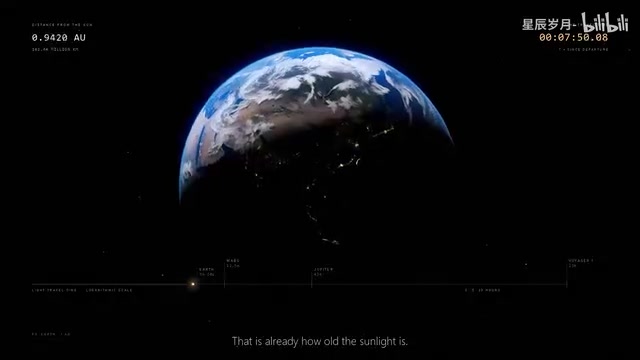
The voiceover begins with the 8 minutes 20 seconds it takes sunlight to reach Earth, then advances to Mars at 12 and a half minutes, Jupiter at 43 minutes, Voyager 1 at 23 hours, and finally lands on the light of stars that "set out before you were born." The speed of light is both the cosmic speed limit and the time scale through which humans perceive the universe. When the voiceover says "the sky is not a place, it is an archive," it translates astronomical common knowledge into an image that ordinary people can directly feel.
Why "Slow" Rather Than "Fast"
Human intuition about speed usually comes from ground-level experience: high-speed rail is fast, airplanes are faster. But this voiceover does the opposite, using the "slowness" of light speed to create a cognitive gap. The speed of light is about 300,000 kilometers per second, yet on a cosmic scale it is frustratingly slow—sunlight takes over 8 minutes to reach Earth, light from Jupiter takes 43 minutes, and signals from Voyager 1 must fly for 23 hours before we can receive them.
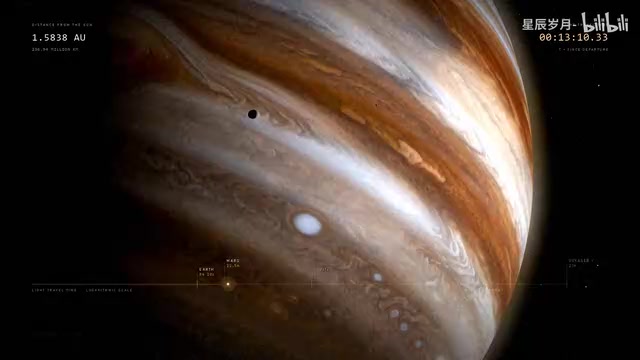
The voiceover repeatedly emphasizes "nothing is faster than this, and nothing is slower than this," which in effect packs two frames of reference into a single sentence: physically, the speed of light cannot be exceeded; experientially, the speed of light is negligible in the face of interstellar distances. This tension is the skeleton of the entire script. It does not pile up data but instead makes every number correspond to a perceptible scenario—such as the Mars communication delay that is "close enough to argue with," or Voyager 1, "launched in 1977, with its light still catching up."
The exact value of the speed of light is 299,792,458 meters per second, usually approximated as 300,000 kilometers per second. In physics, this number does not just mean "very fast"; it is also a fundamental constant of special relativity: no object with rest mass can reach or exceed it, and the upper limit for information transfer is locked by it as well. For this reason, the speed of light plays two roles at once—it is both the limit of speed and a conversion factor for time. Astronomy has thus developed distance units such as "light-year," "light-minute," and "light-hour," folding time directly into spatial description. When we say a star is 100 light-years away, we mean that what we see is what it looked like 100 years ago. This property of "seeing the past" is the fundamental feature that distinguishes astronomical observation from other disciplines.
Voyager 1 was launched in 1977 and is currently more than 24 billion kilometers from Earth, making it the farthest human-made object. The radio signals between it and Earth travel at the speed of light, requiring about 22 to 23 hours one way (fluctuating with the distance between the two). This means commands sent from the ground take nearly a day to be received by the probe, and then nearly another day to confirm the result. This communication delay is not a technical malfunction but a hard constraint of cosmic scale, and it is also the real-world source of the "light still catching up" image in the voiceover.
AI Writing Cosmic Voiceovers: Strengths and Weaknesses
From a textual structure perspective, this voiceover shows clear signs of AI generation: predominantly short sentences, even rhythm, dense imagery, and heavy reliance on "you" as the narrative anchor. The advantage is controllable information density and stable emotional progression, without the digressions or excessive sentimentality common among human writers. The downside lies in the same place—every sentence is "correct," but it lacks a truly unexpected turn.
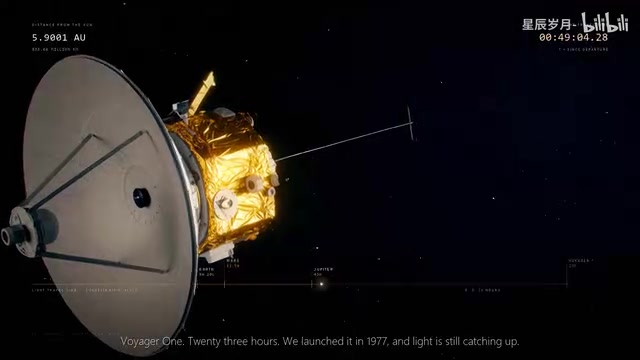
For example, the closing line "the sky is not a place, it is an archive" is beautifully crafted, but it is a safe and tidy metaphor that would not go wrong in any piece of popular astronomy writing, and it is hard to make people remember a specific expression that belongs only to this author. This points to a more practical question: when AI can consistently produce "above-average" voiceovers, a creator's competitiveness will shift from "being able to write" to "choosing accurately"—where to pause, which number to hammer with, and on which frame to leave the audience's emotions.
Large language model text generation relies on statistical learning from massive corpora and tends to produce high-probability, low-risk expressions. This explains why AI voiceovers often have "every sentence correct": it is imitating the average style of a large body of popular science texts—grammatically safe, with common imagery and coherent logic—but it rarely actively chooses low-probability phrasing with personal preference. The short-sentence plus second-person style appears because such structures occur frequently in short-video script corpora and make it easy to control pacing and subtitle segmentation.
Multimodal generation refers to a model's ability to simultaneously process or generate different modalities such as text, images, and audio. In videos like this, the sentence length and pause positions of the script can be directly translated into the timing of subtitle appearances and the rhythm of visual cuts. In the past, this alignment required an editor to adjust frame by frame; now the model can plan it all at the generation stage. However, the precision of multimodal alignment still depends on prompts and later human screening, and end-to-end output is currently closer to a "first draft" than a "finished film"; aesthetic judgment and fact-checking still require humans to backstop it.
Multimodal Generation Is Eating Away at the "Middle Layer" of Light Popular Science
In the screenshots of this video, subtitle frames such as Jupiter, 23 hours, and And the stars? are strictly aligned with the voiceover, indicating that the generation process can already handle both script rhythm and visual beats at the same time. According to feedback in the video's Bilibili comment section, the two words viewers mention most often are "goosebumps" and "I want to learn astronomy," which shows that the emotional entry point of light popular science content is being mass-produced by AI.
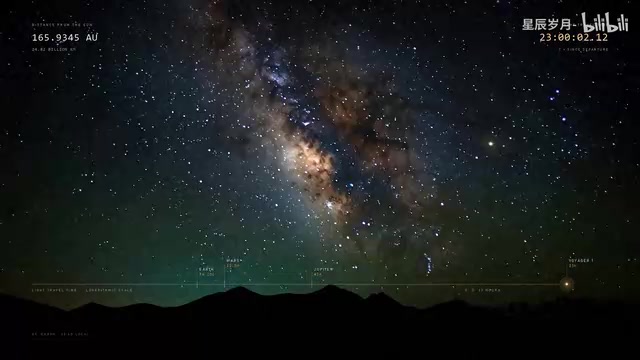
In the past, making a video like this required at least four stages: writer, voiceover, subtitles, and music; now a model can spit out scripts and storyboard prompts end to end, with humans only making aesthetic judgments. This does not mean popular science creators will disappear, but rather that the middle layer—accounts that make a living from information gaps and templated editing—will be the first to feel the pressure. What becomes truly scarce will be topic-selection vision, fact-checking ability, and a personalized narrative voice.
Returning to the voiceover itself, what is most noteworthy is not that "AI writes like a human," but that it chose an angle human authors easily overlook: writing the speed of light as a kind of delay, and the starry sky as a late-arriving message. This angle is not new, but having AI tell it with a steady rhythm, and tell it without breaking immersion, is itself a reusable content experiment. Next time you scroll past a similar cosmic monologue, you might first check whether, beyond being "correct," it leaves behind an error or surprise that makes you stop.
Related articles

Gemini 4 Argon Hands-On: AI Builds Board Games, Constructs Temples, and Trains Robots Autonomously
Gemini 4 Argon hands-on roundup: AI autonomously builds a desk racetrack and temple in Blender, writes a ray tracing engine, trains a humanoid robot to sink 7 shots, plus API pricing and developer access.

The Magic Octagonal Coin: Why Only 9% of People Can Predict Its Flip?
Only 9% of people can correctly predict the Magic Octagon coin flip. This article explains its spatial rotation mechanism, common cognitive pitfalls, and a new hypothesis based on Relevance Theory, exploring the limits of human spatial reasoning.

Sam Altman: AI Is Entering the Era of Scientific Discovery — Math Breakthroughs Will Replicate in Biology and Energy
Sam Altman says AI is entering the era of scientific discovery — math breakthroughs will replicate in biology, materials science, and energy to help develop new drugs and energy sources.