AI Giants Race to Cut Prices: Seedance 2.5 Halves Costs, GPT-6 and Opus 5.5 Launch Same Day

ByteDance, OpenAI, and Anthropic cut prices simultaneously as Chinese open-source models squeeze AI incumbents.
The AI industry is seeing a wave of simultaneous price cuts: ByteDance's Seedance 2.5 introduces a draft mode that reduces video generation costs by 30–77%; OpenAI's GPT-6.0 and Luna use improved cache hit rates to price roughly 50% below GPT-5.6; and Anthropic's Opus 5.5 delivers 30% faster output with 40% lower Agent task costs. All three moves are seen as a direct response to Chinese open-source models closing the capability gap and compressing closed-source pricing power, with the competitive dividends flowing to end users.
AI Giants Race to Cut Prices: Seedance 2.5 Halves Costs, GPT-6 and Opus 5.5 Launch Same Day
The AI industry is entering a clear price competition cycle. ByteDance's Seedance 2.5 has introduced a new mode that dramatically lowers iteration costs, while OpenAI and Anthropic each updated their flagship models on nearly the same day — both leading with "faster and cheaper" as their core pitch. According to a roundup by Bilibili AI channel EVER AI, the wave of price cuts is being driven by continued pressure from Chinese open-source models squeezing the pricing power of overseas incumbents.
Seedance 2.5: How "Draft Mode" Cuts Costs in Half
Video generation models have a persistent pain point in practice — blind generation. Users often need to regenerate clips repeatedly before landing on a satisfying result, and every high-resolution render burns compute and money. The cost of trial and error stays stubbornly high.
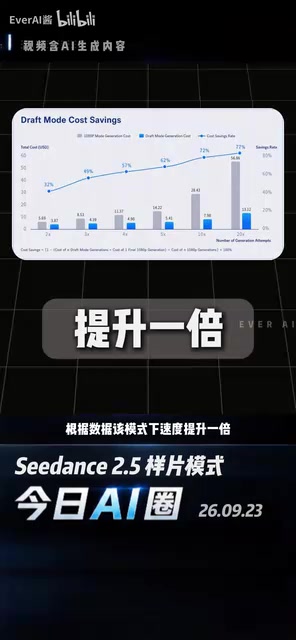
The "draft mode" ByteDance introduced for Seedance 2.5 targets exactly this bottleneck. The logic is straightforward: first shoot a quick 480p low-resolution preview to check composition, movement, and overall feel — then commit to a full 1080p render once you're satisfied. This "draft first, finalize later" workflow is especially valuable for complex shots that are hard to get right on the first try.

According to published figures, the mode doubles generation speed and cuts costs by anywhere from 30% to 77%. The wide range reflects how tightly the savings are tied to shot complexity and how many iterations are needed — the more a shot requires back-and-forth adjustments, the more dramatically the low-resolution preview pays off.
OpenAI's Dual Model Update: GPT-6.0 and Luna Lead with Value
On the same day, OpenAI pushed updates to two models at once — GPT-6.0 and Luna. According to EVER AI, both models use a training approach similar to Astra, making them incremental capability upgrades — but that comes paired with faster response times and more competitive pricing.
A key technical highlight of this update is improved cache hit rates. A higher cache hit rate means the model can reuse previously computed results when processing repeated or similar content, consuming fewer tokens in the process. For developers and enterprise users making high-frequency API calls, token consumption maps directly to cost — so the gains from cache optimization compound significantly at scale.
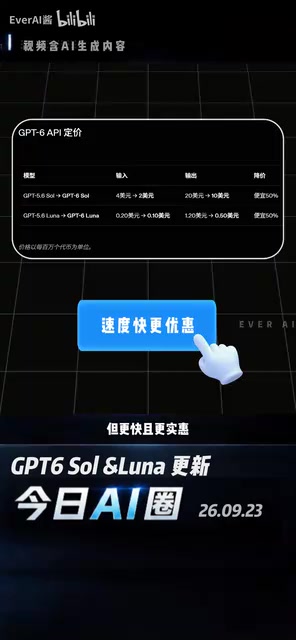
All told, the new models are priced roughly 50% lower than GPT-5.6. This "marginal capability gain, dramatic price cut" strategy reflects OpenAI's calculated trade-off in the current competitive environment — rather than chasing a leap in raw capability, the priority is locking in user stickiness through cost efficiency.
A note on cache hit rates: Cache Hit Rate is a critical metric in API cost optimization. When a request's input prefix closely overlaps with a prior request, the system can reuse the already-computed KV cache (Key-Value Cache) and skip redundant attention calculations. Platforms like OpenAI and Anthropic typically charge a fraction of the normal price for cache-hit tokens — sometimes as low as 10–25% of standard rates. For enterprise applications with long system prompts and highly similar per-call content, lifting the cache hit rate from 50% to 80% can reduce actual billing costs by more than any headline price cut alone. "Higher cache hit rates" is therefore both a genuine engineering improvement and OpenAI's primary cost-benefit message to heavy API users.
Anthropic Strikes Back: Opus 5.5 Is Faster and Cheaper
Anthropicrolled out Opus 5.5 in the same time window. According to the EVER AI summary, Opus 5.5 performs comparably to Fable 5.1 on most tasks — a modest but steady step up.
The real story, again, is efficiency: Opus 5.5 generates output roughly 30% faster than Opus 5.0, and cuts costs on Agent tasks by 40% compared to Opus 5.0. Agent tasks typically involve multi-step reasoning and extensive tool calls, meaning token consumption is enormous and cost sensitivity is extreme. Anthropic's focus on optimizing this specific scenario clearly targets the rapidly growing AI Agent application market.
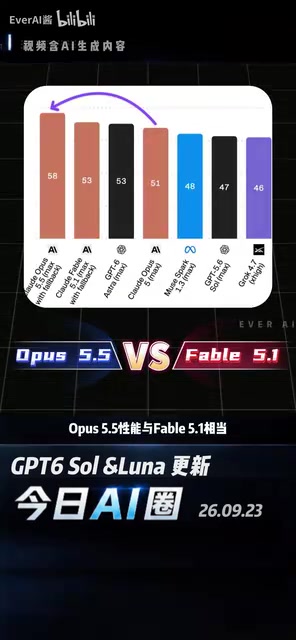
From the community-generated samples, maintaining quality while improving efficiency is clearly the defining direction for flagship model iteration right now.
Why Agent tasks are so expensive: Agent workflows are fundamentally different from single-turn Q&A. An agent must autonomously plan multiple subtasks, repeatedly call external tools (search, code execution, database queries, etc.), and re-inject the full conversation history as context with every model call — causing context length to accumulate continuously as the task progresses, with token consumption growing non-linearly. A complex agent task can involve dozens of model calls, with total token usage easily exceeding a hundred times that of a single conversation. This is why Agent scenarios are so cost-sensitive — a 40% cost reduction translates to enormous economic gains at scale, and why model providers are calling out Agent cost optimization as a headline metric in their own right.
Behind the Price War: The Pressure from Chinese Open-Source Models
Three major players rolling out "cheaper and faster" updates in the same time window is hard to call a coincidence. EVER AI's read: Chinese open-source models have been pushing hard, forcing overseas closed-source providers into a price war.
That interpretation holds up. When open-source models keep narrowing the capability gap with closed-source products — while inherently carrying a structural cost advantage — the pricing headroom for closed-source providers gets continuously compressed. To retain cost-sensitive SMB developers and enterprise customers, the major players have no choice but to drive down per-call costs through training optimizations, caching improvements, and similar technical levers, passing those savings on to users.
For users, this is unambiguously good news — whether it's Seedance 2.5 for video generation or GPT-6.0 and Opus 5.5 for text and Agent use cases, all are evolving toward "doing more with less." The essence of a price war is the transfer of competitive dividends to the end user.
A caveat: the model names, version numbers, and specific figures cited above all originate from a single secondary source. Some product names (Luna, Fable, Astra, etc.) should be verified against official announcements. Readers are encouraged to consult primary sources before making any product decisions.
How Chinese open-source models undercut closed-source pricing: Models like DeepSeekAd and Qwen are released under permissive licenses such as MIT or Apache, allowing any company to deploy them on their own servers and compress marginal per-call costs to near zero. This fundamentally disrupts the pricing logic of closed-source API providers — when enterprises can self-host a comparably capable open-source model at minimal hardware cost, the premium commanded by closed-source APIs shrinks dramatically. Overseas providers face a stark choice: hold prices and accept customer churn, or use technical optimization (caching, distillation, quantized inference, etc.) to cut costs and lower prices to defend market share. The current wave of coordinated price cuts is exactly the latter strategy playing out.
Related articles

OpenAI Partners with Shield: How the Astra Agent Revolutionizes IT Troubleshooting
OpenAI and Shield launch the Astra agent, which autonomously logs into computers and legacy systems to fix IT issues in real time, 35-40% faster than traditional models, with humans involved only when judgment is needed.

iPhone Duo Battery Life Tested: One Charge a Day Is Unavoidable, and the Large Screen Is the Culprit
iPhone Duo battery test: heavy use needs at least one charge a day, and about 30% remains after 6.5 hours of screen-on time. How often the large screen is unfolded is key; a MagSafe battery pack helps, and long-term degradation is also worth watching.

Kimi K3.1 Pro Open-Sourced: 2.8 Trillion Parameters Close In on Opus
Moonshot releases the open-source MoE model Kimi K3.1 Pro, with 2.8T total parameters and 104B activated, trailing Opus 5.5 by under 1 point on Terminal Bench 4.0.