AI Industry Roundup: Mistral Large's New Model and Anthropic's Free Claude Team for Startups

Mistral, Anthropic, OpenAI, and Google DeepMind release new models and ecosystem tools in a dense AI industry update.
This roundup covers several major AI developments. Mistral's new Large model targets cybersecurity vulnerability detection (82% score) but trails Anthropic's Opus 5.5 on general benchmarks. Anthropic expanded its startup support program and upgraded its cybersecurity verification tiers. OpenAI is rolling out invisible text watermarking (TagScreen) for EU users to comply with the AI Act, though detection rates drop significantly under synonym substitution. Google DeepMind released Embedding Gemma 2, a 740M-parameter multimodal embedding model supporting unified search across text, images, audio, and video under Apache 2.0. Liquid AI and Reflection AI introduced an edge device decision model and an open-weight MoE model respectively, while Together AI launched a CLI tool to swap open-source models into Claude Code workflows.
The AI industry has seen a wave of rapid updates recently — from Mistral's next-generation large model and Google DeepMind's multimodal embedding model, to Anthropic's free offering for startups. Companies are simultaneously pushing on model capabilities and ecosystem building. Here's a breakdown of the key developments worth following.
Mistral Large's New Model Targets Cybersecurity
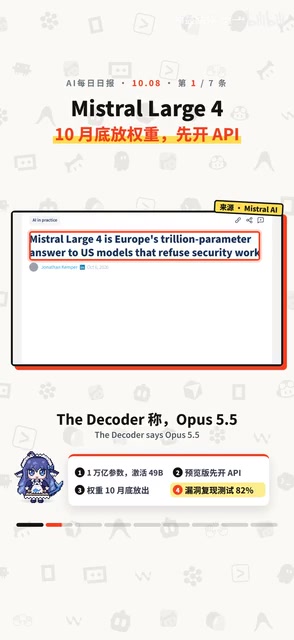
French AI company Mistral has released a new generation of its Large model, now available in public preview and accessible via API. The model was trained in Mistral's European data centers using 3,800 NVIDIA Grace Blackwell chips. Model weights and licensing details won't be released until the end of the month.
The headline selling point is cybersecurity capability. According to Mistral, the model scored 82% on a benchmark for discovering open-source software vulnerabilities. As The Decoder reports, Opus 5.5 and GPT-6 Astra scored near zero on that same test — not because they failed, but because they refused to perform the task at all. On the overall index, however, Mistral Large scores 38 compared to Opus 5.5's 58.
In short, being good at finding vulnerabilities doesn't mean being the best overall. A high score on a single dimension reflects the model's willingness to engage with security tasks, not its general capability. Until the weights are officially released, these numbers should be taken with some caution.

Anthropic's Two Big Moves: Free Claude Team and a Cybersecurity Program
Anthropic's latest push focuses on two areas: ecosystem expansion and opening up access for security professionals.
Startups Can Use Claude Team Free for a Year
Anthropic has expanded its Claude for Startups program, offering eligible startups a free one-year Claude Team plan with up to 5 seats, $1,000 in API credits, access to plugin development via Claude Market Payways, and online Q&A sessions with the AI team.
The eligibility bar is low — you only need to meet one of two conditions: the company was founded less than 5 years ago, or it has received funding in the past two years. No regional restrictions are mentioned in the original announcement. Applications are available through the Claude for Startups program page.
Anthropic's logic is straightforward: most people will benefit from AI indirectly through products built on top of its models. The free period lasts only one year, so the key is figuring out what you want to build with it before you apply.
Cybersecurity Verification Program Upgraded
Anthropic has merged Project Glasswing and its existing verification program into a unified Cyber Verification Program, opening it to a broader range of defensive security practitioners. Verified security professionals gain access to stronger cybersecurity capabilities, with the model's safety classifiers adjusted accordingly.
The new program has three tiers:
- Defender Tier: For incident response and malware analysis. Open to individual researchers and open-source maintainers, with responses within a few days.
- Red Team Tier: Adds authorized penetration testing. Institutional applicants only, with a review process taking several weeks.
- Special Access: For testing safety-critical systems such as aviation systems and power grids. Limited spots available.
The program covers Claude Opus 5.5, Sonnet 5.5, and future models. Vulnerability researchers should first confirm which tier they qualify for.
OpenAI Adds Invisible Watermarks to ChatGPT Text
OpenAI has announced that in the coming weeks it will begin watermarking text outputs for EU users across ChatGPT and Codex, in order to comply with the EU AI Act. API developers can opt in right now, regardless of region.
The technology is called TagScreen. It works by subtly adjusting the model's word choices during generation to leave a statistical pattern that's invisible to the human eye but detectable by automated tools. It's not foolproof: replacing roughly 10% of words with synonyms drops the detection rate from about 92% to 66%. Short texts, math answers, and translated content are even harder to detect reliably.
OpenAI has specifically noted that the absence of a watermark does not mean the content was written by a human. This means watermarks should be treated as a supporting signal — not a definitive source-attribution tool.

The core challenge of text watermarking lies in the tension between imperceptibility and robustness: the more hidden a watermark is, the more easily it breaks under light paraphrasing. TagScreen uses a vocabulary distribution shift approach — subtly biasing word selection probabilities during generation to create detectable statistical patterns — which is one of the leading methods in academic research today. Similar approaches include token-grouping "green list" methods like KGW watermarking. A shared weakness of these methods is their sensitivity to semantics-preserving edits (synonym substitution, round-trip translation), which scramble the original statistical patterns. As a result, text watermarking is currently better suited as a "probabilistic indicator" in content moderation rather than definitive evidence — which is the technical context behind OpenAI's explicit disclaimer. The EU AI Act's requirement that high-risk AI systems label their outputs has accelerated deployment of this capability across major AI providers.
New Developments in Multimodal AI and Edge Computing
Google DeepMind's Multimodal Embedding Model
Google DeepMind has released Embedding Gemma 2, an open multimodal embedding model with 740M parameters. It maps text, images, video, and audio into a shared vector space, making cross-modal search and similarity comparison straightforward.
The model outputs 768-dimensional vectors, with the option to truncate to 512, 256, or 128 dimensions to save storage. It supports a context length of 8,192 tokens and over 100 languages, is licensed under Apache 2.0, and was made publicly available on release day. For developers building local search or QA systems, the ability to search across all four media types in a unified way is the biggest practical win — and at 740M parameters, the model can run on everyday hardware like laptops and phones.
Embedding models differ fundamentally from generative models: instead of outputting text or images, they produce fixed-dimensional dense vectors ("embeddings") representing the semantic position of the input. Mapping different modalities (text, images, audio, video) to the same vector space means you can directly search for images using a text description, or match a piece of audio to related video — without needing to train separate conversion models for each modality pair. This capability is known as cross-modal retrieval. The 768-dimension default is a well-balanced choice between precision and storage cost; truncating to lower dimensions reduces index storage and retrieval computation, which is useful for resource-constrained environments. Apache 2.0 licensing allows commercial use and modification, making it highly attractive for developers who want to deploy locally. At 740M parameters (roughly 1.4GB in FP16), inference can run on consumer-grade GPUs and even some high-end mobile devices.
Liquid AI's On-Device Decision Model
Liquid AI has released a multimodal decision model targeting edge devices. Its goal is not to generate text, but to determine the next action based on visual input and context — targeting resource-constrained hardware like phones and robots. The company published speed and accuracy benchmarks alongside an open-source usage guide. The value of on-device models lies in eliminating network round-trips and enabling basic decision-making even when offline.
Reflection AI's Open-Weight Model
US startup Reflection AI has released its first open-weight model, Beam. It uses a Mixture of Experts (MoE) architecture, activates only a subset of parameters per forward pass, handles text only, supports a 1 million token context window, and was pretrained on 23.8 trillion tokens. The company claims it performs comparably to the GLM model family while requiring 3 to 4 times less inference compute. Reflection AI has raised approximately $4.7 billion from investors including NVIDIA and Sequoia. Worth noting: these performance claims are currently self-reported by the company, have not been independently verified, and the weights have not yet been released.
Mixture of Experts (MoE) is one of the leading architectural approaches for reducing inference costs in large models: the model holds a large number of parameters, but each forward pass activates only a small subset of "expert" sub-networks, while the rest remain dormant. This decouples total parameter count (which determines knowledge capacity) from per-inference compute (which determines running cost). Beam's claimed 3–4x inference compute savings come directly from this design: compared to a dense model of equivalent parameter size, MoE activates far less computation per step. Its 23.8T token pretraining dataset is at the high end of current models (GPT-4 is estimated at ~13T), and the 1 million token context window enables processing of extremely long documents. One practical caveat: MoE architectures have high memory bandwidth demands — all expert weights still need to be loaded into memory — which is a non-trivial hardware constraint for real-world deployment.
Developer Tooling: Running Open-Source Models Behind Claude Code
Together AI has launched Together Link, a free, MIT-licensed CLI tool currently in beta. It connects with Claude Code, Codex, OpenCode, and the Claude and ChatGPT desktop apps.
Within Claude Code, it can swap the Opus tier for Kimi and other tiers for GLM. The default Auto routing mode sends simpler requests to Together's models and forwards complex tasks to Claude Opus — provided you've connected your own Anthropic API key.
Note that the tool is free, but the models are not — you pay Together's standard pricing for model usage. Currently only macOS and Linux are supported, and you'll need a Together account API key. Whether this actually saves you money depends on your specific usage patterns.

Microsoft and NVIDIA Bring Agents to Windows
NVIDIA and Microsoft have announced a collaboration to run AI agents more deeply on Windows PCs, with NVIDIA also previewing the DGX Station for Windows aimed at enterprise desktops. The direction is clear: letting agents directly invoke software and compute resources on Windows. This is more than just a new workstation — it marks the beginning of local models and desktop operations converging, laying the groundwork for on-device AI agents.
Summary
Several clear trends are emerging from this wave of updates: model capabilities are shifting from general-purpose to domain-specific (as seen with Mistral's security focus); ecosystem competition is extending into developer tooling and startup support (Anthropic and Together AI); and multimodal embedding models along with on-device decision models are pushing AI toward local hardware. For developers, new models without publicly released weights and unverified performance claims still warrant careful skepticism.
Related articles

OpenAI Partners with Shield: How the Astra Agent Revolutionizes IT Troubleshooting
OpenAI and Shield launch the Astra agent, which autonomously logs into computers and legacy systems to fix IT issues in real time, 35-40% faster than traditional models, with humans involved only when judgment is needed.

iPhone Duo Battery Life Tested: One Charge a Day Is Unavoidable, and the Large Screen Is the Culprit
iPhone Duo battery test: heavy use needs at least one charge a day, and about 30% remains after 6.5 hours of screen-on time. How often the large screen is unfolded is key; a MagSafe battery pack helps, and long-term degradation is also worth watching.

Kimi K3.1 Pro Open-Sourced: 2.8 Trillion Parameters Close In on Opus
Moonshot releases the open-source MoE model Kimi K3.1 Pro, with 2.8T total parameters and 104B activated, trailing Opus 5.5 by under 1 point on Terminal Bench 4.0.