AI Large Language Model Learning Path for Beginners: A Four-Stage System from Fundamentals to Employment

A 748-episode Bilibili LLM course maps out a 4-stage path from API basics to employment-ready skills.
A 748-episode Bilibili course on AI large models outlines a four-stage learning path — Foundations, Advanced, Practical, and Employment — that reflects the mainstream approach to LLM application development. It covers API calls and prompt engineering, advances into RAG knowledge bases and Agent workflows, reinforces skills through real-world projects like enterprise Q&A and intelligent customer service, and concludes with résumé and interview guidance. The framework is well-structured and useful as a reference scaffold for beginners, though learners should treat claims like "seven-day mastery" with skepticism — real skills come from hands-on coding and project work.
What a Zero-to-Hired AI LLM Course Actually Covers
A Bilibili course series billing itself as "the most comprehensive AI large model tutorial for beginners" has been making waves lately — 748 episodes in total, covering the full journey from introduction to job-ready. Setting aside the marketing hype, the knowledge structure behind this course is actually quite representative. It outlines a typical learning path for LLM application development today, and it's worth using as a reference if you're just getting started.
The creator mentioned that putting this series together involved watching nearly every related course on Bilibili, and even consulting international instructors on YouTube. The conclusion? Over 85% of AI tutorial videos are inconsistent in quality, and very few actually walk learners through the code step by step while explaining why each line is written the way it is. That's a subjective take, but it does highlight a real pain point in the current AI tutorial landscape — lots of concept stacking, not enough hands-on demonstration.
The Four-Stage Learning System: Foundations, Advanced, Practical, and Employment
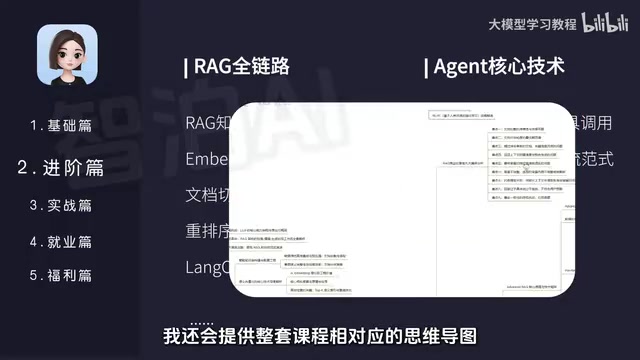
The course breaks the entire learning journey into four stages — and this structure itself serves as a useful learning roadmap.

Stage 1 — Foundations: Environment Setup and Core Concepts
The foundations stage begins with setting up a development environment, registering and configuring LLM APIs, and making your first API calls. From there, it moves into core concepts: prompt engineering, multi-turn conversations, structured output, and Function Calling. This is a well-chosen through-line. For application developers, learning to call APIs, write effective prompts, get the model to return parsable structured data, and integrate external tools forms the bedrock of any LLM application. Starting with API calls rather than jumping straight into Transformer architecture is far more aligned with real-world application development.
Function Calling deserves a closer look — it's a critical mechanism in LLM application development. It lets developers pre-define a set of functions with names, parameters, and descriptions. When a user makes a request that requires external capabilities, the model doesn't fabricate an answer; instead, it returns a structured "call instruction" telling the program which function to execute and with what parameters. Once the program runs the function, it passes the result back to the model, which integrates it into a natural language response. Essentially, Function Calling gives the LLM "hands" to interact with the real world — checking live weather, querying databases, sending emails, or controlling a browser. It's also the foundational layer for building Agents: an Agent's multi-step planning capability depends entirely on the model being able to reliably call tools and interpret their outputs.
Stage 2 — Advanced: RAG Knowledge Bases and Agent Workflows
The advanced stage focuses on two of the hottest areas right now: RAG (Retrieval-Augmented Generation) knowledge bases and Agent workflows. The course covers how to build and use vector databases to design more stable, production-ready intelligent systems. These two areas form the core technical stack of enterprise-grade LLM applications — RAG addresses knowledge staleness and hallucinations, while Agents give the model task-planning and multi-step execution capabilities. Choosing these as the advanced-stage pillars shows the course designers have a solid read on what industry actually needs.
The core idea behind RAG is straightforward: before answering a user's question, the system first retrieves relevant document chunks from an external knowledge base, then feeds those chunks along with the question into the LLM, allowing the model to generate a response grounded in the retrieved context. The benefits are twofold: it compensates for the model's training data cutoff (the model's built-in knowledge has an expiration date), and by anchoring answers to verifiable documents, it significantly reduces the probability of the model hallucinating facts. Vector databases play a key role in the RAG pipeline — documents are split into chunks, converted into high-dimensional vectors, and stored. At query time, semantic similarity (not keyword matching) is used to quickly surface the most relevant content, enabling the model to handle large-scale private document collections that exceed its context window.
Agent workflows are an architectural paradigm that gives models the ability to actively plan and execute. Unlike single-turn Q&A, an Agent can decompose a complex task into multiple sub-steps, autonomously decide which tool to call at each step (e.g., search, code execution, database query), and adjust subsequent actions based on the results — all the way to completing the final goal. This loop of reasoning and acting is the core mechanism that upgrades LLMs from "answering questions" to "completing tasks."
Stage 3 — Practical: Real-World Project Walkthroughs
The practical stage covers several representative projects: enterprise knowledge base Q&A, intelligent customer service, data analysis assistants, and automation office Agents. These happen to be the most common LLM deployment scenarios in enterprise settings today. For learners, the ability to translate concepts into complete, working projects is the critical leap from "understanding the theory" to "being able to do the work."
Stage 4 — Employment: Résumés, Interviews, and Job Market Realities
The employment stage deserves a separate mention. It goes beyond technical content to cover how to package completed projects as résumé entries, break down frequently asked interview questions, and outline the actual requirements and salary ranges for roles like "LLM Application Development Engineer" and "Agent Engineer." For learners with employment as their goal, this combination of technical training and job-seeking guidance is genuinely more practical than pure technical instruction.
The Value and Limitations of This Kind of Course
Looking at the content framework, the roadmap design is sound: API fundamentals and environment setup → prompt engineering and Function Calling to build core skills → RAG and Agents for advanced knowledge → project work to consolidate → employment preparation to wrap up. This is broadly consistent with the mainstream learning sequence in LLM application development today.
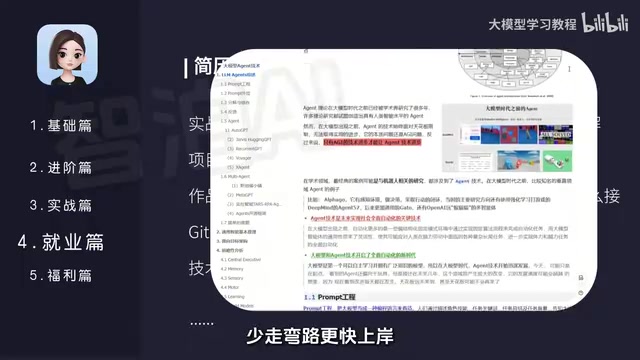
The creator also provides supplementary materials — a development environment starter pack, a study schedule, prompt templates, e-books, and course slides, available for free by leaving a comment. Tools like mind maps and structured study plans do genuinely help with systematic learning.
That said, claims like "748 episodes," "go from zero to expert in seven days," and "get hired as soon as you finish" deserve a healthy dose of skepticism. LLM technology moves fast — no course claiming to be "the most comprehensive" can escape the limits of its publication date. And "seven-day mastery" is mostly marketing copy. Real application development skills are built through repeated iteration on actual projects. For learners, courses like this work best as scaffolding to build a knowledge framework — but genuine progress only comes from writing code, running projects end-to-end, and debugging errors yourself.
Practical Advice for Beginners
If you're preparing to enter LLM application development, consider using this four-stage framework as a reference roadmap: get comfortable with API calls and prompt engineering first, then work through RAG and Agents, and finally use one or two complete projects to connect all the dots. Rather than tracking how many episodes you've watched, focus on what you can build independently. In the AI era, the practical ability to ship and deliver is the kind of hard currency that actually belongs on a résumé — and that holds up under the pressure of a real interview.
Related articles

OpenAI Partners with Shield: How the Astra Agent Revolutionizes IT Troubleshooting
OpenAI and Shield launch the Astra agent, which autonomously logs into computers and legacy systems to fix IT issues in real time, 35-40% faster than traditional models, with humans involved only when judgment is needed.

iPhone Duo Battery Life Tested: One Charge a Day Is Unavoidable, and the Large Screen Is the Culprit
iPhone Duo battery test: heavy use needs at least one charge a day, and about 30% remains after 6.5 hours of screen-on time. How often the large screen is unfolded is key; a MagSafe battery pack helps, and long-term degradation is also worth watching.

Kimi K3.1 Pro Open-Sourced: 2.8 Trillion Parameters Close In on Opus
Moonshot releases the open-source MoE model Kimi K3.1 Pro, with 2.8T total parameters and 104B activated, trailing Opus 5.5 by under 1 point on Terminal Bench 4.0.