AI Large Language Model Learning Roadmap from Scratch: From Beginner to Enterprise-Level Practice

A complete zero-to-hero learning roadmap for AI large language models with practical milestones.
This article provides a structured learning roadmap for AI large language models, organized into three stages: fundamentals (Python, Transformer principles, Prompt Engineering), intermediate (RAG and Agent development with LangChain/LlamaIndex), and hands-on practice (private deployment, fine-tuning, enterprise knowledge base Q&A). It offers tailored advice for learners at different levels and emphasizes that completing a working project matters more than perfecting theory.
Why Can't You Build an AI Agent After Watching So Many Tutorials?
Many people are passionate about AI large language models (LLMs). They've installed a ton of tools and watched plenty of tutorials, but they're still stuck — unable to build a truly functional AI agent from scratch.
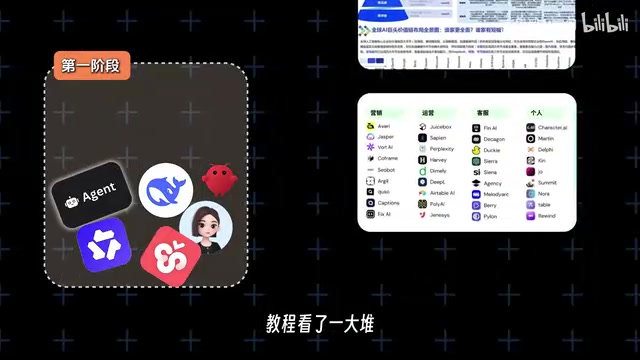
The root cause is actually simple: No one has given you a clear, end-to-end learning sequence. Fragmented knowledge can't form a coherent system. Learning a bit here and a bit there just means bouncing between isolated concepts without ever completing the full pipeline.
In today's LLM landscape, the question is no longer "can it be done" but "who can get the full pipeline running first." Once you truly master the complete chain from theory to deployment, whether it's landing an offer at a top tech company or achieving a personal skill breakthrough, you'll enter a powerful positive feedback loop.
Three Core Modules of a Systematic LLM Course
Recently, a highly popular systematic LLM course appeared on Bilibili, claiming 748 episodes covering everything from creating a new folder to enterprise-level deployment. Marketing hype aside, the course's three-stage structure is genuinely worth referencing — it represents a mainstream learning path for LLMs today.

Fundamentals: Understanding What LLMs Actually Are
The core goal of the fundamentals stage is to build a cognitive framework, covering three main areas:
-
Python Basics: The foundational language for LLM development. You don't need to master it, but you must be able to read code and write simple scripts. Python became the go-to language for AI development thanks to its rich machine learning ecosystem (PyTorch, TensorFlow, HuggingFace Transformers, etc.) and its clean syntax that lowers the barrier for people without a computer science background.
-
Core LLM Principles: Fundamental concepts like the Transformer architecture, attention mechanisms, and tokenization. The Transformer was a revolutionary architecture proposed by Google's team in the 2017 paper Attention Is All You Need. Through its Self-Attention mechanism, the model can attend to all other words in the input sequence simultaneously when processing each word, computing dot products of Query, Key, and Value matrices to determine the relevance weights between words. This parallel computation completely replaced the sequential processing of RNN/LSTM, dramatically improving training efficiency and laying the foundation for models like GPT and BERT. Tokenization is the first step in how LLMs process text — modern LLMs commonly use subword tokenization algorithms like BPE (Byte Pair Encoding) to split text into subword units that fall between individual characters and complete words. Understanding tokenization is crucial for controlling API call costs, optimizing prompt length, and understanding model context window limitations.
-
Prompt Engineering: How to communicate effectively with LLMs — this is the skill that generates practical value the fastest. Core prompt engineering techniques include role assignment, few-shot examples, Chain-of-Thought (CoT) reasoning, and more. It's essentially about guiding the model to produce better outputs through carefully designed inputs, without modifying the model's parameters.
For absolute beginners, the most important thing at this stage is not depth but quickly building a big-picture understanding. Many people get bogged down in mathematical formulas and paper details during the fundamentals stage, spending months without ever making an actual model call — a classic learning path mistake.
Intermediate: RAG and Agent Development Are the Core Battlegrounds
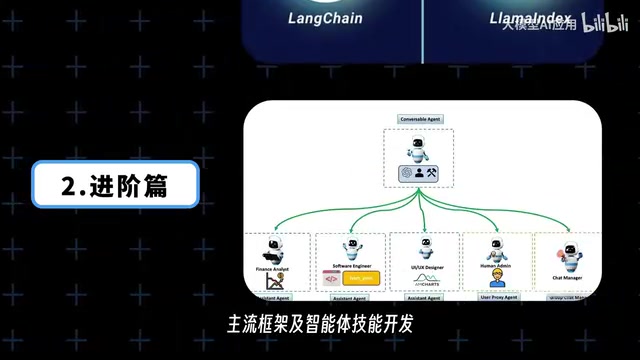
The intermediate stage focuses on the two core directions in LLM application development:
RAG (Retrieval-Augmented Generation) is currently the most widely adopted technology for enterprise deployment. In simple terms, it lets the LLM retrieve relevant information from your private knowledge base before generating an answer. This effectively addresses two major LLM pain points: "hallucination" and "outdated knowledge."
From a technical implementation perspective, a complete RAG pipeline involves several key steps: first, private documents are split into chunks (Chunking), then an Embedding Model converts these text chunks into high-dimensional vectors stored in a vector database (such as Pinecone, Milvus, Chroma, etc.). When a user asks a question, the system vectorizes the query in the same way, retrieves the most relevant document fragments using algorithms like cosine similarity, and finally injects these fragments as context into the Prompt for the LLM to generate the final answer. RAG's advantage is that it gives the model access to the latest knowledge without retraining, and it can explicitly cite sources, significantly reducing hallucination risk. This is why RAG is almost always the first choice when enterprises explore LLM deployment.
Agent (AI Agent) represents a higher form of LLM application. It can not only converse but also autonomously plan tasks, invoke tools, and execute actions. From simple automated workflows to complex multi-agent collaboration systems, agent development is one of the hottest technical directions today.
The core architecture of a modern AI Agent typically includes four modules: Perception (receiving user input and environmental information), Planning (decomposing complex tasks into subtask sequences), Tool Use (executing code, searching the web, calling APIs, etc.), and Memory (short-term working memory and long-term experience storage). A typical Agent framework like the ReAct (Reasoning + Acting) pattern has the LLM alternate between reasoning and acting, with each step deciding the next action based on the previous observation. Since 2024, multi-agent collaboration systems (such as AutoGen, CrewAI) have become a hot topic, where multiple agents with different roles and capabilities collaborate to complete complex tasks, simulating how human teams work.
At the framework level, the course covers the two mainstream development frameworks: LangChain and LlamaIndex. LangChain, created by Harrison Chase in late 2022, provides high-level abstractions like Chains, Agents, and Memory, excelling at orchestrating complex multi-step workflows with support for nearly all major LLMs and tool integrations — making it ideal for building complex Agent workflows. LlamaIndex (formerly GPT Index), created by Jerry Liu, initially focused on enabling LLMs to efficiently access private data, with more refined designs for data connectors, index structures, and query engines, offering a better out-of-the-box experience for RAG scenarios. The two are not mutually exclusive — many real-world projects use LlamaIndex for data indexing and LangChain for overall workflow orchestration. Gaining deep proficiency in at least one framework is a prerequisite for entering the hands-on stage.
Hands-On: Enterprise-Level Projects Are the Real Litmus Test
The hands-on stage includes several typical enterprise application scenarios:
-
Private Model Deployment: Deploying open-source LLMs on local or private cloud infrastructure to address data security and cost concerns. Current mainstream open-source models include Meta's LLaMA series, Alibaba's Qwen series, and Mistral AI's models. Deployment tools like vLLM, Ollama, and Text Generation Inference (TGI) have significantly lowered the deployment barrier. Model quantization techniques (such as GPTQ, AWQ, GGUF formats) can compress model size several times over with acceptable accuracy loss, making it possible to run LLMs on consumer-grade hardware.
-
Fine-tuning: Customizing models with domain-specific data to improve performance in vertical scenarios. Full-parameter fine-tuning requires enormous computational resources, so the industry has developed various Parameter-Efficient Fine-Tuning (PEFT) methods. The most popular is LoRA (Low-Rank Adaptation) — it freezes the original model weights and only trains a set of low-rank decomposition matrices as incremental updates, typically requiring only 0.1%-1% of the original model's parameters to achieve results close to full fine-tuning. QLoRA further quantizes the base model to 4-bit precision, making it possible to fine-tune billion-parameter models on a single consumer-grade GPU. Data quality matters far more than quantity — typically a few hundred to a few thousand high-quality instruction-response pairs can significantly improve model performance on specific tasks.
-
Enterprise Knowledge Base Q&A Systems: A classic RAG deployment scenario and the direction with the strongest enterprise demand. A production-grade knowledge base Q&A system needs to address document parsing (multi-format support for PDF, Word, web pages, etc.), intelligent chunking strategies, hybrid retrieval (vector search + keyword search), reranking, answer source tracing, and many other engineering details.
-
Intelligent Customer Service Systems: A comprehensive application combining dialogue management and business logic. It requires handling multi-turn dialogue state management, intent recognition, slot filling, business system integration, and more — a typical scenario for testing comprehensive engineering capabilities.
-
Agent Hands-On Projects: Building agents that can autonomously complete tasks, such as automated data analysis agents, code generation agents, research assistant agents, etc.
The value of these projects lies not only in the technical implementation itself but also in helping learners understand the complete engineering workflow from requirements analysis to architecture design to deployment.
Some Clear-Headed Thoughts on the LLM Learning Roadmap

While systematic courses like these provide a clear learning path, a few points deserve a rational perspective:
First, 748 episodes require a well-planned learning pace. "Master it in 7 days" is more marketing speak than reality. Systematically learning LLM development, even with 3-4 hours of daily investment, requires at least 2-3 months of sustained effort. Rushing actually makes it easier to give up halfway.
Second, balance the ratio of theory to practice on your own. For learners aiming to quickly get hands-on with application development, I recommend breezing through the fundamentals and dedicating most of your energy to the intermediate and hands-on sections covering RAG, Agents, and more. You can deepen your understanding of theory gradually through practice.
Third, don't just watch — build. LLM development is a highly practice-oriented field. After learning each concept, you should immediately implement it. Even if it's just calling an API or writing a simple RAG demo, the value of hands-on work far exceeds passive watching. Current mainstream LLMs (such as OpenAI, Claude, Qwen, etc.) all provide convenient API interfaces — a few lines of code can complete your first model call, and this instant feedback is crucial for maintaining learning motivation.
Fourth, pay attention to the speed of technological evolution. The LLM field iterates extremely fast — best practices from 2023 may already be outdated by 2024. For example, early RAG's simple vector retrieval approach is being supplemented or even replaced by more advanced solutions like GraphRAG and Agentic RAG. Staying current with cutting-edge developments and regularly updating your knowledge base is a mandatory practice for anyone working in this field.
Progression Advice for Learners at Different Levels
-
Complete Beginners: Spend 1-2 weeks on Python basics, then jump straight into Prompt Engineering for quick positive feedback. Start with API calls from OpenAI or domestic LLM providers to experience the thrill of "writing a few lines of code and having AI do things for you."
-
Those with Programming Experience: Skip the Python section and focus on RAG and Agent development frameworks, getting into project work as soon as possible. Start by building a simple document Q&A system with LangChain or LlamaIndex, then gradually increase complexity from there.
-
Those with Some AI Background: Focus on enterprise-level deployment and fine-tuning techniques, with attention to model optimization and production engineering capabilities. Dive deep into model quantization, inference acceleration, distributed deployment, and other key production technologies, as well as how to design reliable evaluation systems to measure model performance.
Regardless of which path you choose, the most critical point is: Get one complete project running end-to-end first, then optimize the details. In the fast-iterating world of AI LLMs, done is far more important than perfect. A working demo beats ten perfect architecture designs that only exist in your head.
Related articles

WebMCP in Practice: How MakeMyTrip Is Reshaping the Travel Booking Experience
India's largest OTA platform MakeMyTrip uses WebMCP to standardize AI Agent interactions with web apps, replacing fragile DOM scraping with natural language-driven test automation and simplified complex booking scenarios.

Deep Dive into the EYG Programming Language: A New Portable Programming Paradigm Designed for Humans
Deep analysis of the EYG programming language's core design, including algebraic effects, program state persistence, and cross-platform portability, exploring how it addresses modern software fragmentation.

WebMCP in Practice: How MakeMyTrip Is Reshaping the Travel Booking Experience
India's largest OTA platform MakeMyTrip uses WebMCP to standardize AI Agent interaction with web apps, solving DOM scraping fragility, enabling natural language test automation, and simplifying complex international flight bookings.