AI Large Model Development Learning Path: A Complete Guide from Zero to Enterprise Projects

A structured guide from AI basics to enterprise-level large model application development.
This guide maps out a complete learning path for AI large model development, starting from Transformer architecture and prompt engineering, progressing through RAG, LangChain, and Agent development, and culminating in model fine-tuning and private deployment. It emphasizes systematic learning over fragmented tutorials to help developers go from zero to independently building enterprise-grade AI applications.
Why Learning Large Models Requires a Systematic Path
Large model application development has become one of the hottest directions in the tech industry, yet learning resources remain overwhelmingly fragmented. Before creating a structured course, one content creator spent an entire month going through tutorials across every major platform and reached a clear conclusion: the content out there is "generally not systematic or comprehensive enough — most of it only covers the basics of individual tools, while the critical engineering and deployment workflows are barely touched."
This observation hits on the core problem with AI education today. High-traffic viral videos tend to focus on flashy surface-level operations, while the skills that actually determine whether a developer can ship real products — model fine-tuning, private deployment, Agent development — are rarely explained in depth. This article outlines a complete, structured learning path that takes you from zero to enterprise-level project development.

Foundation: Building Solid Conceptual Understanding
From Concepts to Architecture: Understand the Principles Before Picking Up Tools
The first step in learning large models isn't rushing to use tools — it's building a sound understanding of the underlying principles. A sensible entry path starts with core concepts around large models, walks through a complete application development workflow, and ultimately digs into the Transformer architecture.
Transformer is the backbone of modern large models. Introduced by Google in the 2017 paper Attention Is All You Need, it fundamentally transformed the field of natural language processing. Its key innovation was abandoning recurrent neural networks (RNNs), which had previously dominated the field, in favor of a pure attention-based approach to processing sequences. The Self-Attention mechanism allows the model to simultaneously consider the relevance of all other tokens in a sequence while processing each one, enabling it to capture long-range dependencies. Nearly every major large model today — GPT series, BERT, LLaMA — is built on the Transformer backbone. Understanding its core components, including the encoder-decoder structure, Multi-Head Attention, and Positional Encoding, helps you grasp model capabilities and make better technical decisions during fine-tuning and optimization. Many developers skip this step and go straight to calling APIs, only to find themselves completely lost when more complex problems arise.
Prompt Engineering: The Highest ROI Skill for Beginners
At the foundation stage, Prompt Engineering offers the best return on time invested. Techniques like Zero-shot and Few-shot prompting, along with Chain-of-Thought (CoT), can significantly improve output quality without touching any model parameters.
Chain-of-Thought is especially worth mastering. By guiding the model to "think step by step," it dramatically improves performance on reasoning tasks. The reason this works lies in the autoregressive generation mechanism of large models — output is directly influenced by preceding tokens, so explicit intermediate reasoning steps essentially give the model a form of "working memory," substantially reducing errors on complex reasoning tasks. With a solid command of these techniques, developers can adapt general-purpose large models to specific business scenarios at minimal cost.
Leveling Up: From API Calls to Independent Development
RAG and Mainstream Development Frameworks
Once the foundation is in place, the intermediate stage focuses on mastering the full engineering toolkit for large model development. RAG (Retrieval-Augmented Generation) is one of the most practically useful techniques in enterprise applications today. Proposed by Meta AI in 2020, RAG was designed to address two fundamental limitations of purely parametric language models: the knowledge cutoff date that limits timeliness, and hallucination — the phenomenon where a model generates plausible-sounding but factually incorrect information with high confidence.
The RAG workflow has three stages: first, external documents are chunked, vectorized, and stored in a vector database (such as Chroma, Pinecone, or Milvus); when a user submits a query, semantically similar text chunks are retrieved; finally, the retrieved content is injected into the Prompt as context, guiding the model to generate answers grounded in trusted sources. This architecture allows enterprises to combine their private knowledge bases with general-purpose large model capabilities — without retraining the model — making it one of the lowest-cost, most controllable enterprise AI solutions available.

At the framework level, LangChain and LangGraph have become the go-to choices for building complex applications. LangChain provides chain-based invocation, memory management, and tool integration, packaging the large amounts of glue code that would otherwise be written by hand into standardized modules. LangGraph goes further by supporting stateful, multi-step Agent workflow orchestration, using a directed graph structure to describe complex conditional branches and loops. Mastering these two frameworks is the key inflection point between "simple API calls" and "systematic application development."
Agent Development: The Cutting Edge
Agent development is currently the most frontier — and most imaginative — area of the field. Modern Agent frameworks, exemplified by the ReAct (Reasoning + Acting) paradigm, enable large models to alternate between "reasoning" and "acting" — thinking through what to do next, calling external tools (such as search engines, code interpreters, or database APIs), and then continuing to reason based on the results returned. Unlike passive conversational models, Agents can autonomously plan, invoke tools, and execute multi-step tasks.
Multi-Agent Systems go a step further by enabling multiple specialized Agents to collaborate, handling complex enterprise workflows through task decomposition and role assignment. This requires developers to deeply understand three core Agent modules — Planning, Memory, and Tool Use — along with mechanisms like task decomposition and state management.

Model Fine-Tuning and Private Deployment
The advanced content at the intermediate stage centers on model fine-tuning and local deployment. LoRA (Low-Rank Adaptation), introduced by Microsoft Research in 2021, is grounded in an important finding: weight update matrices during fine-tuning of pretrained models have "low intrinsic rank," meaning the full weight update can be approximated by the product of two low-dimensional matrices, drastically reducing the number of trainable parameters. With LLaMA-7B as an example, full fine-tuning requires updating 7 billion parameters, while LoRA typically achieves comparable results by training less than 1% of parameters — making it feasible to fine-tune billion-parameter models on consumer-grade GPUs like the RTX 4090. Building on LoRA, QLoRA further combines 4-bit quantization to reduce VRAM requirements even further. Full fine-tuning remains appropriate for scenarios demanding peak performance with ample resources.
On the deployment side, private on-premises deployment and high-concurrency inference optimization are the two central challenges for enterprise rollout. Industries with strict data security requirements — such as finance, healthcare, and government — often require private deployment to meet compliance standards, while services serving large user bases must address the balance between inference performance and cost through techniques like model quantization, KV Cache optimization, and batched inference. These are precisely the areas that trip up newcomers most and are hardest to piece together from scattered tutorials.
Enterprise Practice: Turning Skills into Real Value
Real-World Projects Ready for Deployment
The ultimate goal of technical learning is to solve real problems. The hands-on stage should revolve around genuine deployable projects — such as intelligent Q&A Agents, e-commerce smart customer service bots, enterprise-grade AI Agents, and intelligent teaching assistants.
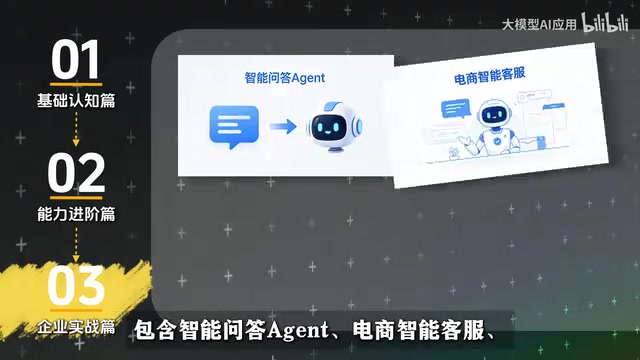
These projects cover the mainstream commercial use cases for large model applications. An e-commerce smart customer service system, for instance, exercises multiple skills simultaneously: RAG knowledge base construction, intent recognition, and multi-turn dialogue management. An enterprise-grade AI Agent often requires integration with internal systems and the use of multiple tools, serving as a comprehensive test of full-stack engineering ability. The real value of working through actual projects lies in exposing engineering details that courses can't teach — like how to balance recall and precision in vector retrieval, how to design error recovery mechanisms for Agents, and how to efficiently manage context windows across multi-turn conversations.
The Leap from Learner to Developer
Real capability shows when you can "use it right after learning it." By working through complete projects end to end, learners connect fragmented knowledge points into a cohesive skill set, making the leap from "calling an API" to "independently completing enterprise-level application development" — which is the core distinction between a hobbyist and a professional developer.
How to Choose Quality Learning Resources
Faced with a sea of AI tutorials, learners should be wary of fragmented content that only covers surface-level operations. A high-quality learning path should have three characteristics: deep integration of theory and hands-on practice, coverage of the full engineering and deployment workflow, and real, reproducible project examples.
For those starting from zero, strictly follow the progressive logic of "Foundation → Intermediate → Enterprise Practice" — don't skip the principles and jump straight to stacking tools. Only by understanding the underlying mechanisms — from Transformer attention computation, to vector retrieval principles in RAG, to the planning and reasoning paradigms of Agents — will you maintain the adaptive capacity needed to keep up with rapidly evolving AI technology. Large model technology is still advancing at high speed, but a solid, systematic foundation remains the most reliable weapon for navigating change.
Related articles

Network Doctor: An Open-Source Terminal Tool for Network Fault Diagnosis
Network Doctor is an open-source terminal network diagnostic tool that integrates ping, dig, curl, and traceroute, automatically detecting connectivity in stages and outputting fault conclusions in natural language.

LangChain Guardrails Explained: Building Safe and Controllable AI Agents
A detailed guide to LangChain Guardrails covering layered ecosystem architecture, middleware implementation, deterministic and model-driven protection for building production-grade secure AI Agents.

Deep Dive into Microsoft's AI Security Tools: Does Performance Really Surpass the Competition?
Microsoft launches enterprise AI security tools claiming superior performance. This deep analysis examines core capabilities, ecosystem advantages, and risks to guide enterprise security decisions.