AI Manga Drama Monetization Explained: Why Now Is the Golden Window to Enter

AI manga dramas offer low costs and high output potential — but sustainable production is the real moat.
A Bilibili creator shared how they produced an AI manga drama for 70 yuan in 10 hours and earned over 100,000 yuan in platform revenue-sharing on Hongguo — revealing three key signals of an early-adopter window: explosive market growth (AI manga dramas exceeded 90% of new micro-drama launches in Q1 2026), major platform subsidies for creators, and a mature technology that most people haven't yet mastered. Compared to live-action short dramas, AI manga dramas offer decisive advantages in cost (under 1,000 yuan per episode), speed (one episode per day), and accessibility (no filmmaking experience needed). Monetization paths include free-drama traffic-sharing, paid-unlock revenue splits, and copyright licensing or platform incentive programs. The article also cautions that low barriers will accelerate competition, single viral hits involve luck, and sustainable content output — not a one-time breakout — is what truly determines long-term success.
Someone spent 10 hours and 70 yuan to produce a manga drama that hit a million views — earning over 100,000 yuan in revenue-sharing on the Hongguo platform. This wasn't a lucky fluke. It's a snapshot of a new content category sitting squarely in its early-adopter sweet spot. The story, shared by a Bilibili creator, laid out the path from production to monetization with refreshing clarity. This article breaks down the core logic to help you decide whether this niche is worth entering.
Why This Is a Red Dividend Period
The creator offered three market signals — and the reasoning holds up.
Signal one: The market is exploding. According to their data, in Q1 2026, AI manga dramas accounted for over 90% of newly launched micro-dramas. Platform traffic is visibly tilting toward this category. When the supply side undergoes a structural shift in content format, it typically means demand and distribution mechanisms have already caught up.
Signal two: Platforms are spending real money. Douyin, Kuaishou, Bilibili, and Hongguo have all rolled out creator support programs — traffic-sharing, revenue splits, and copyright incentives going directly to creators. Platform subsidies are a reliable signal of a rising trend: when major players are willing to pour cash into acquiring content, it means they see long-term value in the category.
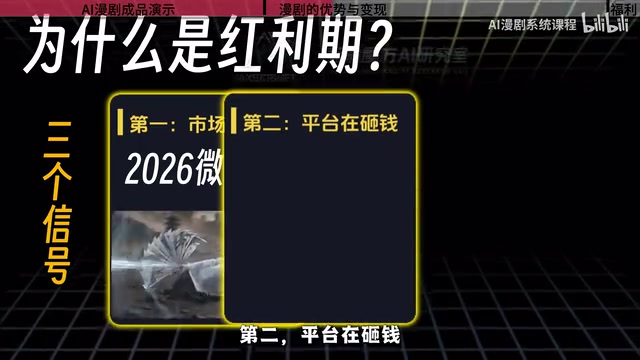
Signal three: Very few people know how to do this yet. The technology just matured, and most ordinary people haven't caught on. This is actually the defining characteristic of a red dividend period: the technical barrier has dropped to a level accessible to regular creators, but knowledge and execution haven't yet gone mainstream. Once the space fills up with similar content, the window closes.
The Core Advantage of AI Manga Dramas: A Structural Edge
The creator used the phrase "structural advantage" to describe how AI manga dramas compare to traditional live-action short dramas — breaking it down across three dimensions.
Cost: A single episode of a live-action short drama can cost hundreds of thousands of yuan. An AI manga drama episode comes in under 1,000 yuan — sometimes just a few dozen. Cut out actors, locations, and props, and labor costs drop by 90%. That cost differential fundamentally changes the economics of content production.

Speed: A traditional team might spend a month on one episode. An AI manga drama can be turned around in a day. One person with one computer can mass-produce content; a small team can consistently ship dozens of episodes a month. On content platforms, update frequency directly affects algorithmic recommendation weight — production capacity itself becomes a competitive moat.
Barrier to entry: No filmmaking experience required. AI tools handle the script, visuals, and voiceover. Mistakes are cheap to fix. The cost of experimentation is nearly zero, which means complete beginners have a real shot at running the full workflow.

That said, "production capacity is the moat" holds true early on — but as more creators flood in and AI-generated content becomes homogeneous, narrative quality and differentiation will likely become the real barriers. A low entry threshold is an opportunity, but it also means competition will escalate quickly.
The typical AI manga drama production pipeline covers four stages: script generation, storyboard/image generation, voice synthesis, and post-production editing. For scripts, large language models like ChatGPT and Claude can rapidly generate content based on proven narrative frameworks. For visuals, popular tools include Midjourney, Stable Diffusion, and ComfyUI workflows optimized for manga aesthetics — with character consistency control being the key technical factor affecting final output quality. For voiceovers, tools like ElevenLabs and Jianying's AI dubbing feature can produce reasonably natural multi-character audio. Final editing is typically done in Jianying or CapCut. The entire pipeline can run locally or in the cloud at low cost — which is how a "70-yuan production budget" becomes achievable. For newcomers, character consistency (keeping a character's appearance uniform across different frames) is the primary technical hurdle to overcome in the early stages.
Three Main Monetization Models
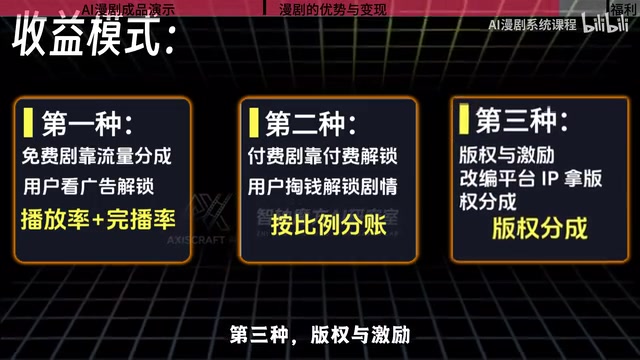
Revenue models tend to be what people care about most. The creator outlined three primary paths.
Free dramas via traffic-sharing: Users watch ads or unlock episodes; the platform pays creators based on view counts and completion rates. The more views, the more you earn. This is the lowest-barrier model and the most beginner-friendly starting point.
Paid dramas via unlock revenue: Users pay directly to unlock content, and creators receive a percentage of that revenue. The per-user value is higher, but it places greater demands on content appeal and paywall conversion design.
Copyright licensing and platform incentives: Adapting platform IP earns copyright revenue splits; participating in platform support programs unlocks additional bonuses. This path depends on deep platform collaboration and suits creators who already have consistent output and a track record.
According to the creator, a single breakout hit can return dozens or even hundreds of times the 70-yuan investment. But they're honest about one thing: earnings fluctuate, and the real money comes from the ability to produce consistently. This point is critical — a single viral hit involves luck. Whether you can build a stable content pipeline and maintain a regular release cadence is what determines how far this business can go.
How revenue-sharing actually works: Using Hongguo as an example, revenue for free dramas is calculated based on "qualified views" — meaning a user's watch time must exceed a certain threshold to count, not just a click. For paid dramas, revenue splits typically fall in the 30–50% range, with the platform retaining the remainder as a channel fee. Notably, episode completion rate is the core metric driving algorithmic recommendations. Even if total views are modest, a drama with consistent 60%+ completion rates per episode will continue receiving organic traffic pushes from the platform — which is why "hook storytelling" is repeatedly emphasized in manga drama creation. Settlement timelines and eligibility requirements vary significantly across platforms. Some require accounts to reach a minimum follower count or pass content review before revenue-sharing is activated. New creators should confirm onboarding requirements before choosing where to launch.
A Grounded Take on This Space
All things considered, AI manga dramas are genuinely sitting in a window where the technology is mature, platforms are subsidizing growth, and competition hasn't yet reached saturation. A few things are worth keeping in mind for anyone considering entering:
- Low costs and high output capacity are the biggest advantages right now — but that also means the barrier will be leveled quickly;
- The key to monetization isn't a single viral hit, but sustainable production ability;
- Platform support policies have a shelf life. The dividend period won't last forever.
For someone starting from zero, this is a real opportunity to test the waters in content creation at relatively low cost. But treating it as a shortcut to overnight wealth means overlooking the sustained effort and content craftsmanship that actually make it work. In any rising trend, the people who capture the most value tend to be the ones willing to commit for the long haul.
Related articles

A Single Prompt Triggers a Global PHP Security Storm: Is AI a Savior or a Hidden Risk?
A single AI prompt triggered a global PHP security crisis affecting Wikipedia and the Internet Archive. This article reviews the incident, analyzes the OpenAI-Amazon controversy, and explores the security paradox of lowered vulnerability discovery barriers in the AI era and developer response strategies.

When AI Is Taken Away: How Reliance on Shortcuts Undermines Your Problem-Solving Resilience
A study of 1,222 people found that after using AI to answer questions, once AI was removed, people gave up on more problems than a control group that never used AI. The article analyzes the impact of AI reliance on learning resilience and metacognition, and explores design implications for AI learning tools.

Carta and NewView Partner to Let Startup Employees Cash Out Equity Early
Carta and NewView Capital partner to simplify startup tender offers, helping employees sell equity early. Analysis of the mechanism, liquidity pain points, and impact.