AI News Roundup: Liquid Decision Models and Saluki 27B Local Deployment Guide

Open-weight decision models, a 7.89GB 27B model, Agent tools, and a 75% API price cut dominate this AI roundup.
This AI roundup covers four updates favorable to local deployment and cost control. Liquid AI released 3B and Omni 600M open-weight decision models with single-pass inference, scoring 82.9 on benchmarks. Saluki 27B uses IQ2 quantization to compress a 27B model to ~7.89GB with an 88-point tool-calling score, supporting llama.cpp and Docker under Apache 2.0. A composable, model-agnostic Agent skills library trended on GitHub under MIT license. Finally, Claude Haiku 5.5 launched with ~75% lower costs and a new tunable Effort parameter for balancing quality and speed.
This edition of the AI roundup focuses on newly released open-weight models and open-source tools, with one central question: can you run it locally? From Liquid AI's decision models to the ~7.89GB Saluki 27B, to Anthropic's price cuts, this wave of updates is especially developer-friendly for those focused on local deployment and cost sensitivity. Here's a breakdown of each.
Liquid AI Releases Open-Weight Decision Models
According to the Hugging Face blog, Liquid AI has released a new generation of open-weight decision models, including a ~3B parameter version and an Omni 600M version. These models are designed to output answers directly in a single forward pass, without relying on lengthy multi-step reasoning chains — making them well-suited for latency-sensitive decision-making scenarios.
In public benchmarks, the 3B version achieved an average score of 82.9. For a model at just 3B parameters, this is quite impressive, demonstrating solid all-around capability while remaining compact. The 600M Omni version further lowers the deployment barrier, making it worth exploring for resource-constrained edge or mobile environments.

Decision models have been gaining attention recently because they compress "reasoning" into a single forward pass, eliminating the overhead of repeated sampling and long chain-of-thought generation. For Agent systems that require fast response times, this design can significantly reduce both latency and inference costs.
Decision Models vs. Reasoning Models: Decision models and mainstream reasoning models (such as o1 or the DeepSeekAd-R1 series) differ fundamentally in architectural philosophy. Reasoning models improve accuracy by generating extensive intermediate steps (Chain-of-Thought), at the cost of a multiplicative increase in output tokens — and thus higher latency and cost. Decision models "internalize" reasoning into their weights: during training, they learn to map inputs directly to optimal outputs through large volumes of decision data, requiring only a single forward pass at inference time. This design excels in scenarios requiring millisecond-level responses, such as real-time game AI, high-frequency trading signal generation, and robotic motion control. The tradeoff is that the model's "reasoning process" is opaque and difficult to debug, and it typically underperforms same-scale reasoning models on tasks requiring multi-step logical deduction. Liquid AI was previously known for its proprietary LFM (Liquid Foundation Model) architecture — based on liquid neural network theory and distinct from Transformers — which is likely one reason it achieves competitive benchmark scores at small parameter counts.
Saluki 27B: A 27B Model Compressed to ~7.89GB
Conway Research has released the model card for Saluki 27B. The most striking feature is its quantization configuration — using IQ2 quantization to compress a 27B-parameter model down to approximately 7.89GB. This means a consumer-grade GPU, or even some integrated graphics setups, may be able to run a 27B-class model.
The model card notes a tool calling score of 88, indicating that its function-calling capabilities for Agent scenarios have been specifically optimized. It's licensed under Apache 2.0, making it commercially friendly and free for developers to integrate into their own products.
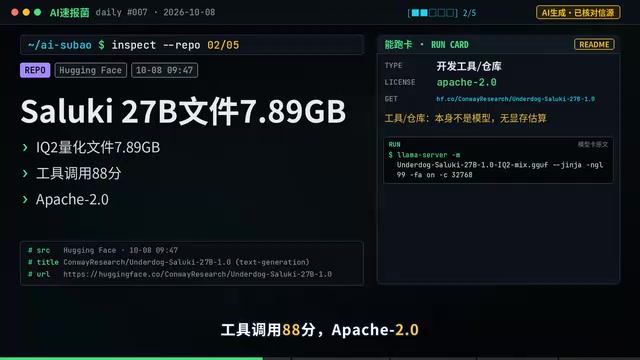
For deployment, Saluki 27B can be run locally on CPU or GPU via llama.cpp, and also supports Docker containerized deployment. While IQ2 quantization introduces some precision loss, for users looking to experience a large model on limited hardware, the balance between a 7.89GB file size and 27B parameter scale is well worth trying.
IQ Quantization Explained: IQ quantization is a non-uniform, importance-weighted quantization scheme introduced in the llama.cpp ecosystem — distinct from traditional uniform quantization methods like Q4 or Q8. Traditional quantization compresses all layer weights with equal precision reduction, while IQ quantization allocates different bit depths based on each weight's importance to the output: weights with greater impact on model output retain higher precision, while less important weights are compressed more aggressively. IQ2 means each weight uses an average of approximately 2 bits, making it one of the highest-compression tiers among mainstream quantization options — which is why a 27B model can be compressed to just under 8GB. By comparison, Q4 quantization of the same parameter count typically requires ~14–16GB, and Q8 requires ~28GB. Precision loss with IQ2 is more noticeable on knowledge-intensive tasks (such as factual Q&A) but is relatively contained on structured output and tool-calling tasks — which explains why Saluki 27B specifically highlights its tool-calling score as a key metric.
Open-Source Agent Tools and Skills Trend on GitHub
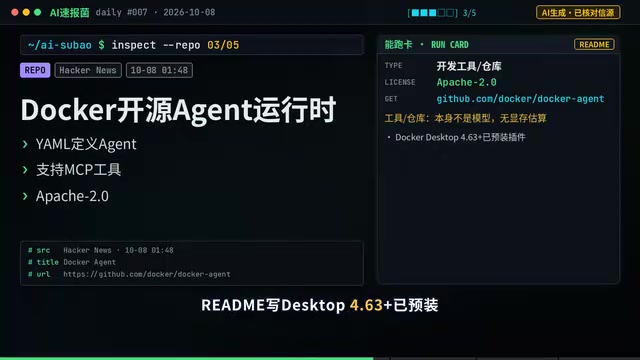
On the tooling front, two projects are worth highlighting this edition. The first is an open-source framework that defines Agents via agent.yml, with support for MCP (Model Context Protocol), also under Apache 2.0. The README notes that its Desktop version comes with relevant dependencies pre-installed for a smoother out-of-the-box experience.
The second is an engineer Agent skills library (Skills) that trended on GitHub. Its design philosophy is "small and composable" — skills are modularly broken down, flexibly combinable, and compatible with any model, released under the more permissive MIT license. This composable skill design is becoming the dominant paradigm for Agent tooling: no vendor lock-in, assemble capabilities on demand, and lower migration and integration costs.
What is MCP (Model Context Protocol)? MCP is a standardized protocol proposed and open-sourced by Anthropic in late 2024, designed to address interface fragmentation between AI models and external tools or data sources. Its design is analogous to LSP (Language Server Protocol) in programming languages — defining a universal Client-Server communication standard so that any model (Client) can call any tool (Server) through a unified interface, without needing custom adapters for each pairing. The MCP server side can expose three types of capabilities: Tools, Resources, and Prompts, which clients discover and invoke on demand. Dozens of official and community MCP Server implementations already exist, covering file systems, databases, browser control, code execution, and more. For Agent frameworks, MCP support means being able to directly reuse the entire MCP tool ecosystem without building integrations from scratch — dramatically reducing the cold-start cost for new frameworks.
Anthropic Launches Claude Haiku 5.5 with ~75% Cost Reduction
According to Anthropic's official website, Claude Haiku 5.5 is now live. The company states it delivers an average cost reduction of approximately 75% — a major win for high-frequency, budget-sensitive applications. The Haiku series is positioned as lightweight and fast, and this significant price cut further lowers the bar for use cases like batch processing, customer service, and data cleaning.

Additionally, Haiku 5.5 introduces a tunable Effort parameter for the first time, allowing developers to balance response quality against cost and speed — dial Effort up for deeper reasoning, or down for low-latency responses. This kind of fine-grained cost control is exactly what production environments actually need.
The Effort Parameter: The Effort parameter (also known as Extended Thinking or Thinking Budget) is a reasoning cost-control mechanism that several major API providers have recently introduced. The underlying principle is controlling the upper limit of "thinking tokens" a model is allowed to consume before generating its final answer. Higher Effort allows the model to produce a longer internal reasoning chain, typically yielding better answer quality — but at proportionally higher time and cost. Lower Effort produces quick answers, suitable for simple tasks that don't require deep reasoning. OpenAI's o-series implements similar functionality via the
reasoning_effortparameter (low/medium/high), while Google Gemini uses athinking_budgettoken count for control. For production environments where a single application handles both "simple queries" and "complex analysis," the Effort parameter lets developers dynamically adjust reasoning depth at the request level — without maintaining separate model deployments for different task types — making it a practical tool for reducing overall inference costs.
Summary
This edition's updates share a common thread: open-source first, locally runnable. Liquid's compact decision models, Saluki 27B compressed to just 7.89GB via IQ2 quantization, and the composable Agent Skills library all work to lower the hardware and cost barriers for deploying large models in practice. Anthropic's price cut echoes the same trend from the cloud side. For developers, the most pragmatic starting point for evaluating any new model remains the same: can you get it running locally?
Related articles

Why Does the Tesla Roadster Need to Fly? A Deep Dive into Musk's Wild Demo
Tesla's Roadster launch showed wall-climbing, upside-down driving, and flying stunts—but The Vergecast notes the demo car may lack a battery, the Rocket version is invite-only and not street-legal, and the website terms don't guarantee delivery. After nine years of delays, why does this car still need to exist?

AI Is Not a Replacement: Human-AI Collaboration Through the Lens of Factory Root Cause Analysis
Starting from factory root cause analysis, this article explains how AI accelerates evidence chain construction rather than replacing human experts, exploring the pragmatic implementation logic and business value of 'AI supporting people rather than replacing them.'

AI Agent Decision Auditing: Building an Evidence Chain in Regulated Workflows
Starting from a Reddit discussion, this article analyzes three core issues in AI agent decision auditing within regulated workflows: what fields audit records should contain, how to handle feedback latency for erroneous decisions, and how to continuously calibrate LLM judge consistency with human judgment.