AI Penetration Testing Agents in Practice: From Skill Configuration to Fully Automated Vulnerability Discovery
Breaking down the six core agent capabilities and demonstrating how to use Skill configuration to build an AI pentesting agent for automated vulnerability discovery.
Starting from the fundamental gap between ordinary AI chat tools and agents—chat tools can only propose solutions while agents can directly create files, run and debug, and deliver results—the article proposes the six essential core capabilities of an agent: autonomous environment perception, autonomous planning, autonomous decision-making, direct execution, memory, and tool calling. Applying this framework to penetration testing, SRC automated vulnerability discovery needs exactly such an executor, while Skill configuration encapsulates actions like information gathering, subdomain enumeration, and vulnerability verification into callable skills. AI pentesting agents lower the barrier to repetitive work, shifting security engineers' value toward goal setting, path judgment, and result verification.
Can AI actually help us find vulnerabilities? How big an impact will it have on security engineers? Many people are still at the stage of curiosity and imagination. Today we'll take a hands-on approach and break this down: from understanding what an agent is, to using Skill configuration to build an AI penetration testing agent that can automatically discover vulnerabilities.
Chat tools vs. agents: the difference is more than just "can it take action"
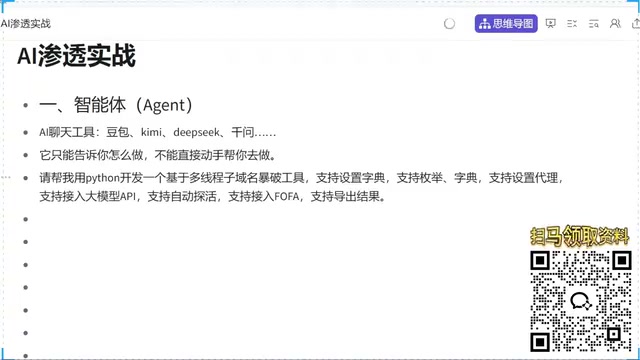
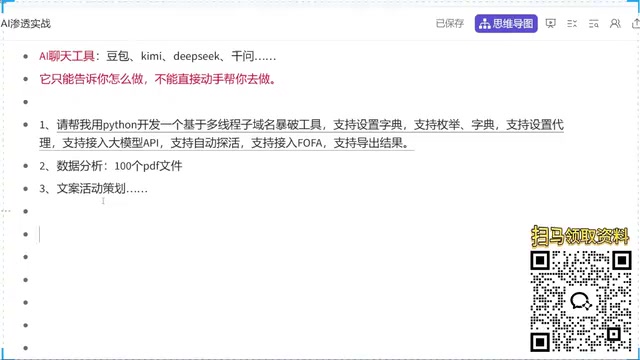
Let's start with a scenario everyone can relate to. You open Doubao, Kimi, DeepSeekAd, or Qwen and ask it to write a subdomain brute-force tool in Python. It can plan the steps and output code that looks pretty convincing.
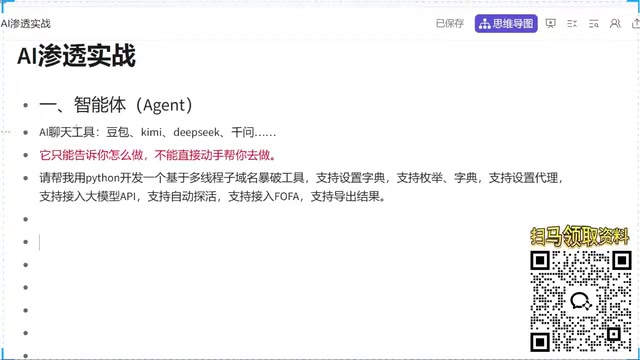
But here's the problem: it won't create files on your computer, and it won't run the code. You still have to create a .py file yourself, paste the code in, run it, test it, and when it throws an error, paste the error message back into the chat window, wait for suggestions, then paste them back again. This back-and-forth is a huge waste of time.
This is the fundamental gap between ordinary AI chat tools and agents—the former can only tell you how to do something, while the latter can actually do it for you. What we want is: AI writes the code according to requirements, creates the files, runs and debugs directly, and solves syntax errors or functional issues on its own. You hand it a goal, and it delivers the result.
This logic doesn't just apply to development tools. For example, giving AI a hundred PDF files to extract and summarize data, or asking it to plan a complex large-scale event, create a large number of files, and output PPTs, Word documents, and Excel spreadsheets—doing all this by hand is laborious, and an agent should just get it done.
The six core capabilities of an agent
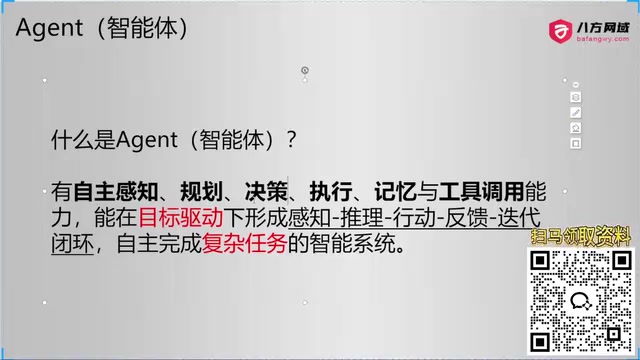
For an AI tool to deserve the name "Agent," it must simultaneously possess six core capabilities. Let's break these down one by one using "developing a program" as an example—whether it's a script, software, website, mini-program, or app.
1. Autonomous environment perception
When running on your computer, it needs to clearly see the current situation: is this an empty folder, a half-finished code project, or code that's already written and just waiting for refinement and optimization? Without perceiving the environment, subsequent actions have no basis.
2. Autonomous planning
To develop a piece of software, what needs to be done—frontend, backend, data connections, file storage—it has to break this down step by step itself, rather than waiting for you to feed it every step.
3. Autonomous decision-making
What to do when problems arise? If the network can't connect or the computer is missing dependencies, and it just stops there with the task interrupted, that's certainly not smart enough. It needs to figure out solutions on its own.
4. Direct execution
This is the key differentiator between chat tools and agents. It can create files, connect to databases, and run operating system commands—these all fall under execution capability. Without execution, it's still "all talk and no action."
5. Memory
Complex projects often involve very long and very numerous conversations. It must remember what you said before; otherwise, you'd have to re-explain the context every time, and efficiency goes out the window.
6. Tool calling
The most basic includes creating files and connecting to databases; more broadly, it also includes calling various tools like git to achieve goals. Tool-calling capability determines the boundaries an agent can reach.
Only when these six capabilities are all in place can you achieve the effect of "giving a complex goal and completing the task through continuous iterative loops."
From agent to AI penetration testing agent
Applying this framework to penetration testing scenarios makes the approach clear. SRC automated vulnerability discovery doesn't need one-off Q&A; it needs an executor that can perceive the target environment, plan testing paths, make autonomous decisions when encountering anomalies, directly execute commands, remember context, and invoke various security tools.
Skill configuration plays the role of "capability encapsulation" here: packaging specific actions in penetration testing—information gathering, subdomain enumeration, vulnerability verification—into skills that the agent can invoke, so it knows which tools to call at which stage and in what order to proceed. The subdomain brute-force tool demonstrated in the original material is a typical example of such a skill: from requirements to code to execution, the entire chain is closed-loop by the agent itself.
Skill configuration as a concept originates from engineering practices that move large language models from "general conversation" toward "professional execution." A Skill is essentially a module that packages the operating procedures, available tool list, input/output conventions, and exception handling strategies for a certain type of task into something an agent can load on demand. It typically contains three parts: first, a task description written in natural language (telling the model when to use this skill); second, callable function or command interfaces (scripts, APIs, CLI tools); third, validation rules before and after execution. Taking subdomain enumeration as an example, a Skill would declare "call this when target assets need to be discovered," internally encapsulating details like dictionary selection, concurrency control, and result deduplication, so the agent only needs to decide when to invoke it and with what parameters to get structured results. This design makes capabilities reusable and composable, and also makes it easy to replace or upgrade a specific tool without modifying the main workflow.
What this means for security engineers
What AI penetration testing agents change isn't "whether to use AI" but where the focus of work lies. Repetitive information gathering, tool orchestration, and code debugging will increasingly be handed over to agents for iterative loops; the value of security engineers will land more on goal setting, path judgment, and result verification.
In other words, the barrier to vulnerability discovery is lowering, but the requirements for "knowing what to dig for and how to judge that you've found it" are rising. The efficiency gap between those who can configure Skills and manage agents well and those who only manually type commands will only grow wider.
SRC (Security Response Center) is the official channel for enterprises to receive vulnerability submissions from external white-hat hackers, such as the security emergency response centers built by major internet companies. The core workflow of participating in SRC vulnerability discovery includes four stages: asset discovery, vulnerability probing, verification and reproduction, and report submission. Among these, asset discovery and vulnerability probing rely heavily on tool orchestration and repeated scanning—exactly the areas where agents can deliver the most value. Unlike authorized internal penetration testing, SRC scenarios emphasize strict constraints on target scope and the bottom line of "causing no damage," which also means that AI penetration testing agents must have built-in scope validation and operation rate-limiting mechanisms when deployed; otherwise, the risks brought by automation will be amplified accordingly.
One-line Summary
Breaking down the six core capabilities of agents and demonstrating how to use Skill configuration to build an AI penetration testing agent that automatically discovers vulnerabilities.
Paragraph Summary
The article starts from the fundamental gap between ordinary AI chat tools and agents, pointing out that chat tools can only give solutions while agents can directly create files, run and debug, and deliver results. It then proposes the six essential core capabilities of an agent: autonomous environment perception, autonomous planning, autonomous decision-making, direct execution, memory, and tool calling, breaking each down using program development as an example. Applying this framework to penetration testing, SRC automated vulnerability discovery needs exactly such an executor that can perceive targets, plan paths, make autonomous decisions, execute commands, remember context, and invoke security tools, while Skill configuration is responsible for packaging actions like information gathering, subdomain enumeration, and vulnerability verification into callable skills. The article concludes that AI penetration testing agents lower the barrier to repetitive work, and the value of security engineers will land more on goal setting, path judgment, and result verification.
Related articles
Understanding AI Usage Through Unix Permissions: The 0rwx Model
Introducing the 0rwx model from Hacker News: using Unix read, write, and execute permissions to break down AI usage into information input, content generation, and action triggering—plus its insights and limitations for product design and security boundaries.
Scientific Evidence vs. Regulatory Rol…
Scientific Evidence vs. Regulatory Rollback: Europe's Chemical Rules Debate
A Le Monde opinion piece argues that science increasingly links chemical exposure to "lifestyle diseases" while Europe weakens regulation. This article examines the evidence, policy drivers, and HN debate.
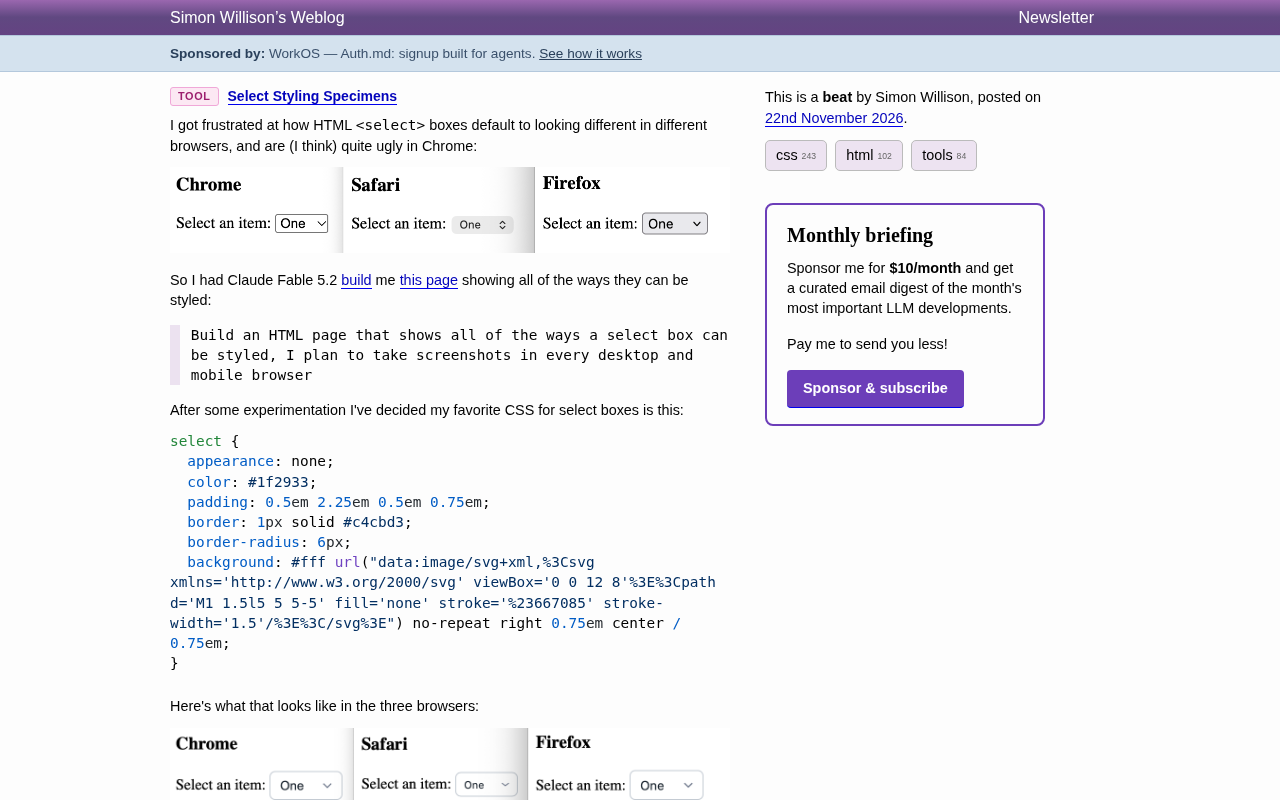
Cross-Browser Unified Select Styling: A CSS Approach and AI-Assisted Practice
Simon Willison shares using Claude to generate a select styling test page, plus a cross-browser CSS approach: appearance:none with an inline SVG arrow to fix Chrome, Safari, Firefox differences.