AI-Pilled: When AI Wins You Over Completely, What New Doors Open Up?

Unpacking the "AI-pilled" phenomenon: how to rationally embrace AI empowerment without losing yourself
This article explores the popular tech concept of being "AI-pilled" — completely won over by AI. It traces the term's linguistic evolution from The Matrix's red pill to internet memes, analyzes the typical traits of AI believers and the real capability expansion AI enables, while warning of risks like cognitive offloading and critical thinking degradation from over-reliance, advocating for positioning AI as a collaborative partner rather than a substitute for thinking.
A New World for AI Believers
In tech circles, there's an increasingly popular term — "AI-pilled" (being completely convinced and won over by AI). Rooted in internet culture, this expression describes people who have deeply embraced AI technology and integrated it into every aspect of their work and life.
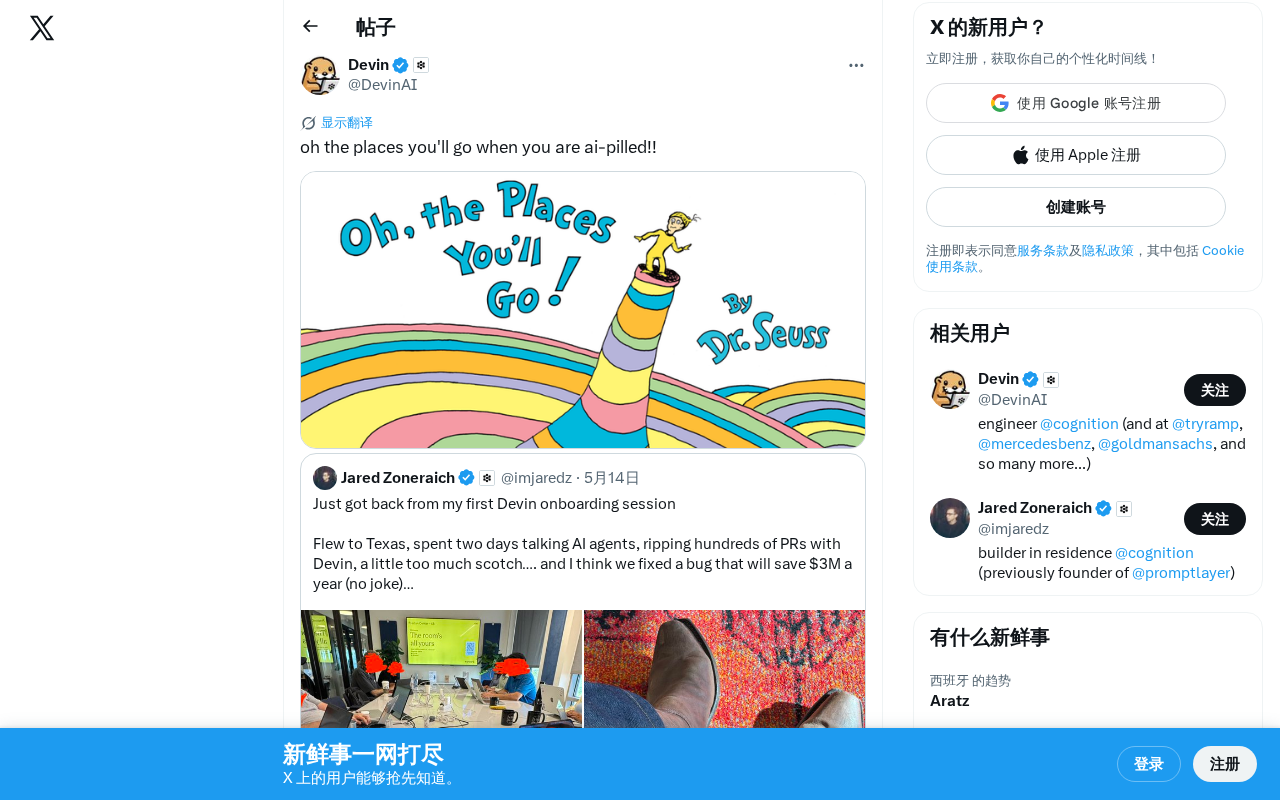
Recently on social media, a user exclaimed: "oh the places you'll go when you are ai-pilled!!" This phrase borrows from Dr. Seuss's classic picture book Oh, the Places You'll Go!, conveying a sense of excitement and optimism about AI's ability to empower individuals.
It's worth noting that the original book was published in 1990 as Dr. Seuss's final work before his passing, and it has long been a top graduation gift in the United States. The book uses second person to narrate a journey through life's ups and downs, with core themes of "limitless possibilities" and "self-driven agency." This intertextual reference is no accident — it precisely captures the psychological state of the AI-pilled crowd: an almost childlike excitement born from the shattering of one's perceived ability boundaries. In the context of social media, borrowing classic cultural symbols to express new technology experiences is itself a textbook case of the "emotional resonance" strategy in tech communication.
What Does AI-Pilled Mean? From the Red Pill to the AI Pill
The suffix "-pilled" originates from the iconic scene in The Matrix — choosing the red pill means seeing the real world. In contemporary internet culture, "X-pilled" means someone has been thoroughly convinced by a particular idea, undergoing a fundamental cognitive shift.
The evolution of this linguistic phenomenon is quite fascinating. The red pill/blue pill metaphor from The Matrix (1999) originally symbolized a binary choice between "awakening and ignorance," but it was extensively borrowed and remixed in 2010s internet subcultures. "Red-pilled" first gained popularity in men's rights communities, then expanded to broadly describe any moment of "cognitive awakening," spawning variants like "black-pilled" (nihilism) and "blue-pilled" (maintaining the illusion). In the AI era, "AI-pilled" continues this memetic evolution — it strips away the political undertones of the original term while preserving the core meaning of "paradigm-shifting epiphany," becoming a neutral or even positive term in tech circles to describe AI believers.
"AI-pilled" specifically refers to those who, after experiencing an "aha moment" with AI capabilities, begin to fundamentally re-examine their work methods, learning approaches, and even ways of thinking. They no longer see AI as a simple tool but as a paradigm shift.
Typical Traits of AI Believers
People who have been won over by AI typically exhibit the following characteristics:
- Fully AI-integrated workflows: From writing and coding to data analysis, AI assistance is incorporated into nearly every step, with obvious efficiency gains
- Constant exploration of new AI tools: Maintaining high interest and enthusiasm for trying every newly released AI product
- Fundamental cognitive reframing: Beginning to evaluate all tasks through the lens of "can AI help me with this?"
- Real-world efficiency multipliers: Achieving output improvements of several times — or even orders of magnitude — in areas like writing, coding, and design
Real Capability Expansion Through AI
Indeed, AI has brought unprecedented expansion to individual capabilities:
- A person with no design background can generate professional-grade visual content through AI
- A solo developer can use AI coding assistants to complete projects that previously required team collaboration
- A content creator can leverage AI for research and ideation, dramatically improving both output quality and speed
There's concrete technical logic behind this. Modern AI systems built around large language models (LLMs) are essentially compressed knowledge bases and retrieval interfaces for humanity's vast knowledge — they transform "domain languages" and "operational patterns" that used to require years of professional training into capabilities accessible through natural language. For non-designers, Midjourney or DALL-E outsources "aesthetic judgment" to the model; for solo developers, GitHub Copilot dramatically reduces the cognitive burden of "syntax memorization" and "boilerplate code." The essence of this "cognitive outsourcing" is transforming professional knowledge from something that "must be internalized" to something that "can be invoked," thereby freeing individual energy to be reallocated to higher-level creative and judgment work.
This feeling of "going to new places" is real — AI is lowering the barriers to entry across fields, giving more people the opportunity to explore domains that were previously out of reach.
Staying Rational: The Other Side of Being AI-Pilled
The enthusiasm of being AI-pilled also needs rational balance. Over-reliance on AI may lead to atrophy of foundational skills, a lack of critical scrutiny of AI outputs may cause quality issues, and ignoring AI's limitations may result in costly mistakes at critical moments.
This risk is not alarmist — it's a real concern backed by cognitive science. The theory of "cognitive offloading" in psychology shows that when an external tool handles a cognitive task for an extended period, the corresponding neural circuits in the brain weaken due to lack of activation — consistent with the "use it or lose it" principle of neural plasticity. Research documenting the decline in human spatial memory after widespread GPS adoption is well-established, and the long-term effects of AI writing assistance may follow a similar pattern. An even more insidious risk is "metacognitive degradation": when AI consistently provides "good enough" answers, people may gradually lose their standards for judging "what a truly good answer is," and the capacity for critical evaluation itself faces the risk of atrophy.
There is an important dividing line between blind AI worship and rational AI adoption.
How to Embrace AI Empowerment in a Healthy Way
For those who want to fully leverage AI's capabilities, the following strategies are worth considering:
- Define AI's role clearly: Treat AI as a powerful collaborative partner, not a substitute for thinking
- Keep core skills sharp: AI assistance doesn't mean abandoning fundamentals — your underlying abilities remain your competitive moat
- Establish output verification practices: Maintain a healthy skepticism toward AI-generated content and develop a habit of fact-checking
- Keep learning and adapting: AI technology iterates rapidly, and continuous learning is essential to keep benefiting from it
When you let yourself be "won over" by AI with the right mindset, the world truly does open many new doors for you. The key is that you are the one harnessing AI — not the other way around.
Key Takeaways
- "AI-pilled" describes people who have been thoroughly convinced by AI's capabilities and have fully embraced AI technology — the term itself reflects the profound influence of internet meme culture on technology discourse
- AI is lowering barriers to entry across fields; its technical essence is transforming professional knowledge from "must be internalized" to "can be invoked"
- Over-reliance on AI carries real cognitive risks, including foundational skill atrophy and critical thinking degradation
- The key to embracing AI in a healthy way is positioning it as a collaborative partner rather than a substitute for thinking
Related articles
Deep Dive into AI Agent Skill Design: …
Deep Dive into AI Agent Skill Design: Engineering Practices from Anthropic and Perplexity
A deep dive into Skill design philosophy from Anthropic's Claude Code team and Perplexity's Agent team, covering the Tax Test, Gotchas Flywheel, progressive disclosure, and Eval-First practices for building high-quality AI Agent skill systems.
Deep Dive into OpenAI's Official GPT-5…
Deep Dive into OpenAI's Official GPT-5.6 Prompting Guide: The Shift from Manual to Automatic
A deep dive into OpenAI's official GPT-5.6 Sol prompting guide: conciseness-first, outcome-oriented design, autonomy boundaries, tool routing, and reasoning intensity tuning.
 Deep Dives
Deep Dive into How OpenClaw (Open-Source Crayfish) AI Agent Works
Deep analysis of OpenClaw AI Agent internals: System Prompt, tool calling, SubAgents, Skill system, memory, and Context Engineering explained.