AI-Powered Automatic Environment Patching: JS Reverse Engineering with Sandbox + Prompt

Automate JS reverse engineering environment patching using AI, Proxy sandbox, and smart prompting.
Environment patching is the most painful part of JS reverse engineering. This article details an automated approach using a Proxy+vm sandbox to capture all missing BOM/DOM objects as structured logs, then prompting AI to analyze (not just fix) and generate complete patches. The result: encrypted e-commerce data retrieved in seconds without manually writing a single line of environment code.
The Reverse Engineer's Eternal Headache: Environment Patching
Anyone who's done crawler reverse engineering knows the pain of "environment patching" all too well. You extract an encryption algorithm from obfuscated JavaScript, excitedly drop it into Node.js, and get bombarded with a chain of errors:
- Missing
document - Some method absent from
window - After manually adding
window = {}, the script detects an illegal proxy object
It's an endless cat-and-mouse game. What should be a simple task of extracting encrypted data can turn into an all-nighter of manually patching hundreds of lines of prototype chain code. This is why the reverse engineering community half-jokingly says "environment patching" are the two most demoralizing words in the field.
The root cause lies in the structural differences between JavaScript runtime environments. JavaScript was created by Brendan Eich at Netscape in 1995, deeply coupled with its host environment (the browser). The ECMAScript specification (maintained by ECMA TC39) only defines the language core — syntax, type system, prototype chain mechanics — while objects like window, document, and navigator were never part of the language spec, remaining the "host environment's responsibility." This architecture was historically reasonable: different hosts (browsers, servers, embedded devices) could implement different API layers as needed, keeping the language core lightweight and portable.
This split became a critical fork in 2009 when Ryan Dahl created Node.js: it reused Chrome's V8 engine to execute the ECMAScript core, but deliberately stripped out all browser-specific Web API layers — hundreds of interfaces defined by WHATWG and W3C specs. Node.js positioned itself as a "server-side runtime" rather than a "browser emulator," a reasonable engineering trade-off in 2009 that became a major pain point for reverse engineers over a decade later.
The difference isn't just about the number of APIs — it's about the completeness of object prototype chains. In browsers, HTMLElement inherits from Element, which inherits from Node, and every node in this chain has precise property descriptors. Anti-scraping scripts exploit these differences, embedding extensive environment fingerprint detection logic: checking navigator.webdriver flags, canvas rendering capabilities, AudioContext spectrum characteristics, and even WebGL renderer information.
This article is based on a reverse engineering workflow shared by a Bilibili content creator, exploring how to hand off the tedious environment patching work to AI automation.
Core Concept: Turning AI into an Automated Environment Patch Generator
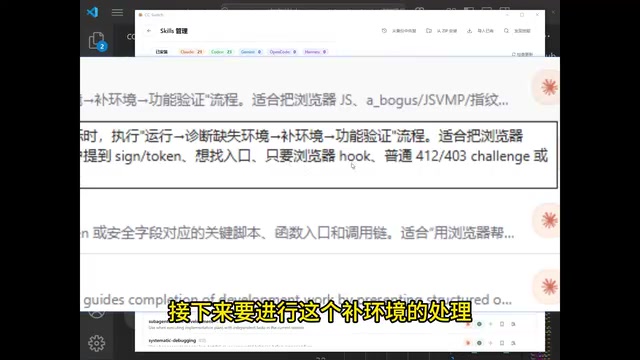
The core idea here is upgrading AI from "an assistant that helps fix errors" to "an automated environment patch generator." The entire implementation relies on a carefully designed Skill (an encapsulated capability module) — essentially a JS reverse engineering sandbox environment patching tool.
The Skill's Design Logic
The creator pre-writes all core browser objects needed for environment patching — the browser's BOM (Browser Object Model) and DOM (Document Object Model) — into the Skill, forming a sandbox-like structure.
BOM provides interfaces for interacting with the browser window, including window, navigator, location, history, and other objects that are naturally absent in Node.js. DOM is the tree-structured representation of HTML documents, with document as its root node providing methods like createElement and querySelector.
Importantly, BOM and DOM aren't two isolated islands — they're deeply coupled through prototype chains. The window object is both the top-level BOM object and the global scope in browser JavaScript. This means window.document, window.navigator, and window.location must not only exist, but have correct prototype chain membership. For example, document's prototype chain should be HTMLDocument → Document → Node → EventTarget → Object. Any missing or mismatched link can trigger the integrity checks built into anti-scraping scripts.
You only need to provide three things:
- An obfuscated JS file
- The located encryption entry point
- The rewrite target for local Node.js
The rest is handled automatically.
The Three-Step Automated Flow
The Skill automatically executes a closed-loop process:
- Step 1: Diagnose missing environment. The sandbox runs the script, actively detecting which objects and methods are missing in the current environment, printing all missing items like a log.
- Step 2: AI auto-patches the environment. This is the critical step. After diagnosing missing items, AI automatically generates corresponding patches based on the printed logs — if the script needs
createElement, AI generates a complete Node object, with no manual intervention. - Step 3: Self-validation. After patching, AI runs verification on its own to confirm whether the encryption flow works.
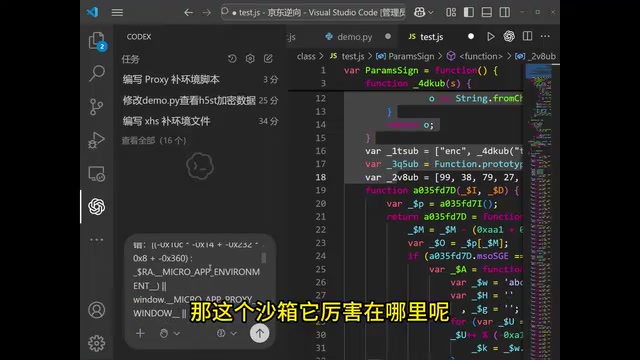
The "sandbox" here technically relies on deep collaboration between JavaScript's Proxy object mechanism and Node.js's vm module. Proxy is a metaprogramming feature introduced in ES2015 that intercepts and customizes fundamental object operations, supporting 13 trap types including property reads (get trap), property writes (set trap), and function calls (apply trap).
The vm module handles execution context isolation at the process level: vm.createContext() essentially creates an independent Isolate context snapshot in the V8 engine. The injected global objects become the root scope of that context, allowing the sandbox to precisely control which global variables a script can "see," while preventing the script from escaping to the Node.js main process through process, require, and similar host objects.
The key value of combining these two: converting "property undefined errors" that would crash the script into "access record logs" that can be structurally processed — precisely capturing all behavior when a script tries to read window.xxx or document.yyy without directly throwing errors. This is the technical foundation that enables Step 1 to systematically output all missing items, and what distinguishes this approach from the "patch one, error another" loop.
Key Insight: Prompt AI to Analyze, Not Just Fix
The most instructive aspect of this approach is the prompt design philosophy.
Most people, when throwing error messages at AI, instinctively say "help me fix this error." But the creator does the opposite:
I didn't directly ask it to fix the error. I pasted the error information into the designated location, but instead of asking it to fix directly, I first had it analyze using the appropriate Skill.
This distinction is crucial. Asking AI to "fix errors" only produces "whack-a-mole" behavior — patch one, another appears, falling into the same loop as manual patching. Having AI first perform environment proxy detection analysis with the sandbox allows it to understand what the script is checking for and what's missing, then systematically generate a complete patch rather than piecemeal fixes.
This design philosophy has deeper roots in cognitive science. When AI faces the instruction "fix the error," its attention is anchored on the error message itself — a local perspective that only sees the current crash point. In prompt engineering, this is called the "framing effect": how a task is described fundamentally changes the model's reasoning path and output quality.
"Fix errors" activates pattern-matching local repair; "analyze sandbox logs" activates intent-inference global modeling — two fundamentally different reasoning chains.
This design also aligns with prompt engineering best practices for Chain-of-Thought and Task Decomposition: breaking down "environment patching" into four structured sub-tasks — "diagnose → analyze → generate → verify" — each with clear input/output boundaries, dramatically reducing the complexity the model must handle in a single reasoning step.
The sandbox is responsible for "exposing the problem" (outputting detection logs); AI is responsible for "understanding and solving the problem" (generating corresponding objects). Together they form an automated closed loop.
Live Demo: Getting Encrypted E-commerce Data in Seconds
The creator demonstrated the entire workflow using a real e-commerce crawler case.
He opened a new conversation, pasted the pre-configured prompt and error information, and invoked the env environment patching Skill to process the current script. AI quickly analyzed that the script contained an encrypted data field called HOST and generated the final demo.py file.
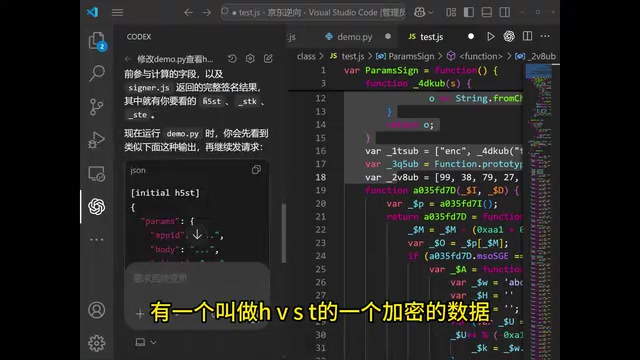
Running the generated file produced output clearly containing these key parameters:
- Timestamp
tvalue - Encrypted
HOSTvalue
With the correct HOST value, the request successfully returned real e-commerce data, including specific product information.
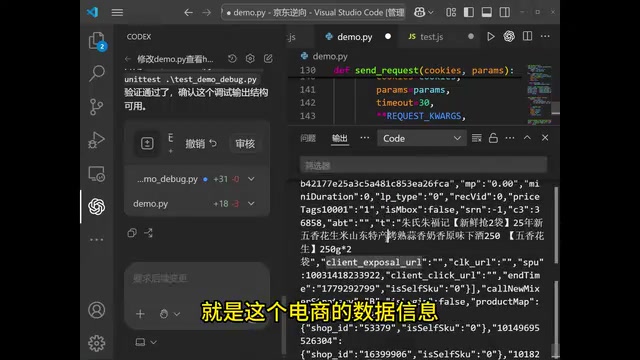
The developer didn't manually patch a single line of environment code throughout the entire process. Work that would have taken all night manually patching prototype chains was automatically handled by AI with the intelligent sandbox in seconds.
Realistic Assessment: AI's Capabilities and Limits in Reverse Engineering
This approach showcases AI's enormous potential in reverse engineering, but its applicable scope deserves honest assessment.
Clear advantages: For common BOM/DOM environment patching scenarios, the AI + sandbox combination dramatically lowers the barrier, turning work that previously required senior expertise into a streamlined process accessible even to beginners.
Boundaries to be aware of:
- The quality of the sandbox itself determines the ceiling. The more complete the preset environment objects in the Skill and the more precise the detection logs, the better AI can patch. Building the sandbox still requires professional expertise.
- More sophisticated anti-scraping techniques may require more than environment patching. VMP (Virtual Machine Protection) and WebAssembly (WASM) represent two technical ceilings in current anti-scraping systems, though with very different defensive mechanisms.
VMP originated in software copyright protection (commercialized by tools like VMProtect and Themida). Its core is "instruction set privatization" — original JavaScript logic is compiled into custom bytecode that attackers cannot directly read, executed dynamically at runtime by an embedded interpreter. Since each VMP-protected script may use a different "virtual machine architecture" (opcode mapping, register layout), reverse engineers must re-analyze the interpreter logic for each specific script, with effort growing exponentially. Even with the complete script source code, what you see is only "interpreter + bytecode" — the real business logic is hidden in the bytecode sequence.
WASM uses "compilation isolation" — encryption logic written in C/C++/Rust is compiled into .wasm binary modules. Even when decompiled to WAT (WebAssembly Text Format), the result is a hard-to-understand low-level instruction sequence. WASM modules are typically deeply coupled with JavaScript glue code, making them difficult to extract and execute independently. WASM's security model also has native sandboxing — modules cannot directly access the host JavaScript's memory space, and both sides can only interact through strictly defined import/export interfaces.
High-end anti-scraping systems often combine both techniques: VMP hides logic through private instruction sets, WASM hides it through compilation isolation — the two complement each other's defensive boundaries.
For these two techniques, AI-assisted environment patching can only solve "where it's called" — not the core problem of "what logic is being called." Even with AI assistance, significant professional reverse engineering experience is still required.
- Reverse engineering involves legal and compliance boundaries. These techniques must only be used within authorized and legal contexts, for learning and research purposes only.
Closing Thoughts
The essence of this approach is transforming AI from a "chat tool" into an "automation engine" — using a carefully designed sandbox Skill to expose problems, then using appropriate prompts to guide AI to systematically resolve them.
The implications extend beyond crawler reverse engineering: many seemingly tedious, experience-dependent technical tasks can be automated through a "professional tool encapsulation + AI intelligent filling" model.
The creator also previewed a next step: using AI to write AST (Abstract Syntax Tree) plugins that automatically deobfuscate tens of thousands of lines of obfuscated code into readable source.
AST is the tree-structured intermediate representation of source code, where each node represents a syntactic construct (function declarations, variable assignments, binary operations, etc.). In the JavaScript ecosystem, the ESTree spec defines a unified AST node format, and major tools like Babel, ESLint, and Prettier are all built on it.
To understand AST's role in reverse engineering: obfuscation tools don't modify code execution semantics — they apply "semantics-preserving transformations" to the AST while maintaining semantic equivalence. This means these transformations are theoretically reversible — identify the transformation pattern, write a reverse AST conversion rule to restore it.
The Babel ecosystem provides a complete AST manipulation toolchain: @babel/parser parses source code into syntax trees, @babel/traverse enables depth-first traversal with node replacement, @babel/types provides type-safe node construction APIs, and @babel/generator regenerates readable code from the modified syntax tree.
AI's core value in this flow is converting "identifying obfuscation patterns and writing corresponding transformation rules" — a step heavily dependent on human expertise — into a code generation task driven by natural language descriptions. Different obfuscation tools produce significantly different AST patterns, and AI's value in generating AST transformation logic lies in converting the experiential judgment of pattern analysis into an automatable code generation process.
Rather than complaining that major platforms' encryption is getting harder to crack, learn to use AI to turn these challenges into automatable workflows. The evolution of tools is redefining what "technical barrier" means.
Key Takeaways
Related articles

Alibaba Launches Happy Shrimp: AI-Powered One-Click Complete Song Generation
Alibaba launches Happy Shrimp, an AI music generation tool that creates complete songs with lyrics, melody, arrangement, and vocals from natural language descriptions. In-depth analysis of its core features, differentiation from competitors like Suno, and industry impact.
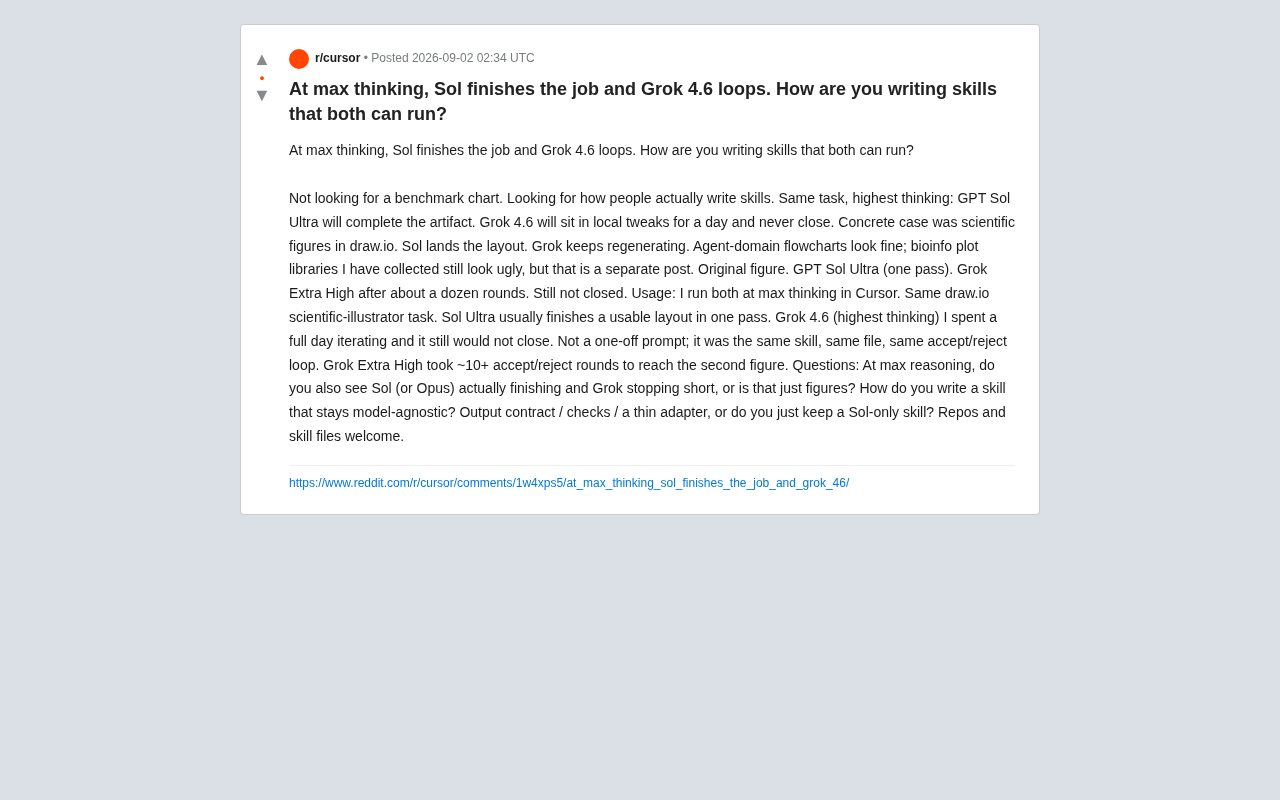
GPT Sol Ultra vs Grok 4.6: Real-World Task Completion Benchmark in Reasoning Mode
Developer benchmark reveals GPT Sol Ultra completes draw.io scientific diagrams in one iteration while Grok 4.6 fails to converge despite maximum reasoning mode, exposing that reasoning depth ≠ task delivery capability.
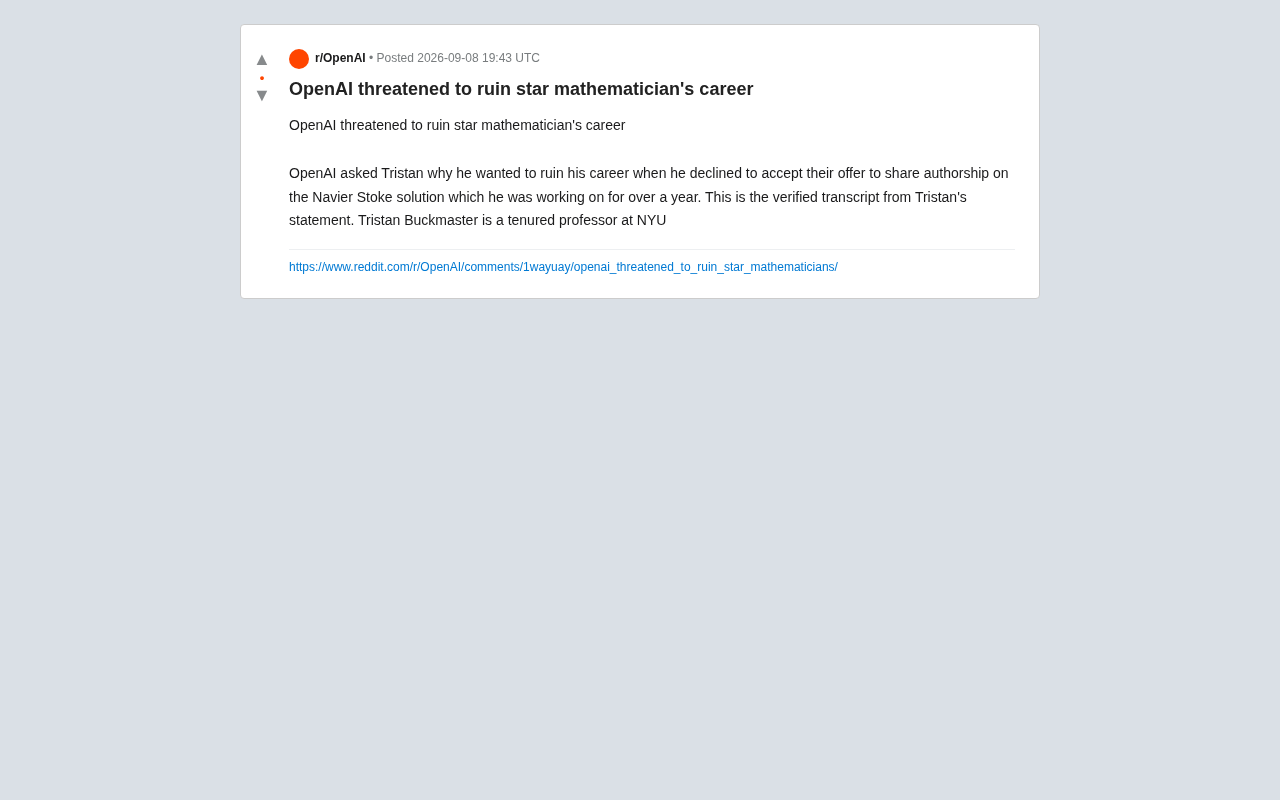
OpenAI Authorship Dispute: The Battle Over Academic Boundaries in the AI Era
OpenAI disputes authorship with mathematician Tristan Buckmaster over Navier-Stokes research, raising ethical questions about AI involvement in science.