AI-Powered Point-and-Click Game Engine: No Code, Just Creativity
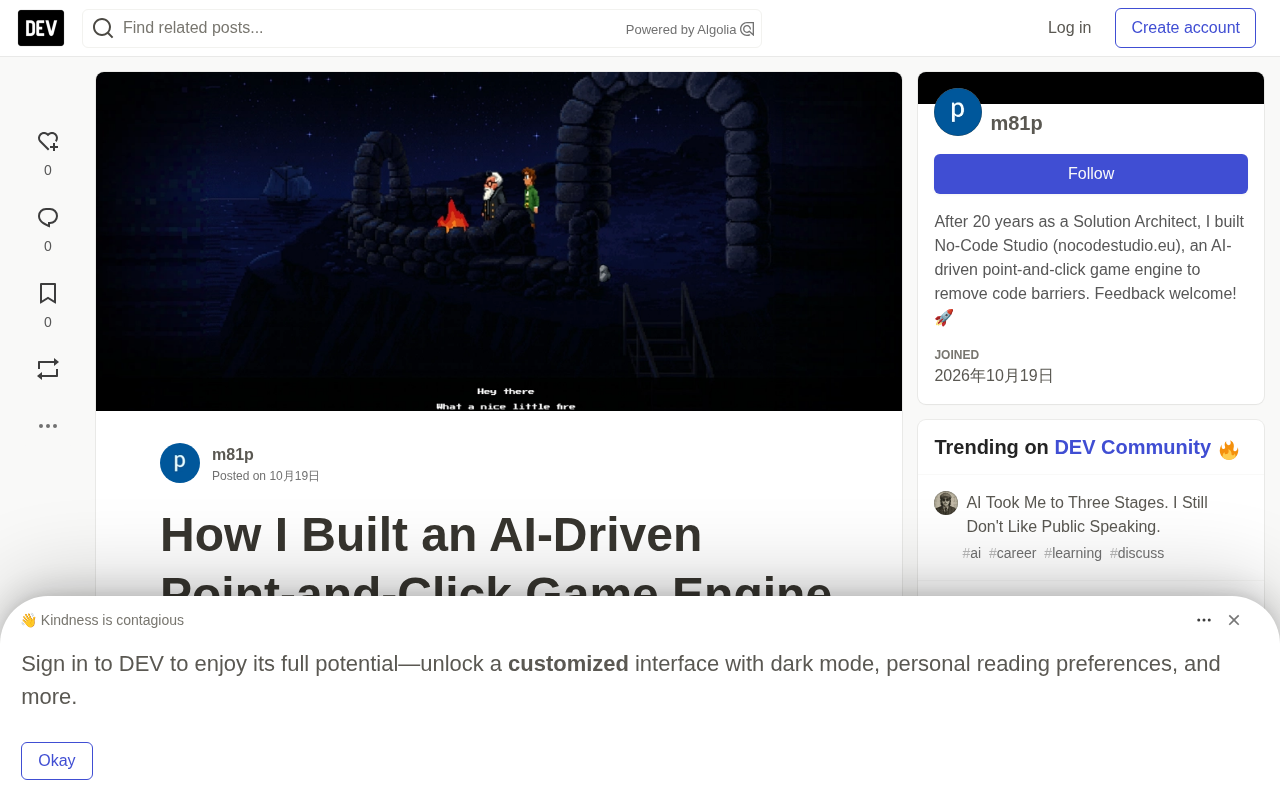
A developer built No-Code Studio, an AI-powered no-code point-and-click game engine that lowers the development barrier.
This article introduces No-Code Studio, an AI-powered no-code engine for point-and-click adventure games. It addresses the boilerplate and configuration friction of traditional development by letting users configure scenes and interactions visually while AI generates the underlying code. The core tech is complete and released as an early demo; limitations include narrow category focus and an unproven ecosystem.
Classic point-and-click adventure games have enduring appeal, but the traditional development process always comes with too much technical friction: boilerplate code, tedious configuration, and repeatedly testing basic puzzle logic. One developer built No-Code Studio for this reason—an AI-powered point-and-click game engine designed to lower the barrier to game development.
The Core Pain Point: Technical Friction in Traditional Development
According to the developer, traditional point-and-click game development often requires handling a large amount of technical detail before you even touch the actual puzzle logic. From project initialization to scene setup to interaction testing, every step can drain a creator's energy. This friction is especially pronounced for indie developers and small teams, and many good ideas therefore never make it past the prototype stage.
No-Code Studio attempts to shift this burden into an AI-assisted environment, letting creators focus on imagination, design, and mechanics themselves.
Point-and-click adventure games are a type of narrative game whose primary interaction is mouse clicking: players advance the story and solve puzzles by clicking objects in the scene, dialogue options, or the inventory. Their typical technical structure includes scene management, an item system, dialogue trees, state machines, and puzzle triggers. These modules often need to be built early in the project before subsequent content creation can be supported.
The term "boilerplate code" refers to generic code that is unrelated to specific game content but must be repeatedly written for every project of the same kind—for example, scene loading, click hit detection, adding and removing inventory items, and save/load functionality. In traditional development, this code usually has to be implemented manually by the developer or ported from an old project, which is time-consuming and error-prone, and is one of the main sources of friction for indie developers.
The Solution: Visual Framework + AI Assistance
The core of No-Code Studio is a visual framework. It allows users to build game scenes and interactions through drag-and-drop and configuration, while AI handles the underlying code generation and logic wiring. This model is consistent with the current trend of low-code/no-code tools, but it is specifically optimized for the niche category of point-and-click adventure games.
The developer emphasizes that the core technology was already "fully developed and robust" at the early release stage and is currently provided as a demo. This means it is not a proof of concept, but an early product with real usability.
At their core, low-code/no-code tools replace handwritten code with visual configuration: users express logic by dragging components, setting properties, and connecting nodes. In game development, such tools typically provide interfaces such as scene editors, event triggers, and logic graphs, enabling non-programmers to build runnable prototypes.
AI-assisted code generation, building on visual operations, has the model translate the user's configuration intent into underlying scripts or engine calls. Combining the two can lower the learning curve, but the actual effect depends on how well the AI understands the semantics of game logic, as well as the debuggability and maintainability of the generated code. For categories with relatively fixed rules like point-and-click adventure games, AI assistance is highly feasible.
Who Is It For?
- Story creators: Authors who are not familiar with programming but want to turn narratives into interactive experiences.
- Indie game developers: Developers who want to quickly validate puzzle designs and skip boilerplate code.
- Game design learners: Students or enthusiasts who want to understand the logical structure of point-and-click games through visual means.
Industry Significance and Limitations
No-Code Studio represents one direction for AI-assisted game development: automating repetitive technical work so that creative people can participate more directly in building. However, it currently focuses on point-and-click adventure games, so its generality is limited. In addition, the stability, export options, and community ecosystem of the early demo still need to be observed.
The developer is soliciting feedback in the Dev.to community. For readers interested in game development toolchains or the practical implementation of AI applications, this is an early project worth watching.
Point-and-click adventure games hold an important place in game history, from the early Monkey Island series to later narrative adventure titles, with core gameplay revolving around exploration, dialogue, and item combination. Because the category's rules are mature and its interaction model is stable, it has become an ideal testing ground for AI-assisted development tools—its logical boundaries are clear, making it easy to validate the results of automated generation.
However, the depth of such games is often reflected in the cleverness of puzzle design and the complexity of narrative branches, which are precisely the parts hardest to automate with tools. Tools like No-Code Studio can solve the problem of "how to implement it," but "what to design" still depends on the creator's judgment—and this is also a key dimension when evaluating the practical value of such tools.
One-line Summary
The developer built No-Code Studio, an AI-powered no-code point-and-click game engine that lowers the barrier to development.
Paragraph Summary
This article introduces No-Code Studio, an AI-powered no-code engine created by a developer specifically for point-and-click adventure games. It notes that traditional development involves a great deal of boilerplate code and configuration friction that hinders creative execution; No-Code Studio uses a visual framework that lets users drag-and-drop to configure scenes and interactions, with AI generating the underlying code, so creators can focus on puzzle and narrative design. The core technology is complete and has been released as an early demo, with target users including story creators, indie developers, and game design learners. The article also points out the limited generality caused by its category focus, and that stability, export options, and community ecosystem remain to be observed, while arguing that this direction is worth watching.
Related articles

OpenAI Partners with Shield: How the Astra Agent Revolutionizes IT Troubleshooting
OpenAI and Shield launch the Astra agent, which autonomously logs into computers and legacy systems to fix IT issues in real time, 35-40% faster than traditional models, with humans involved only when judgment is needed.

iPhone Duo Battery Life Tested: One Charge a Day Is Unavoidable, and the Large Screen Is the Culprit
iPhone Duo battery test: heavy use needs at least one charge a day, and about 30% remains after 6.5 hours of screen-on time. How often the large screen is unfolded is key; a MagSafe battery pack helps, and long-term degradation is also worth watching.

Kimi K3.1 Pro Open-Sourced: 2.8 Trillion Parameters Close In on Opus
Moonshot releases the open-source MoE model Kimi K3.1 Pro, with 2.8T total parameters and 104B activated, trailing Opus 5.5 by under 1 point on Terminal Bench 4.0.