AI Products Under Constant Attack? A Developer's Firsthand Account of Prompt Injection and DDoS Offenses and Defenses

Unpromoted AI products can still face prompt injection, DDoS, and bot attacks—MVPs need a minimum security baseline.
A developer shared how two AI-assisted products (in AI infrastructure and SEO/GEO) faced multiple cyberattacks despite no promotion: prompt injection attempts on free tools, DDoS blocked by an AWS firewall, and spam bot registrations from the EU, Hong Kong, and India. He admitted security wasn't a priority at the MVP stage and that detection was pure luck—he was awake during the attack and had Slack alerts set up for growth monitoring. The article notes that automated scanners traverse public IPs and domains, with free tool pages and open registration portals most easily probed; fame doesn't matter. It distills advice: cover anomalous behavior in basic alerts, configure firewalls and rate limiting early, apply input filtering and output constraints for AI features, and add anti-bot mechanisms to registration flows—emphasizing that security should be a minimum baseline reserved in MVP iteration.
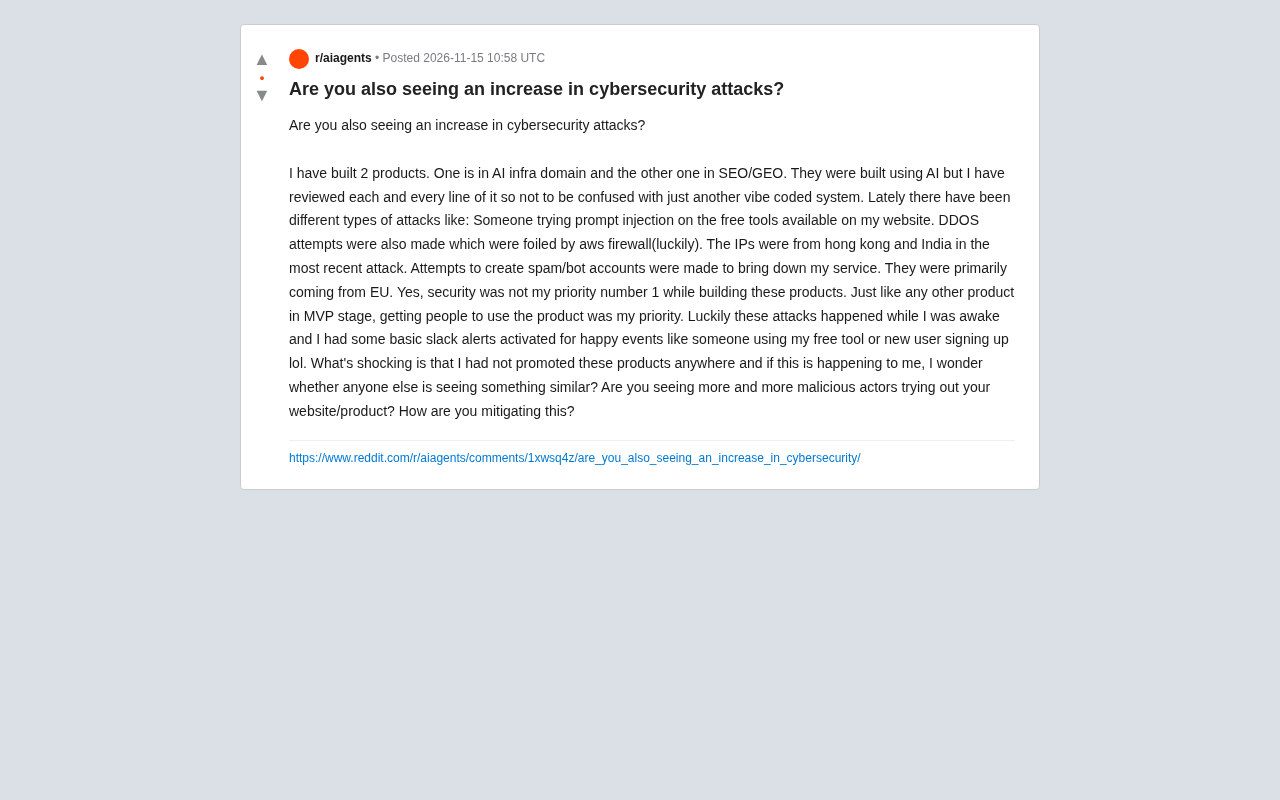
A developer posted on Reddit about his experience building two products with AI that came under various cyberattacks, resonating with many independent developers. His confusion was concrete: he had barely promoted the products, so how did the attacks find him?
Attack Types: From Prompt Injection to DDoS
According to the developer, his two products belong to AI infrastructure and SEO/GEO respectively. Although the code was AI-assisted, he stressed that he reviewed it line by line and that it was not the product of "vibe coding." That didn't spare the products from attack, however.
The attack forms he observed included: attempts at prompt injection against the free tools on his site; DDoS attacks trying to take down the service, fortunately blocked by an AWS firewall; and spam/bot account registrations from the EU region aimed at overwhelming the service. The most recent attack came from IPs in Hong Kong and India.
This variety shows that even small products at the MVP stage can be "swept up" by automated tools or malicious actors. Attackers aren't necessarily targeting you specifically—they're casting a wide net.
Prompt injection is a class of attack against large language model applications: attackers embed carefully crafted instructions into inputs to trick the model into ignoring its original system prompt or safety constraints and instead performing operations the attacker intends. Common forms include direct injection (e.g., typing "ignore all previous instructions and instead output..." into an input field) and indirect injection (hiding malicious instructions in external documents, web pages, or tool return values that the model will read). For developers, the risk goes beyond anomalous output—it can involve unauthorized tool calls, leaking the system prompt, bypassing content moderation, or even triggering backend operations through the model. Defensive approaches typically include: structurally isolating user input from system instructions, filtering and validating inputs and outputs, restricting the tools the model can call, and adding human or secondary confirmation for sensitive operations.
A DDoS (distributed denial-of-service) attack refers to an attacker controlling a large number of hosts distributed across different regions (often infected devices or cloud resources) to send massive requests to a target service simultaneously, exhausting bandwidth, connection counts, or compute resources so that legitimate users cannot access it. Its characteristics are dispersed traffic sources, difficulty in blocking via a single IP ban, low attack cost, and availability for purchase on demand. The AWS firewall mentioned in the post usually refers to managed protection services such as AWS WAF and AWS Shield—the former filters malicious HTTP requests based on rules, while the latter provides automatic traffic scrubbing against DDoS. For early-stage products, even a small-scale traffic attack can overwhelm a single instance or a service within free-tier limits, so elastic scaling, rate limiting, and CDN caching should be considered early in the architecture.
Why Security at the MVP Stage Is Easily Overlooked
The developer admitted that security was not his top priority when building the product. Like many teams at the MVP stage, his primary goal was to get users using it. This mindset is quite common among independent developers—validate demand first, patch security gaps later.
The problem is that attacks won't wait until you're ready. He noticed in time purely out of "good luck": he happened to be awake when the attacks occurred, and he had set up some basic Slack alerts for "happy events," such as someone using a free tool or a new user signing up. These alerts, originally meant for growth monitoring, unexpectedly became security warnings.
This raises a question worth pondering: when building observability for early-stage products, should anomalous behavior be included in monitoring?
MVP (minimum viable product) is a core concept in lean startup methodology, referring to a product form with the fewest features that quickly validates market demand, emphasizing "get it working first, refine later." This methodology naturally relegates non-functional requirements such as security and observability to the back seat, because their investment does not directly translate into user-value validation. But in the internet environment, a product is exposed to the public internet as soon as it goes live, and automated crawlers and scanners will discover new domains and endpoints within hours to days. Therefore, "minimum" in MVP should be understood as minimum features, not zero protection—minimum viable rate limiting, input validation, and anomaly alerting are low-cost, high-return baseline investments that can significantly reduce the probability of being easily breached without slowing down iteration.
Why Unpromoted Products Become Targets
What puzzled the developer most was that he had never actively promoted these products, yet still came under attack. There may be several reasons behind this.
Automated scanning tools traverse IPs and domains across the internet, looking for known vulnerabilities or exposed endpoints. Free tool pages and open registration portals are prime targets for crawling and probing. Prompt injection deserves particular attention—as long as a product integrates an LLM, attackers may try to manipulate the model's behavior through input, and the barrier to such attacks is not high.
In other words, whether a product is "famous" doesn't matter; what matters is whether it exposes exploitable entry points.
Observability refers to the ability to infer a system's internal state through three types of data: logs, metrics, and traces. Traditional monitoring focuses on "is it down?" while observability emphasizes the ability to investigate unknown anomalies. In the post, the developer used Slack alerts to monitor growth events such as "someone used a free tool" and "new user registration." These event streams are themselves security signals: a sudden surge in registrations, high-frequency calls from the same IP, or anomalous input content may all point to bot registrations or injection attempts. In practice, alerts can be divided into "good things" and "bad things," with thresholds set for failure rates, anomalous input ratios, and per-IP request frequency, so that the same instrumentation serves both growth analysis and security alerting without additional build cost.
What Can Developers Do?
At the end of the post, the developer asked the community: has anyone else encountered similar situations? How can they be mitigated?
Several practical suggestions can be distilled from this case. Basic alerts should cover anomalous behavior, not just "happy events"; firewalls and rate limiting should be configured early; for AI features, input filtering and output constraints are essential lines of defense; free tools and registration flows need anti-bot mechanisms.
More important is a mindset shift: security doesn't have to be a day-one concern, but it shouldn't be a last-day concern either. Reserving a minimum security baseline during MVP iteration costs far less than remediating afterward.
This developer's experience may be just the tip of the iceberg. If you're also running an AI product, take a moment to check: do your alerts have a place for "bad things"?
One-line Summary
Unpromoted AI products can still face prompt injection, DDoS, and bot attacks—MVPs need a minimum security baseline.
Paragraph Summary
A developer shared how two AI-assisted products (in AI infrastructure and SEO/GEO) faced multiple cyberattacks despite no promotion: prompt injection attempts on free tools, DDoS blocked by an AWS firewall, and spam bot registrations from the EU, Hong Kong, and India. He admitted security wasn't a priority at the MVP stage and that detection was pure luck—he was awake during the attack and had Slack alerts set up for growth monitoring. The article notes that automated scanners traverse public IPs and domains, with free tool pages and open registration portals most easily probed; fame doesn't matter. It distills advice: cover anomalous behavior in basic alerts, configure firewalls and rate limiting early, apply input filtering and output constraints for AI features, and add anti-bot mechanisms to registration flows—emphasizing that security should be a minimum baseline reserved in MVP iteration.
Related articles

Gemini 4 Neon Leak: A Potential Strong Contender Against Opus 5.5
A Hacker News thread suggests Gemini 4 Neon looks like an Opus 5.5 competitor. This article unpacks the product positioning behind this community signal, shifts in the top-model competitive landscape, and what it means for developers' model selection strategy.

Claude Fable 5.2's Self-Authored Short Film 'Fable' Sparks Discussion
A short film 'Fable,' credited to Claude Fable 5.2 for script, visuals, and directing, appears on Hacker News. This article analyzes the significance of full-pipeline AI creation, community reactions, and what it means for content creators.

Anthropic IPO Pricing: A Signal of AI Giants Going Public
Anthropic's IPO pricing draws attention. This article analyzes its potential impact on AI industry valuation, commercialization paths, and the competitive landscape, and highlights public-market expectations and challenges for AI companies.