AI Recursive Self-Improvement (RSI): How Far Are We from the Real Thing?

AI can now accumulate experience and assist in R&D, but true RSI — where the improvement method itself evolves — remains human-controlled.
Recursive Self-Improvement (RSI) isn't about fixing single errors — it's about whether a system can continuously evolve the way it improves itself. Acer AI's RSI Agent structures experience accumulation into a full workflow using practice, execution, and verification agents, writing successes and failures into a memory bank for future tasks. In testing, an agent equipped with exploration memories scored 1.00 on a Shotcut watermark task versus 0.40 without; OS World 20 completion rates rose from ~72% to ~79%. However, test conditions weren't fully controlled, and the deeper issue remains: the rules governing practice generation, verification standards, and memory updates are still hardcoded by humans. OpenAI has reached the "automated research intern" stage, but full RSI — where the system autonomously refines its improvement process under comparable resources — has yet to arrive.
In the past, making an AI more capable required a team of people working behind the scenes — preparing data, retraining models, running evaluations, then shipping a new version. The AI got used; humans did the upgrading. Now, that division of labor is starting to blur: some AI systems have begun participating in finding problems, writing code, running experiments, checking results, and passing useful lessons forward to future tasks.
This path has a dedicated name — RSI, short for Recursive Self-Improvement. What sets it apart from ordinary error correction is that ordinary correction only fixes the problem at hand, whereas RSI is concerned with two additional questions: Can the lessons from this attempt be preserved? And can the method the system uses to improve itself also be refined over time?
What RSI Actually Means
Think of RSI like the relationship between an employee and a company. An employee might write their experience into a handbook for future colleagues — but if that employee can also redesign the company's training program so that every new hire learns faster, that's closer to the full picture of RSI.
In other words, the key question for measuring how far a system is from complete RSI is whether the improvement method itself has started to change. Simply accumulating experience isn't enough. The system must be able to identify flaws in its own improvement process and autonomously adjust that process so each successive round reliably gets stronger.
The concept of RSI traces back to AI safety research, particularly mathematician I.J. Good's 1965 "intelligence explosion" hypothesis: once an AI becomes smart enough to improve its own design, a feedback loop kicks in — each generation stronger than the last, accelerating until it far surpasses human intelligence. This is why RSI has long been a high-priority topic in the AI safety community. In practice, RSI researchers typically break it into layers: the shallowest involves prompt optimization (automatically adjusting input formats); the middle layer covers tool-calling strategies and workflow adjustments; the deepest layer involves modifying training objectives, evaluation criteria, or architecture itself. Work like Acer AI's current system sits at the middle layer — it can optimize how to use tools to complete tasks, but has not yet touched the more fundamental question of what criteria to use when judging whether it's actually improving.
Acer AI's RSI Agent: Turning Experience Accumulation into a Process
Acer AI recently released an RSI Agent that turns experience accumulation into a complete, structured workflow. Its core design keeps the underlying model parameters fixed; before formal testing begins, saved memories are locked in, and subsequent tasks draw directly from those memories.
The system uses multiple specialized agents working in concert: a practice-scheduling agent decides what to practice based on task goals, existing memories, and exploration results; an execution agent carries out the tasks; a verification agent checks the final results. Successful approaches and failure feedback are organized and written into a memory bank that future tasks can access.
The Watermark Removal Task: The Gap Between 0.40 and 1.00
One particularly illustrative task used Shotcut, a video editing application. The research team gave the agent a video with a watermark at the top and asked it to remove the watermark while preserving the original aspect ratio and resolution — no stretching or distortion allowed. Upon completion, the agent had to deliver two things: an exported video file and a project file that could be further edited.
The team compared two historical runs. The first run had no prior exploration experience: the agent used generic cropping and padding, and the final video looked done, but the project file contained no software-recognized crop operations. It scored 0.40. The second run entered the task with exploration-derived memories that had been locked in beforehand: it knew to use the application's native crop function and checked whether the correct settings were reflected in the project file. It scored 1.00.
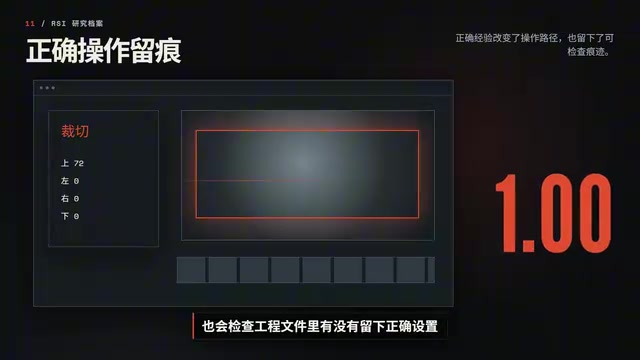
A word of caution: the conditions for these two runs were not fully aligned, so while we can observe a performance difference, we cannot attribute the entire score change to memory alone. The higher-scoring run also used more iterations — it completed the task more thoroughly, but that doesn't prove it was faster or more resource-efficient.
Overall Performance on OS World 20
The team also applied this approach to the OS World 20 benchmark — an evaluation that has agents actually operate a computer and software rather than answer questions. Tasks include video editing, presentation repair, web navigation, and more, scored by how much the agent actually completes.
Across 82 offline tasks, average completion rose from roughly 72% to roughly 79%. However, these 82 tasks were not each run once under identical conditions — half used original baseline scores, and the resources and number of attempts per task varied. So the 72%-to-79% figures indicate that overall performance in the report trended upward, but those 7 percentage points cannot be fully credited to memory. The report demonstrates higher completion rates; whether efficiency also improved requires separate analysis.
OS World is a benchmark jointly released by CMU and other institutions specifically designed to evaluate an AI agent's ability to complete complex tasks in a real desktop OS environment. Unlike pure text Q&A benchmarks, OS World requires agents to directly control the mouse, keyboard, and application interfaces. Tasks include file management, office software operations, and web browsing, scored based on actual output files or system state changes — not the model's text descriptions. OS World 20 is an updated version with expanded task types and difficulty levels. These "embodied" evaluations are considered more credible than language benchmarks because they cannot be gamed by memorizing answers — the initial state and file contents of each task can be randomized, so agents must genuinely understand and execute the workflow to earn points.
Memory Is a Double-Edged Sword
The biggest risk the RSI Agent must guard against is that memory can amplify errors. If the verification agent makes a misjudgment and logs a flawed approach as a success, that bad experience gets written into long-term memory and reused by future tasks. A manual written with errors is often more dangerous than having no manual at all.
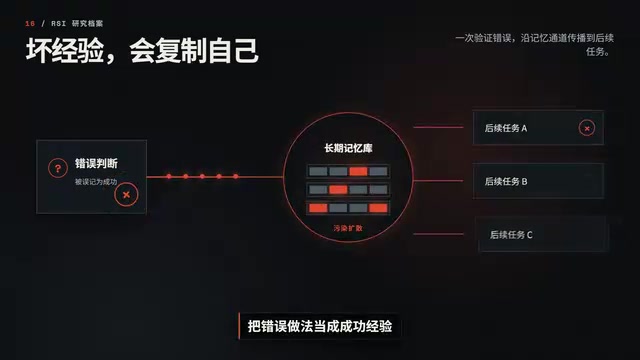
At this point, the RSI Agent can already explore environments, verify results, and pass experience forward to subsequent tasks on these computer-based challenges. But the overarching "improvement framework" is still designed by humans: how practice is generated, how decisions are divided, what rules govern acceptance, how memory gets updated — all of this is encoded in a fixed structure. High-level goals and deployment decisions also remain firmly in human hands.
This risk has a corresponding technical concept in machine learning — the inverse of "catastrophic forgetting under distribution shift," namely overfitting to a small number of successful cases. When the verification module itself is unreliable, the system is essentially measuring itself with a miscalibrated ruler, and each measurement result feeds back into how the next ruler is calibrated. This is one of the core concerns in RSI safety discussions: if the reward signal (i.e., "what counts as success") can be indirectly modified by the system, it may learn not to complete tasks but to make the verification agent more likely to award high scores. Acer AI's current approach limits this risk by fixing the underlying model parameters and locking in memories before formal tasks begin, but the judgment quality of the verification agent remains the weakest link in the entire chain.
From Automated Research Intern to Automated Research Scientist
The renewed attention on RSI also relates to AI entering the R&D pipeline. According to analysis from content creators, OpenAI has announced that its internal systems have reached the "automated research intern" stage — by OpenAI's own definition, the system can complete well-scoped research tasks under human guidance, including some that would originally take skilled researchers several days. OpenAI aims to progress further toward the goal of an "automated AI research scientist," pointing toward a higher degree of R&D automation.

But this shouldn't be read as a countdown to full RSI. Research priorities are set by humans, humans judge which results are worth pursuing, and humans decide whether to scale, pause, or deploy the system. OpenAI itself has acknowledged that it does not yet know how to safely reach fully aligned RSI.
Complete RSI Is Still Missing One Critical Step
Taken together, what the publicly available results support is this: experience can be retained, and AI can participate in R&D. But complete RSI is still missing one key step — the system being able to modify its own improvement methods and reliably get stronger over successive rounds under comparable resources and independent evaluation.
Simply running more iterations or spending more compute cannot support the conclusion that "the system is self-improving." The real watershed for RSI is whether the methods used to find problems, try solutions, and validate results can themselves evolve automatically. For now, AI has arrived at the doorstep of experience accumulation and long-term memory — but autonomous evolution of the improvement framework itself remains in human hands.
Related articles

Australia Considers Following Canada's Lead to Deepen EU Ties
Australia signals it may follow Canada in deepening EU trade ties amid U.S. trade policy uncertainty, seeking diversification and risk hedging through closer EU engagement.

CREEM 2.0: The All-in-One Monetization Platform for AI Founders
CREEM 2.0 hit #1 on Product Hunt, offering AI founders a single platform for global payments, tax compliance, usage billing, affiliates, and payouts.

NovaSynth: Stress-Testing Voice AI Agents with Simulated Callers
NovaSynth by Noveum simulates real-world callers with accents, noise, and interruptions to stress-test voice AI agents across 30+ dimensions with actionable fix recommendations.