AI Replacing Jobs: What's Lost Goes Beyond Income to Dignity and Social Connection

AI replacing jobs costs more than income—it strips away structure, social connection, purpose, and status that work provides.
The Economist notes that as AI replaces jobs at scale, people lose far more than wages. A Google DeepMind literature review highlights five latent psychological benefits of paid work: daily structure, social contact, collective purpose, status, and a push against inertia. Studies show early retirement accelerates cognitive decline, lottery windfalls lead few to quit entirely, and long-term unemployed Germans see happiness jump at retirement as their social category shifts. Anthropic and Musk are preparing equity or cash compensation, but replacing work's psychological benefits with money remains an equally tough challenge.
《The Economist》 recently published an article raising an issue long obscured by techno-optimist narratives: when AI truly begins to replace human jobs at scale, what people lose goes far beyond the numbers on a paycheck. The structure work imposes on daily life, the social contact it brings, the sense of collective purpose, the social status it confers, and the push it provides against inertia—these psychological benefits are difficult to replace with a cash payout.
Tech Giants' Foresight and the Blind Spot of Optimism
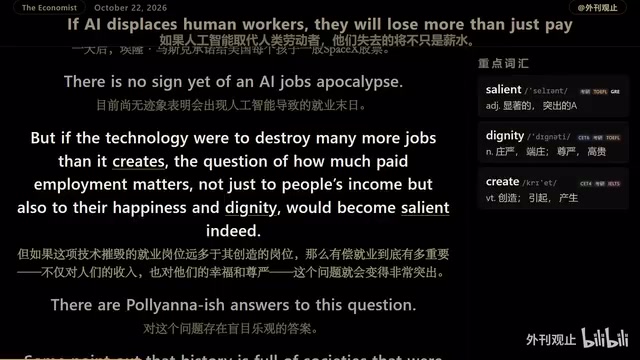
Anthropic has announced plans to contribute 5% of its shares to a public-interest fund that could eventually distribute cash to people affected by economic upheaval. Musk, meanwhile, has promised one share of SpaceX stock to every American child. Behind these moves lies a clear-eyed anticipation of AI's employment impact—though there are no signs of an AI jobs catastrophe yet, if the technology destroys far more jobs than it creates, then the size of compensation and the meaning of paid employment for happiness and dignity will become an unavoidable topic.
There is an overly optimistic response to this: some point out that history is full of societies not organized around paid work; survey data also shows most retired Americans report being satisfied with life. The implication—solve the small problem of "how to fund a life without work," and everyone can happily grow tomatoes and take river cruises. But the truth is far more complicated.
Anthropic's proposed "public-interest fund" is essentially a shareholder value redistribution mechanism: the company injects part of its equity (rather than cash) into an independent fund, managed by trustees, that ultimately distributes returns to those affected by the AI economy. This arrangement differs from traditional corporate social responsibility—it attempts to directly hedge the externalities of technological unemployment at the capital level. Musk's promise of one SpaceX share to every American child is closer to a symbolic "universal basic equity" concept—replacing one-time cash compensation with the long-term appreciation of a growth asset. The common logic of both is: if AI-generated wealth is highly concentrated in a few companies, then letting the public hold equity in those companies may be a more direct path to shared prosperity than tax-based transfer payments. But such schemes have yet to answer a key question: there is a timing mismatch between the distribution cycle of equity returns and the immediacy of unemployment shocks.
Five Latent Benefits That Work Provides
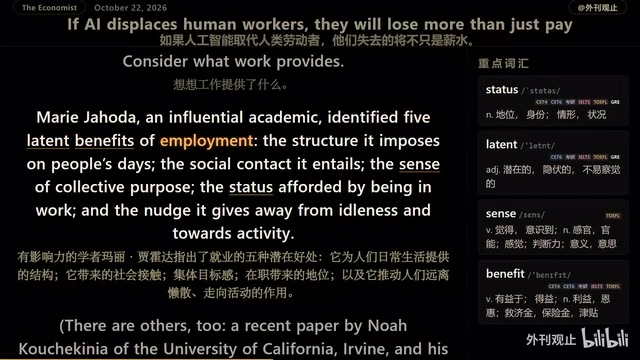
A literature review on well-being and work published last month by Google DeepMind researcher Stephanie Chan and colleagues provides a useful reminder: the benefits of paid employment far exceed income itself. Influential scholar Marie Jahoda (spelled "Jehoda" in the original) identified five latent benefits of employment—the structure work imposes on daily life, the social contact it brings, the sense of collective purpose, the status conferred by being employed, and the force that pushes people away from inertia toward activity.
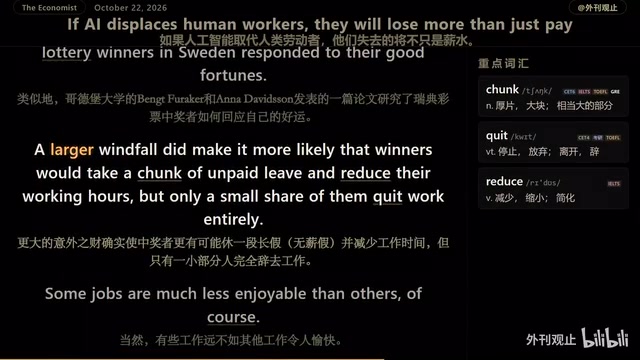
A recent paper by Noah Kouchikinia of the University of Michigan and co-authors from UC Irvine found that adults who leave the workforce before retirement age experience accelerated cognitive decline. Even people with ample means seem wary of a life of pure leisure—not many Silicon Valley billionaires drop everything to focus on hobbies. Bengt Fuehraker and Anna Davidson of the University of Gothenburg studied the responses of Swedish lottery winners: larger windfalls did make winners more likely to take unpaid leave and reduce working hours, but only a small fraction quit entirely.
Marie Jahoda (spelled "Jehoda" in the original) was a major figure in 20th-century social psychology. Building on her 1930s research on an unemployed community in Marienthal, Austria, she proposed the famous latent functions of employment theory. The core insight is that even setting aside wages, employment itself satisfies human psychological needs through five "latent functions"—time structure, social contact, collective goals, identity status, and regular activity. Jahoda argued that unemployment causes psychological harm not because of laziness or lost income, but because these five functions are simultaneously stripped away. This framework later became a cornerstone of unemployment psychology and well-being research, and is the theoretical starting point for understanding the "non-monetary costs" of AI replacing human work.
Can Substitute Activities Fill the Void Left by Work?
Of course, some jobs are far more pleasant than others, and people can also derive latent benefits from activities such as caregiving and full-time parenting. Michelle Jonginellis of the University of Melbourne and colleagues studied the effect of volunteering on the well-being of Australian retirees: even a minimal commitment of just one hour per week produced significant improvements in life satisfaction and sense of purpose scores.
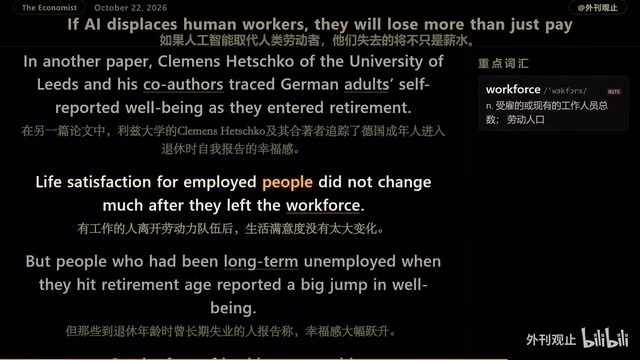
But for those who want to work and look forward to working, this is no comfort. Clemens Hetschko of the University of Leeds and colleagues tracked self-reported well-being among German adults entering retirement: life satisfaction changed little for employed people after they left the workforce, but long-term unemployed people saw a sharp jump in happiness upon reaching retirement age. On the surface this seems strange—employed people almost certainly experienced greater changes in daily rhythm and income. The authors' theory is that the unemployed completed a social category switch: from an unwelcome category at working age to a respected category at retirement age.
In other words, anyone who casually asserts that "people can replace paid employment with other activities" is ignoring the evidence. Some jobs are indeed bad, but nothing else today delivers the same packaged psychological and monetary benefits in such a socially acceptable form. If AI takes away people's jobs, ensuring they have enough money to live is a big problem; giving them a sense of self-worth will be an equally difficult challenge.
The "social category switch" theory in the research by Clemens Hetschko and colleagues draws on the sociological concepts of role exit and identity reconstruction. In societies like Germany where occupational identity is central, unemployed people of working age are often categorized as "unwelcome dependents" and bear stigmatizing pressure; yet once they reach the statutory retirement age, the same unemployed status is redefined as "deserved rest," and social evaluation reverses accordingly. This category switch explains why long-term unemployed people experience a jump in happiness at retirement—what they escape is not the work itself, but the identity devaluation brought by unemployment. For those unemployed due to AI, this finding means: if society cannot provide a dignified identity narrative for being "replaced by technology," cash compensation alone will struggle to eliminate the psychological gap.
One-line Summary
AI replacing jobs not only costs income but also strips away the psychological benefits work provides—structure, social connection, purpose, and status.
Paragraph Summary
《The Economist》 points out that when AI replaces jobs at scale, people lose far more than wages. A literature review by Google DeepMind researcher Stephanie Chan and colleagues reminds us that paid employment provides five latent psychological benefits: daily structure, social contact, collective purpose, social status, and a push against inertia. University of Michigan research found early retirement accelerates cognitive decline; a Swedish lottery winner study shows windfalls lead only a small minority to quit entirely; a German tracking study found long-term unemployed people's happiness jumps at retirement because their social category shifts from unwelcome to respected. Anthropic and Musk have begun preparing with equity or cash compensation, but replacing work's psychological benefits with money will be an equally difficult challenge.
Related articles

How Accurate Are Sci-Fi's Predictions About AI?
How accurate are sci-fi's predictions about AI? Drawing on a Hacker News discussion, this article analyzes sci-fi's foresight and blind spots in AI development, arguing its true value lies in inspiring thought rather than precise prediction.

SwarmEvolve: Latent-Space Agent Swarms Accelerate Evolutionary Search
SwarmEvolve lets hundreds of low-cost agents swarm-reason in latent space, sharing info via KV caches to achieve fast evolutionary search for math and science problems—reaching in a median of 3–8 minutes the best scores other frameworks need 60 minutes for.

trainlint: Static Checks Catch ML Training Bugs That Don't Crash
trainlint is a static analysis tool that finds ML training bugs that don't throw errors, including data leakage, leftover eval mode, and softmax/CrossEntropyLoss conflicts across 14 categories. This article covers its principles, validation results, and limitations.