AI SDK Adds Z.ai Provider Support, Dependency Chain Updated in Sync

@ai-sdk/zai@2.0.11 patch released, synchronously upgrading two underlying dependencies to maintain AI SDK ecosystem integrity.
`@ai-sdk/zai@2.0.11` is a patch-level update whose core action is synchronously upgrading `@ai-sdk/provider-utils@4.0.59` and `@ai-sdk/openai-compatible@2.0.83`. This package provides an official AI SDK adapter layer for Zhipu AI's Z.ai platform, using the OpenAI-compatible protocol to enable unified interface calls and reduce migration costs. Dependency sync may mean upstream utility functions or the compatibility layer fixed issues, but release notes don't elaborate—checking the commit diff is needed. No breaking changes, low risk; regression testing is recommended.
The AI SDK ecosystem has received a small but important update. @ai-sdk/zai@2.0.11 has been released, providing an official adapter layer for Zhipu AI's Z.ai platform, while also triggering synchronized upgrades for two underlying packages: provider-utils and openai-compatible.
A Patch Release That Deserves Attention
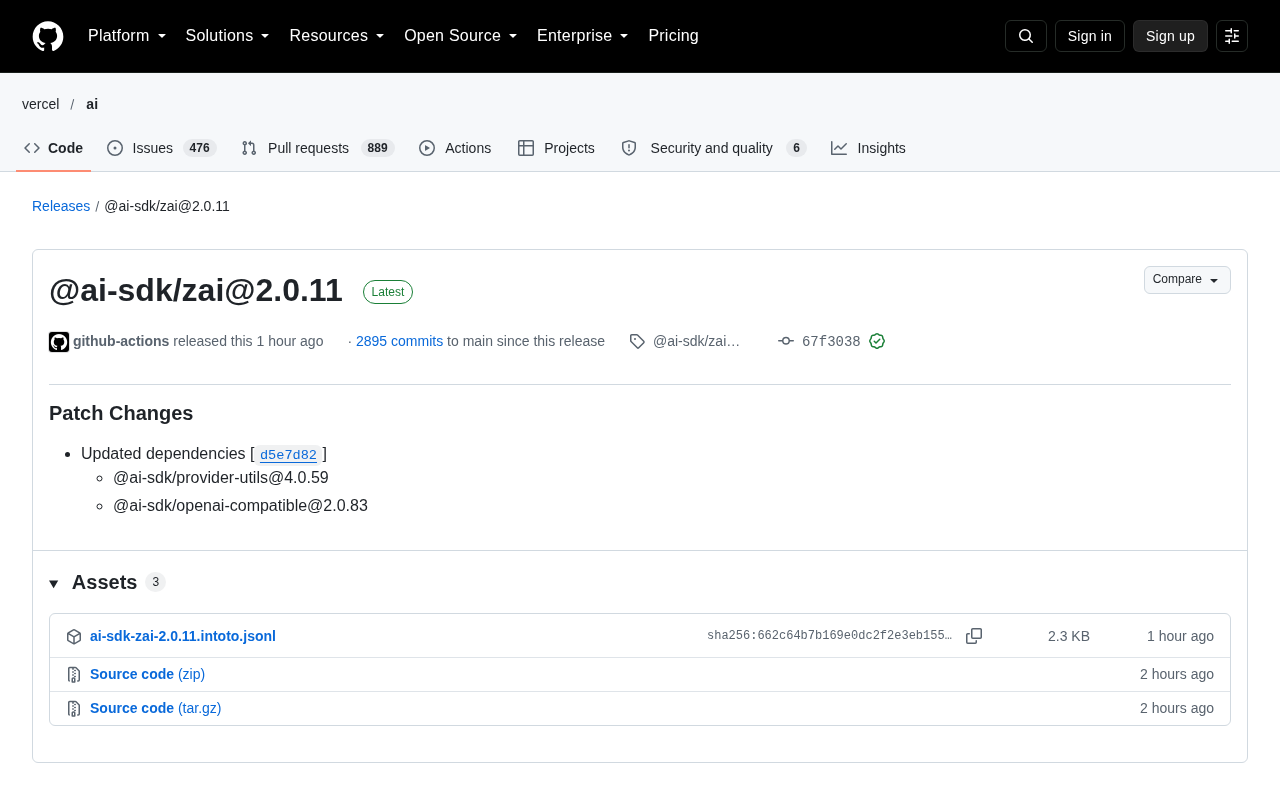
Judging by the version number, 2.0.11 is a patch-level release, marked as "Patch Changes" in the GitHub Release notes. The direct trigger for this update was the version bump of two dependencies: @ai-sdk/provider-utils@4.0.59 and @ai-sdk/openai-compatible@2.0.83.
On its own, the release record doesn't carry much information—no new feature descriptions, no API change notes. But within the overall architecture of the AI SDK, this kind of "dependency sync" update often means that upstream packages have fixed certain compatibility issues or edge cases, and downstream provider packages need to follow suit to maintain consistent behavior. For developers currently using Z.ai models, upgrading to 2.0.11 is the most direct way to keep the dependency chain healthy.
Z.ai's Position in the AI SDK Ecosystem
The AI SDK aims to provide a unified interface for calling models from different vendors. The role of the @ai-sdk/zai package is to wrap Zhipu AI's API into a provider that conforms to the AI SDK specification, allowing developers to switch model sources with the same set of code.
You may not have noticed that this package's dependencies include @ai-sdk/openai-compatible. This indicates that Z.ai's interface maintains a high degree of compatibility with OpenAI's API in its design—a common practice among domestic large model vendors. The benefit is low migration cost for developers; the downside is that certain platform-specific parameters may be filtered out by the abstraction layer. If you need to use Z.ai's unique capabilities, you may need to bypass the provider layer and call the native interface directly.
What is a Provider?
In the context of the AI SDK, a Provider is an adapter module that implements a unified interface specification, responsible for converting a model vendor's HTTP API into standard methods callable within the SDK. The AI SDK core library defines interfaces such as LanguageModelV1, requiring providers to implement methods like doGenerate (non-streaming generation) and doStream (streaming generation), and to return response objects with a unified structure. @ai-sdk/zai is exactly such a provider: it exposes a createZai() factory function externally, and internally handles authentication, request body construction, response parsing, and error mapping. This layered design decouples upper-layer application code from specific vendors—when switching model sources, you only need to replace the provider instance without modifying business logic.
What is the OpenAI-Compatible Protocol?
OpenAI compatibility refers to a vendor's REST API maintaining consistency or high similarity with OpenAI's official API in terms of request paths, JSON field naming, SSE streaming response format, and so on—typically including the /v1/chat/completions endpoint, the messages array structure, and streaming chunks like choices[].delta.content. The @ai-sdk/openai-compatible package abstracts these commonalities into a reusable provider base class, so vendors only need to provide a baseURL, model list, and a small amount of differential configuration to integrate with the AI SDK. The trade-off is that platform-specific parameters (such as certain vendors' custom sampling fields or tool-calling extensions) may not be passable through the generic layer.
The Engineering Signal Behind the Dependency Update
A single patch update pulling two underlying dependencies simultaneously—this pattern is common in monorepo-managed SDK projects. @ai-sdk/provider-utils typically carries utility functions shared across various providers, such as request construction, streaming response parsing, and error mapping; @ai-sdk/openai-compatible provides a generic implementation of the OpenAI-compatible protocol.
Their simultaneous upgrade may mean:
- Some utility function behavior in provider-utils has changed, requiring all provider packages that depend on it to update in sync
- The openai-compatible layer has fixed a bug related to streaming output or tool calling, with Z.ai passively following along as a downstream beneficiary
- Or it's a routine version alignment operation with no substantive logic changes
The release notes don't elaborate on specific changes. If developers care about the details, they need to check the diff of the corresponding commit (d5e7d82).
Monorepo and Dependency Sync
The AI SDK is managed as a monorepo, with all official provider packages and foundational packages like @ai-sdk/provider-utils and @ai-sdk/openai-compatible located in the same code repository, released uniformly through workspaces and the changesets tool. When a foundational package changes, changesets automatically generates patch versions for downstream packages that depend on it and bumps the dependency range—this is exactly the mechanism behind @ai-sdk/zai@2.0.11 pulling two underlying dependencies simultaneously.
Patch Versions and Semantic Versioning
Following the SemVer specification, an increment in the patch position of a MAJOR.MINOR.PATCH version number indicates a backward-compatible bug fix that introduces no new features or breaking changes. Therefore, 2.0.11 carries low upgrade risk for consumers, but it may still contain subtle behavioral corrections (such as error code mapping adjustments or boundary handling for streaming chunks). Running regression tests on critical paths remains a prudent practice.
What Developers Should Do
If you use @ai-sdk/zai in your project, upgrading is straightforward:
npm install @ai-sdk/zai@2.0.11
Or use the corresponding command for pnpm / yarn. Since it's a patch version with no breaking changes, the upgrade risk is low. However, it's recommended to run your existing model invocation tests after upgrading to confirm that critical paths such as streaming responses and tool calling are functioning normally.
For developers who haven't yet integrated Z.ai, if your project already uses other AI SDK providers, the migration cost mainly lies in API Key configuration and model name replacement. Z.ai provides an OpenAI-compatible interface format, so code changes are usually minimal.
Summary
@ai-sdk/zai@2.0.11 is not a version with standout features; its value lies in maintaining the completeness of the AI SDK provider matrix. For developers relying on Z.ai, this is a patch worth following up on; for those still on the sidelines, the existence of this package means yet another model option callable within the AI SDK framework.
One-line Summary
@ai-sdk/zai@2.0.11 patch released, synchronously upgrading two underlying dependencies to maintain AI SDK ecosystem integrity.
Paragraph Summary
@ai-sdk/zai@2.0.11 is a patch-level update whose core action is synchronously upgrading two underlying dependencies: @ai-sdk/provider-utils@4.0.59 and @ai-sdk/openai-compatible@2.0.83. This package provides an official AI SDK adapter layer for Zhipu AI's Z.ai platform, leveraging the OpenAI-compatible protocol to enable unified interface calls and lower migration costs for developers. Dependency sync may indicate that upstream utility functions or the compatibility layer fixed compatibility issues or edge cases, but the release notes don't elaborate on details—checking the commit diff is necessary for confirmation. The upgrade has no breaking changes and carries low risk; regression testing of streaming responses and tool-calling paths is recommended. For developers already integrated with Z.ai, it's a patch worth following up on; for those on the sidelines, it means the AI SDK now has one more callable model option.
Related articles

Gemini 4 Argon Hands-On: AI Builds Board Games, Constructs Temples, and Trains Robots Autonomously
Gemini 4 Argon hands-on roundup: AI autonomously builds a desk racetrack and temple in Blender, writes a ray tracing engine, trains a humanoid robot to sink 7 shots, plus API pricing and developer access.

The Magic Octagonal Coin: Why Only 9% of People Can Predict Its Flip?
Only 9% of people can correctly predict the Magic Octagon coin flip. This article explains its spatial rotation mechanism, common cognitive pitfalls, and a new hypothesis based on Relevance Theory, exploring the limits of human spatial reasoning.

Sam Altman: AI Is Entering the Era of Scientific Discovery — Math Breakthroughs Will Replicate in Biology and Energy
Sam Altman says AI is entering the era of scientific discovery — math breakthroughs will replicate in biology, materials science, and energy to help develop new drugs and energy sources.