@ai-sdk/harness-opencode Patch Analysis: AGENTS.md Symlink Permission Fix

@ai-sdk/harness-opencode 1.0.196 confines repository AGENTS.md symlinks under restrictive permission modes, fixing a subtle path escape risk.
1.0.196 is a patch release of @ai-sdk/harness-opencode whose core change confines AGENTS.md symlinks within the repository under restrictive permission modes, preventing agents from reading or writing paths outside the repository via links. AGENTS.md is a project instruction entry point that AI coding agents read and trust first, making it part of the attack surface; the issue only surfaces when both restrictive permission mode and a symlink in the repository are present simultaneously, making it highly subtle and common in multi-tenant or sandboxed deployments. The @ai-sdk/harness dependency is bumped to 1.0.193, and the release is automatically published by github-actions with a verified signature, reflecting a high-frequency, small-step patch cadence. Users with restrictive permission mode enabled are advised to upgrade to 1.0.196 or later and check whether project instruction files are symlinks.
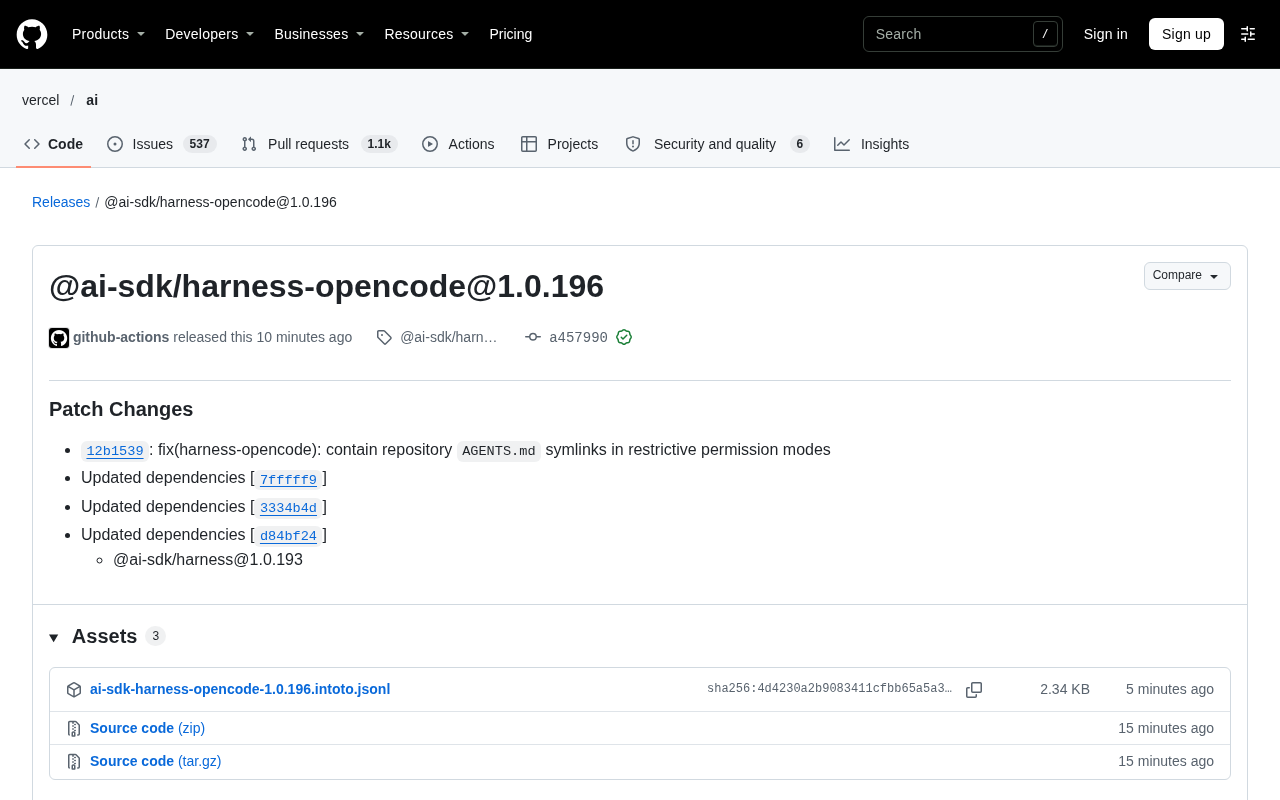
@ai-sdk/harness-opencode has released patch version 1.0.196, with a core change that tightens a security boundary: in restrictive permission modes, it now brings AGENTS.md symlinks within the repository under control. The version number looks like a routine iteration, but this fix points to a type of easily overlooked issue—how AI coding tools handle path escape via symlinks when reading and writing project-level instruction files.
What This Patch Changes
According to the changelog in the GitHub release notes, the description of this patch (commit 12b1539) is fix(harness-opencode): contain repository AGENTS.md symlinks in restrictive permission modes. The key words are contain and restrictive permission modes.
In other words, under tightened permission configurations, harness-opencode now confines AGENTS.md symlinks within the repository to the expected scope, rather than letting them point to arbitrary paths outside the repository. The release notes also list several dependency updates, with the external dependency @ai-sdk/harness upgraded to 1.0.193.
The release was completed automatically by github-actions, and the commit carries a GitHub verified signature, indicating it is the product of a standardized CI release process rather than a manual ad-hoc push.
Why AGENTS.md Deserves Its Own Patch
AGENTS.md is one of the key entry points through which AI coding agents read project context, typically used to carry instructions such as code conventions, build commands, and directory conventions. It is naturally read and trusted first by agents, which makes it part of the attack surface.
The problem lies in symlinks. If the AGENTS.md in a repository is a soft link pointing to a file outside the repository, then in a restricted execution environment, the agent could follow that link to read content it should not be able to read, or write operations could land outside the expected directory. The patch uses contain to constrain this behavior—essentially patching the boundary of the permission model rather than adding new functionality.
The subtlety of this type of issue is that it is almost never triggered in normal usage scenarios; it only surfaces when both "restrictive permission mode" and "symlink exists in the repository" conditions are met simultaneously. Therefore it will not appear in feature demos, but it becomes a real risk in multi-tenant or sandboxed execution deployments.
Symlinks and Path Escape
A symbolic link is a special file in Unix-like file systems whose content is merely a string reference pointing to another path; when reading or writing that link, the kernel automatically resolves it to the target path. In security contexts, it is often used as a means of "path escape": sandboxes or permission layers typically only check whether the path string passed by the user falls within the allowed root directory, while a symlink hides the real access target behind link resolution, causing a mismatch between what is checked and what is actually read or written. The classic defense is to first resolve the real path (e.g., realpath) and then verify it is still within the allowed root, or to outright reject links in untrusted directories. This patch "fences" AGENTS.md symlinks within the repository to the repository scope—precisely this approach applied to the AI coding agent scenario.
The Project's Maintenance Style as Seen Through Its Version Cadence
From version 1.0.196 and the dependency at 1.0.193, it is clear that the harness-related packages adopt a high-frequency, small-step patch release cadence. This kind of cadence usually implies two things: first, the core interfaces are relatively stable with changes concentrated in boundary fixes; second, the release pipeline is highly automated, with github-actions directly producing signed commits.
For users, the benefit of this cadence is that security fixes arrive quickly; the cost is that one needs to pay attention to the semantics of each patch's changes, especially descriptions involving permissions, paths, and sandboxes, because they often do not manifest at the API level yet change runtime behavior.
Semantic Versioning and the Meaning of Patch Releases
Semantic Versioning (SemVer) splits a version number into three segments: major.minor.patch. A major version change indicates incompatible API changes, a minor version indicates backward-compatible new features, and a patch number is used only for backward-compatible bug and security fixes. Therefore, 1.0.196 only increments the patch position relative to the previous version, meaning the external interface is unchanged and upgrading theoretically has no migration cost—which is also why this article recommends following up directly. A high-frequency, small-step patch cadence is common in mature libraries: after core interfaces are frozen, increments are concentrated on boundary condition fixes, each release is small in scope and rollback-friendly, and security fixes reach users within hours—at the cost of requiring upgraders to understand the semantics of each patch rather than just looking at the version number.
Usage Recommendations
If your pipeline or agent runtime has restrictive permission mode enabled, it is recommended to upgrade directly to 1.0.196 or later. When upgrading, note whether AGENTS.md will still resolve as expected if it is a symlink—the semantics of the fix are "confined within the repository scope," and links pointing outside the repository may no longer be allowed.
Additionally, it is worth adding "whether project instruction files are symlinks" to your repository checks. Such structures are not uncommon in monorepos and multi-package shared configuration scenarios, and making them explicit in advance is more convenient than troubleshooting after permission modes are tightened.
FAQ
Does this update add any new capabilities? No. This is a pure patch fix, with changes limited to symlink containment under permission modes and dependency updates.
Will there be an impact if I don't upgrade? It may only be affected when restrictive permission mode is enabled and an AGENTS.md symlink exists in the repository. If neither condition is met, the risk surface is small; but per the convention of security patches, following up is still recommended.
Related articles

Nothing CMF Buds 2A Drops to $17.89 on Black Friday: A New Low for ANC Earbuds
Nothing CMF Buds 2A wireless earbuds Black Friday deal: just $17.89 on Amazon, about $11 off retail and a record low. ANC earbuds at an entry-level price.

When AI Creation Gets Accused of "Spitting": Hacker News Heats Up Over the Glaude Controversy
A Hacker News post, "Spitting in the Face of Glaude," sparks debate on AI creation transparency and attribution ethics. This analysis examines the blurred creator identity behind the controversy and offers practical advice for AI content production.

Akai Embraces Custom Firmware: MPC Sample 1.4 Lets Users AI-Program Their Sampler
Akai embraces the modding community with MPC Sample 1.4 firmware, supporting vibe-coded custom firmware and effects. We analyze the impact of this open strategy on music hardware and AI-assisted programming.