AI SDK MiniMax 3.0.85 Patch Update: Anthropic Dependency Synced

@ai-sdk/minimax 3.0.85 is a patch update that only syncs the Anthropic dependency to 4.0.108.
The @ai-sdk/minimax in the AI SDK ecosystem released the 3.0.85 patch version, with the only substantive change being the synced upgrade of the @ai-sdk/anthropic dependency to 4.0.108, automatically published by GitHub Actions with GPG signature verification. The MiniMax package itself adds no new APIs or modifies request logic—it's dependency lockstep maintenance under the multi-package monorepo architecture. Since the changelog doesn't disclose specific Anthropic-side changes, the actual impact requires checking its independent release notes. Projects using semantic version ranges may automatically incorporate this update, while exact version pinning requires manual adjustment. Regression testing for streaming output and error handling is recommended after upgrading.
A Low-Key Version Iteration
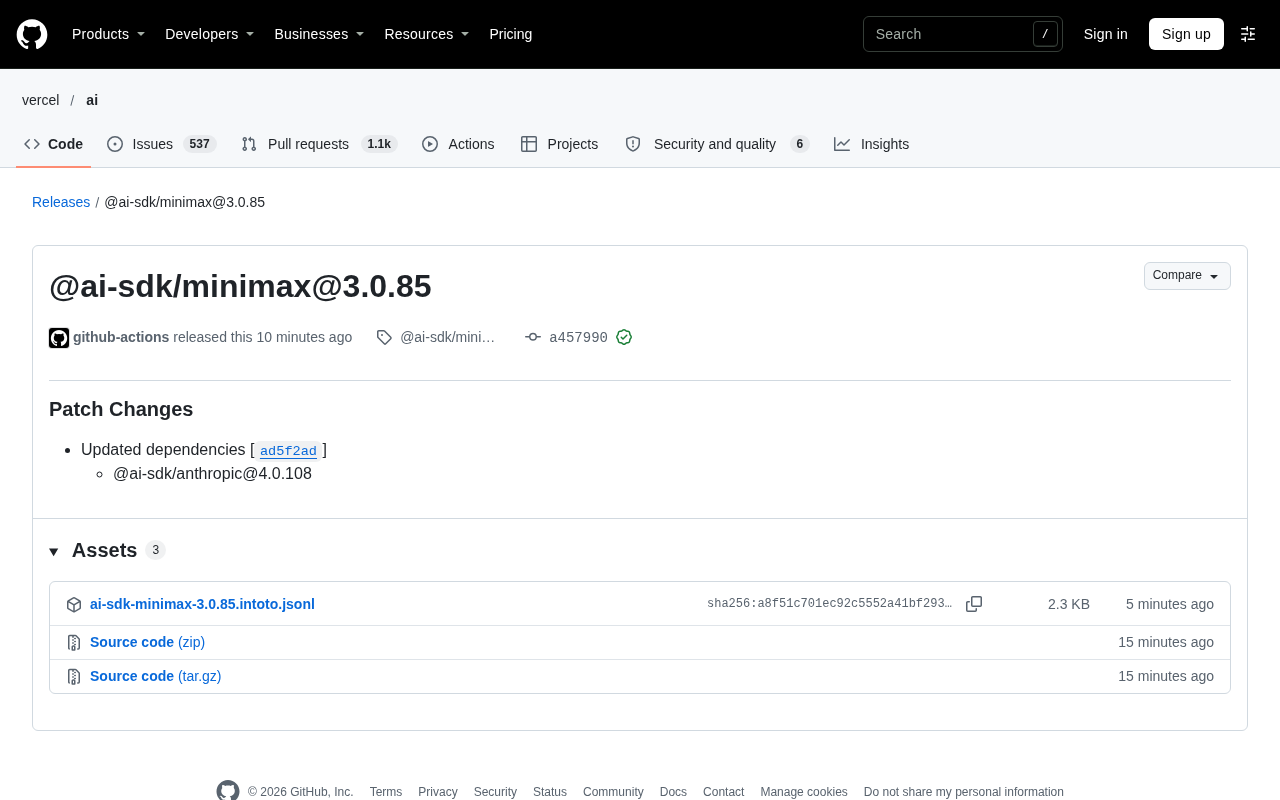
The MiniMax provider package in the AI SDK ecosystem recently released version 3.0.85. Judging from the changelog on GitHub, this is a typical patch update, with essentially one core change: the @ai-sdk/anthropic dependency was synced and upgraded to version 4.0.108.
Such updates are not uncommon in the AI SDK release cadence. The AI SDK is managed as a multi-package monorepo, and each model provider's adapter package gets upgraded in lockstep as underlying shared dependencies receive fixes. This change was automatically published by GitHub Actions, with a GPG-signed commit, making the process highly automated.
Breaking Down the Patch
The Only Substantive Change
The changelog explicitly labels this as Patch Changes and references a commit hash ad5f2ad, indicating that @ai-sdk/anthropic@4.0.108 was pulled in. In other words, the MiniMax package itself adds no new APIs and modifies no request logic—it simply bumps the dependency tree forward by one notch.
For developers using @ai-sdk/minimax, the actual impact of this upgrade depends on what's included in the Anthropic package 4.0.108. Since the changelog doesn't expand on the Anthropic-side changes, it's impossible to determine from the available material alone whether any behavioral changes are involved.
Automated GitHub Actions publishing and GPG signing form the foundation of this kind of patch's trustworthiness. GitHub Actions is GitHub's built-in CI/CD service; repositories can configure workflows that automatically run tests, build version numbers, and publish to npm when events like merges or tagging are triggered—which is why these patches often lack manually written descriptions. GPG signature verification means commits or tags are signed with a private key, allowing recipients to verify origin and integrity using the public key to prevent versions from being tampered with or impersonated. Together, these two mean: the release process is standardized and reproducible, but the change descriptions are typically taken directly from commit messages, offering limited detail. If developers need to understand the real changes, examining the diff of the corresponding commit hash (such as ad5f2ad in this article) is often more effective than reading the changelog.
Why Dependency Upgrades Deserve Attention
The AI SDK's design philosophy is to let different model providers share a single set of calling interfaces. As one of the core provider implementations, the Anthropic package's internal utility functions, streaming response handling, message format conversion, and other logic may be reused by other packages. When dependency versions are inconsistent, type definition conflicts or runtime behavioral differences can easily arise. Therefore, even patch-level syncing helps maintain consistency across the entire SDK ecosystem.
For projects with locked versions, it's recommended to check the independent changelog of @ai-sdk/anthropic@4.0.108 before upgrading to confirm there are no changes affecting your usage.
Semantic Versioning (SemVer) is the key basis for this update being judged as "low risk." SemVer splits version numbers into three segments—major.minor.patch: major version changes typically contain breaking API changes, minor versions represent backward-compatible new features, and patch versions only fix defects without changing public interfaces. The "patch update" mentioned in the article refers to the third segment incrementing (3.0.84 → 3.0.85). However, SemVer only constrains the package's own exposed APIs and doesn't guarantee that its internal dependency upgrades won't indirectly change behavior—for example, a dependency package might adjust default timeouts or retry policies in a patch. Therefore, for updates that "bump the dependency tree forward by one notch," you still need to combine them with the upgraded dependency's own changelog to judge the actual impact, which is precisely why the article recommends checking the independent release notes of @ai-sdk/anthropic@4.0.108.
Multi-package monorepo and version lockstep provide the background for understanding this release. A monorepo means placing multiple interrelated npm packages in the same code repository for unified management—the AI SDK follows exactly this structure: the core package provides abstract interfaces, while each provider adapter package (such as @ai-sdk/anthropic and @ai-sdk/minimax) implements the calling details for specific models. Since these packages often share utility functions and type definitions, once an upstream package releases a version, downstream packages often need to raise their dependency versions in sync, forming "lockstep upgrades." The benefit is avoiding multiple versions of type definitions within the same repository, reducing issues like failed instanceof checks, type incompatibilities, or streaming response parsing differences; the cost is frequent releases with small amounts of release information per package—as with this one-line patch record.
Practical Advice for Developers
Upgrade Strategy
If your project already uses @ai-sdk/minimax and your dependency management uses semantic version ranges (such as ^3.0.0), this update will most likely be incorporated automatically. If you use exact version pinning, you'll need to adjust manually. Considering this is a patch version, the likelihood of breaking changes is low, but lockstep dependency upgrades still require regression testing.
Points to Watch
This release has limited information, with no accompanying migration guide or behavioral notes. After upgrading, developers should focus on verifying that MiniMax-related calls work correctly, especially scenarios involving streaming output and error handling. If problems are found, you can roll back to the previous version and wait for subsequent fixes.
Summary
@ai-sdk/minimax@3.0.85 is a maintenance release aimed at syncing dependencies, reflecting the normal state of version lockstep under the AI SDK's multi-package architecture. It doesn't constitute a feature highlight in itself, but for teams tracking SDK stability, it's a link in the version management chain worth noting.
One-line Summary
@ai-sdk/minimax 3.0.85 is a patch update that only syncs the Anthropic dependency to 4.0.108.
Paragraph Summary
The @ai-sdk/minimax in the AI SDK ecosystem released the 3.0.85 patch version, with the only substantive change being the synced upgrade of the @ai-sdk/anthropic dependency to 4.0.108, automatically published by GitHub Actions with GPG signature verification. The MiniMax package itself adds no new APIs or modifies request logic—it's a dependency lockstep maintenance under the multi-package monorepo architecture. Since the changelog doesn't disclose the specific changes on the Anthropic side, the actual impact of the upgrade requires checking its independent release notes. Projects using semantic version ranges may automatically incorporate this update, while projects with exact version pinning need to adjust manually. It's recommended to focus regression testing on streaming output and error handling scenarios after upgrading, and roll back to the previous version if problems are found.
Related articles

Nothing CMF Buds 2A Drops to $17.89 on Black Friday: A New Low for ANC Earbuds
Nothing CMF Buds 2A wireless earbuds Black Friday deal: just $17.89 on Amazon, about $11 off retail and a record low. ANC earbuds at an entry-level price.

When AI Creation Gets Accused of "Spitting": Hacker News Heats Up Over the Glaude Controversy
A Hacker News post, "Spitting in the Face of Glaude," sparks debate on AI creation transparency and attribution ethics. This analysis examines the blurred creator identity behind the controversy and offers practical advice for AI content production.

Akai Embraces Custom Firmware: MPC Sample 1.4 Lets Users AI-Program Their Sampler
Akai embraces the modding community with MPC Sample 1.4 firmware, supporting vibe-coded custom firmware and effects. We analyze the impact of this open strategy on music hardware and AI-assisted programming.