AI SDK Releases @ai-sdk/zai@1.0.14 Patch Update

@ai-sdk/zai releases 1.0.14 patch, syncing underlying dependency versions with no breaking changes.
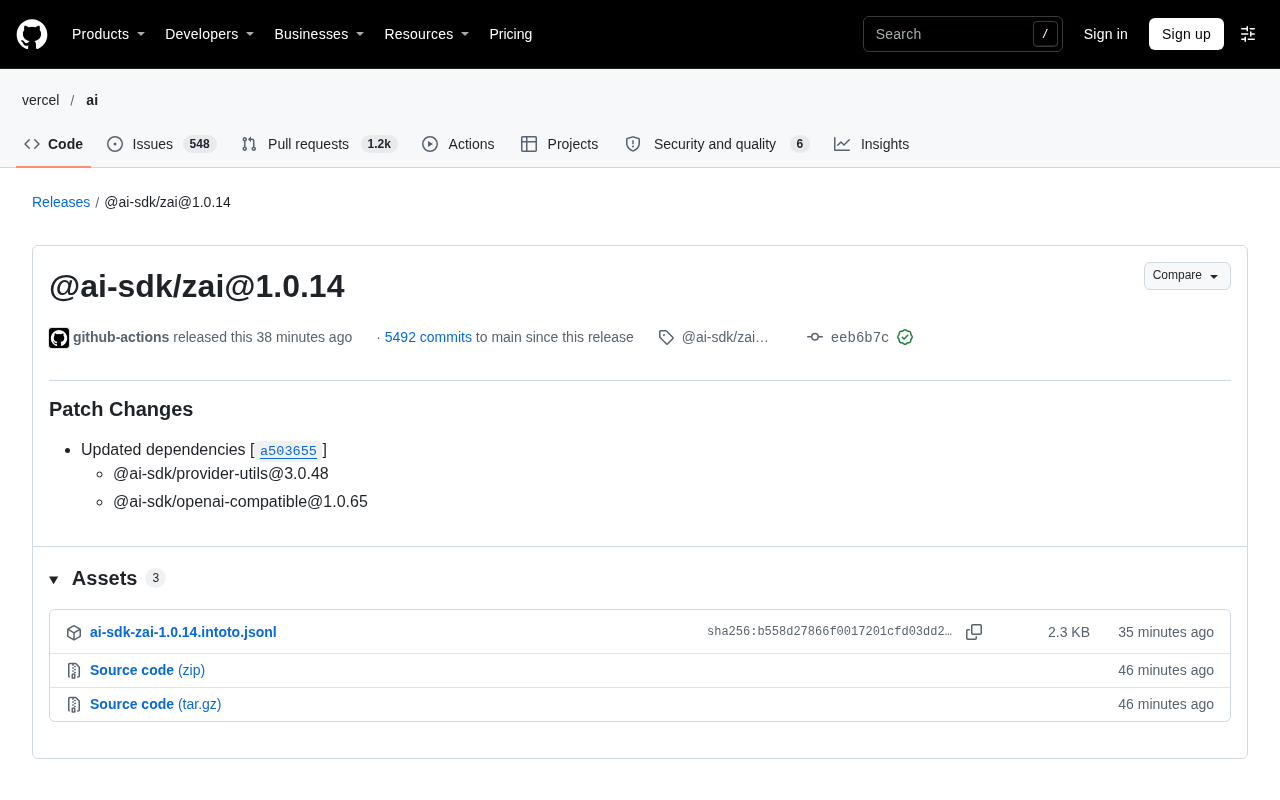
The AI SDK project under Vercel has released @ai-sdk/zai@1.0.14, a patch version that syncs two internal dependency packages: @ai-sdk/provider-utils to 3.0.48 and @ai-sdk/openai-compatible to 1.0.65. These packages provide common utilities and the OpenAI compatibility layer, and the update means inheriting upstream bug fixes or minor optimizations. The version was automatically published by GitHub Actions with signed commits, conforming to the project's automation standards. For developers, upgrade risk is low, the API remains unchanged, and existing code requires no adjustments; if the project directly depends on the relevant underlying packages, version alignment should be noted to avoid multiple-instance issues. This update reflects the maintenance pattern under AI SDK's modular architecture, where provider adapters are decoupled from core utility packages.
The AI SDK project under Vercel has recently released version @ai-sdk/zai@1.0.14. This is a typical patch update, primarily aimed at syncing underlying dependency versions rather than introducing new features or breaking changes.
Core Content of the Patch Update
According to the release notes on GitHub, this update is of the Patch Changes type. The patch version number (the last digit in 1.0.14) follows semantic versioning conventions and is typically used for backward-compatible bug fixes.
Dependency Synchronization
The specific content of the update is adjusting the dependency versions for two internal packages:
@ai-sdk/provider-utilsupdated to3.0.48@ai-sdk/openai-compatibleupdated to1.0.65
These two packages are foundational modules in the AI SDK ecosystem that handle provider interfaces and the OpenAI compatibility layer. As one of the provider adapters, @ai-sdk/zai depends on the common utilities and compatibility logic they provide. This version bump means the upstream packages may contain bug fixes or minor optimizations, and @ai-sdk/zai inherits these improvements by syncing dependencies.
@ai-sdk/provider-utils is a shared utility library in the AI SDK ecosystem, providing foundational capabilities used by various provider adapters, such as HTTP request wrapping, streaming response parsing, error handling, and retry logic. It is not directly user-facing but is referenced as an underlying dependency by adapters like @ai-sdk/zai and @ai-sdk/openai. When this package releases a patch update, it typically means certain edge cases have been fixed or utility functions have been made more robust; downstream adapters can inherit these improvements by syncing versions without modifying their own code.
@ai-sdk/openai-compatible is a compatibility layer package used to adapt third-party model services that follow the OpenAI API specification (such as Z.ai, DeepSeekAd, Together AI, etc.). It encapsulates OpenAI-style request/response formats, enabling different providers to integrate with AI SDK in a unified way. @ai-sdk/zai relies on this package to communicate with the Z.ai service, so version updates to this compatibility layer may involve fixes to request parameter handling, streaming, or error mapping; syncing to 1.0.65 helps maintain behavioral consistency.
Release Background
This version was automatically published by GitHub Actions, and the commit record shows the release came after the 5492nd commit on the main branch. The commit carries a GitHub verified signature, indicating the process conforms to the project's automated release standards.
Semantic Versioning (SemVer) is a widely adopted version numbering specification with the format major.minor.patch (e.g., 1.0.14). A major version change indicates incompatible API modifications, a minor version change indicates backward-compatible feature additions, and a patch version change indicates backward-compatible bug fixes. This update of @ai-sdk/zai from 1.0.13 to 1.0.14 only involves the patch digit, clearly signaling "no breaking changes," allowing developers to assess upgrade risk accordingly.
Impact on Developers
For developers already using @ai-sdk/zai, upgrading to 1.0.14 is a low-risk operation. Since it is a patch version, the API interface remains unchanged, and existing code requires no adjustments. The main benefit of upgrading is obtaining stability improvements from underlying dependencies.
Upgrade Recommendations
If the project locks versions via a package manager, @ai-sdk/zai can be safely updated to 1.0.14. If the project directly depends on @ai-sdk/provider-utils or @ai-sdk/openai-compatible, attention should be paid to version alignment to avoid multiple-instance issues with the same package.
Ecosystem Observations
The release cadence of AI SDK reflects the characteristics of its modular architecture: provider adapters are decoupled from core utility packages, with updates managed through independent version numbers. This pattern allows developers to introduce support for specific providers as needed without bearing the upgrade burden of the entire SDK. The ongoing maintenance of @ai-sdk/zai also demonstrates the project's investment in multi-provider compatibility.
For teams focused on AI application development, tracking such patch updates helps maintain the health of the dependency chain—especially in production environments, where timely application of fixes can prevent potential toolchain issues.
One-line Summary
@ai-sdk/zai releases 1.0.14 patch, syncing underlying dependency versions with no breaking changes.
Paragraph Summary
The AI SDK project under Vercel has released the @ai-sdk/zai@1.0.14 patch version, primarily syncing two internal dependency packages: @ai-sdk/provider-utils to 3.0.48 and @ai-sdk/openai-compatible to 1.0.65. These two packages provide common utilities and the OpenAI compatibility layer respectively, and the update means inheriting upstream bug fixes or minor optimizations. This version was automatically published by GitHub Actions, with commits verified by signature, conforming to the project's automation standards. For developers, upgrade risk is low, the API remains unchanged, and existing code requires no adjustments; if the project directly depends on the relevant underlying packages, attention should be paid to version alignment to avoid multiple-instance issues. This update reflects the maintenance pattern under AI SDK's modular architecture, where provider adapters are decoupled from core utility packages.
Related articles

Nothing CMF Buds 2A Drops to $17.89 on Black Friday: A New Low for ANC Earbuds
Nothing CMF Buds 2A wireless earbuds Black Friday deal: just $17.89 on Amazon, about $11 off retail and a record low. ANC earbuds at an entry-level price.

When AI Creation Gets Accused of "Spitting": Hacker News Heats Up Over the Glaude Controversy
A Hacker News post, "Spitting in the Face of Glaude," sparks debate on AI creation transparency and attribution ethics. This analysis examines the blurred creator identity behind the controversy and offers practical advice for AI content production.

Akai Embraces Custom Firmware: MPC Sample 1.4 Lets Users AI-Program Their Sampler
Akai embraces the modding community with MPC Sample 1.4 firmware, supporting vibe-coded custom firmware and effects. We analyze the impact of this open strategy on music hardware and AI-assisted programming.