AI SDK Releases @ai-sdk/zai 3.0.59 Patch Update
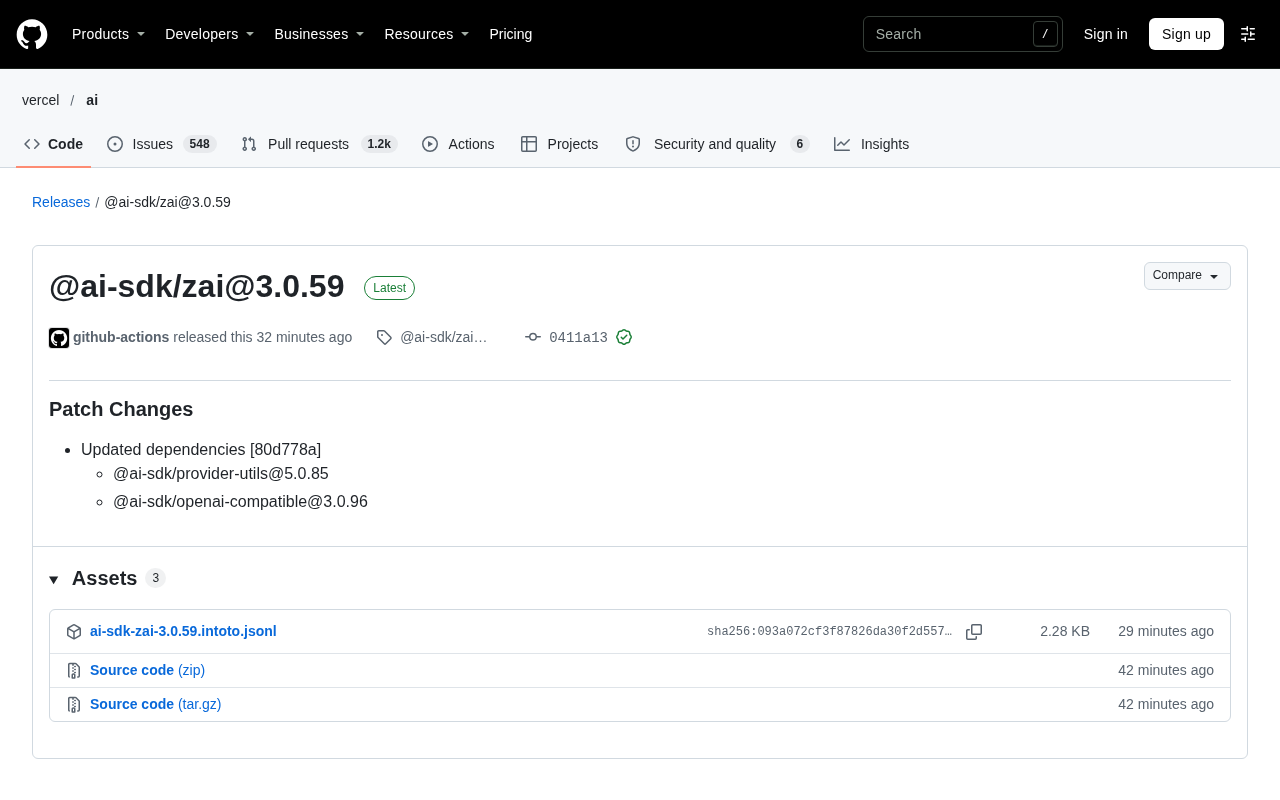
@ai-sdk/zai releases 3.0.59 patch, syncing underlying dependency versions and demonstrating AI SDK's multi-package linkage mechanism.
@ai-sdk/zai is updated to 3.0.59, a patch release focused on dependency synchronization with no new features or breaking changes. The only changes update @ai-sdk/provider-utils to 5.0.85 and @ai-sdk/openai-compatible to 3.0.96 to stay in sync with AI SDK's internal module cadence. This patch reflects the multi-package repository's dependency linkage mechanism, automatically triggered by github-actions, with no external API changes. Developers should monitor dependency tree alignment; production environments should pin versions and upgrade at controlled times, while experimental projects can follow patches for underlying improvements.
Title
AI SDK Releases @ai-sdk/zai 3.0.59 Patch Update
Meta Description
AI SDK releases @ai-sdk/zai 3.0.59 patch version, with the core change syncing @ai-sdk/provider-utils 5.0.85 and @ai-sdk/openai-compatible 3.0.96 dependencies. This article explains the background of this patch release and its practical impact on developers.
Article Content
The Z.ai provider package in the AI SDK ecosystem has received a version update. According to the release record on GitHub, @ai-sdk/zai has been updated to 3.0.59, a patch-level release focused primarily on dependency synchronization.
A Routine Patch Release
From the release notes, @ai-sdk/zai@3.0.59 is explicitly marked as Patch Changes, introducing no new features or breaking changes. Such versions are typically used to fix minor issues, sync upstream dependencies, or maintain version consistency across packages.
For most developers using AI SDK, this kind of patch update carries low risk and relatively manageable upgrade costs.
Dependency Updates Are the Core of This Release
The release record lists only one change: updating dependencies. Specifically, two packages are involved:
@ai-sdk/provider-utilsupdated to 5.0.85@ai-sdk/openai-compatibleupdated to 3.0.96
This indicates that the release of @ai-sdk/zai is not an independent evolution but rather an effort to stay in sync with the version cadence of other modules within AI SDK. provider-utils and openai-compatible are foundational building blocks of the AI SDK provider layer — the former carries general utility functions, while the latter enables model services compatible with the OpenAI interface to be integrated quickly. The Z.ai provider package depends on them, so when upstream releases a patch, downstream follows suit.
@ai-sdk/openai-compatible is a key abstraction in the AI SDK provider layer: it wraps OpenAI-style HTTP interfaces (such as /v1/chat/completions and /v1/embeddings) into a unified provider interface, enabling any model service compatible with this protocol to be integrated into AI SDK in a unified way without requiring separate implementations for each service. @ai-sdk/provider-utils provides shared foundational utilities across providers, including request header handling, streaming response parsing, error mapping, and schema validation. Together they form the base dependencies of provider packages, so their patch updates trigger synchronized releases of all downstream provider packages (including @ai-sdk/zai).
Why Patch Versions Are Worth Noticing
Looking at the version number alone, 3.0.59 is just a minor change after the decimal point. But in an SDK ecosystem where dependency chains are tightly interlinked, the significance of a patch version lies not in the number of features but in maintaining compatibility.
AI SDK is organized as a multi-package repository, where provider packages share underlying utilities and compatibility layers. When provider-utils or openai-compatible releases a fix, all provider packages that depend on them need to follow up; otherwise, version mismatches may occur. This release of @ai-sdk/zai is a manifestation of this linkage mechanism.
If developers are using @ai-sdk/zai in their projects, it is advisable to check whether the versions of provider-utils and openai-compatible in the dependency tree are aligned. Patch updates typically do not change the external API, but keeping dependencies consistent can avoid potential parsing or behavioral differences.
AI SDK employs a combination of monorepo and semantic versioning (SemVer): multiple packages are released independently within the same repository but reference each other via the workspace: protocol or exact version ranges. When an underlying package releases a patch, upper-layer packages need to update their dependency declarations and re-release; otherwise, users may resolve to an older version of the underlying package during installation, leading to inconsistent behavior. Therefore, the core value of such "dependency-sync" patches lies in locking in the correct dependency combination rather than introducing functional changes; it is also a standard practice for maintaining inter-package consistency in a monorepo.
Automation Signals in the Release Process
The release record shows that this version was published by the github-actions account, with commits verified by GitHub signature. This suggests that AI SDK's release process is highly automated, and patch versions may be automatically triggered by CI pipelines after dependency updates.
For teams building applications with AI SDK, this automated cadence means they need to establish corresponding dependency update strategies. Regularly checking versions and validating patch upgrades in test environments are common practices to reduce maintenance costs.
Practical Impact on Users
@ai-sdk/zai is AI SDK's provider implementation for Z.ai services. If you use AI SDK to call Z.ai's model capabilities, this patch update is unlikely to change how you use it. It is more of an internal version alignment within the ecosystem, ensuring smooth collaboration among modules.
However, frequent patch releases also remind developers: when locking dependency versions, one should weigh stability against timely access to fixes. For production environments, pinning versions and upgrading at controlled times is a safe choice; for experimental projects, following patch updates allows earlier access to improvements in underlying utilities.
How to Track Future Versions
AI SDK release records can be viewed on the Releases page of the GitHub repository, where each version is labeled with the change type and associated commits. Following updates to @ai-sdk/zai while also monitoring version changes in provider-utils and openai-compatible helps in anticipating upgrade impacts.
The 3.0.59 release itself contains limited information, but it reflects how AI SDK's multi-package collaboration operates: underlying utilities update, upper-layer providers follow, and automated processes complete the release. Understanding this chain is more valuable than remembering a specific version number.
One-line Summary
@ai-sdk/zai releases 3.0.59 patch, syncing underlying dependency versions and demonstrating AI SDK's multi-package linkage mechanism.
Paragraph Summary
@ai-sdk/zai is updated to 3.0.59, a patch release focused on dependency synchronization, introducing no new features or breaking changes. The only changes involve updating @ai-sdk/provider-utils to 5.0.85 and @ai-sdk/openai-compatible to 3.0.96, aiming to stay in sync with the version cadence of other modules within AI SDK. The article notes that such patches reflect the dependency linkage mechanism of a multi-package repository, automatically triggered by github-actions, with no changes to the external API. Developers should pay attention to dependency tree alignment; for production environments, pinning versions and upgrading at controlled times is recommended, while experimental projects can follow patches to gain access to underlying improvements.
Related articles

Nothing CMF Buds 2A Drops to $17.89 on Black Friday: A New Low for ANC Earbuds
Nothing CMF Buds 2A wireless earbuds Black Friday deal: just $17.89 on Amazon, about $11 off retail and a record low. ANC earbuds at an entry-level price.

When AI Creation Gets Accused of "Spitting": Hacker News Heats Up Over the Glaude Controversy
A Hacker News post, "Spitting in the Face of Glaude," sparks debate on AI creation transparency and attribution ethics. This analysis examines the blurred creator identity behind the controversy and offers practical advice for AI content production.

Akai Embraces Custom Firmware: MPC Sample 1.4 Lets Users AI-Program Their Sampler
Akai embraces the modding community with MPC Sample 1.4 firmware, supporting vibe-coded custom firmware and effects. We analyze the impact of this open strategy on music hardware and AI-assisted programming.