AI SDK Releases Vue 2.0.274 Patch, Syncs Upgrade to ai@5.0.274

@ai-sdk/vue@2.0.274 patch update, mainly syncing the dependency ai@5.0.274.
The AI SDK team released @ai-sdk/vue@2.0.274, a typical patch update with no new APIs or breaking changes, focused on syncing ai@5.0.274 into the Vue adapter package. It includes six dependency changes across multiple commits. Dependency alignment helps avoid subtle issues for Vue users such as inconsistent type definitions and streaming response handling differences. The main branch has accumulated 4,688 commits since the last version, and the release was completed by GitHub Actions and GPG-signed.
The AI SDK team has released version @ai-sdk/vue@2.0.274 on GitHub. Judging from the minor version bump, this is a typical patch update — no new APIs or breaking changes, with the focus placed on dependency synchronization.
What the Patch Update Contains: The Dependency Chain Moves Forward as a Whole
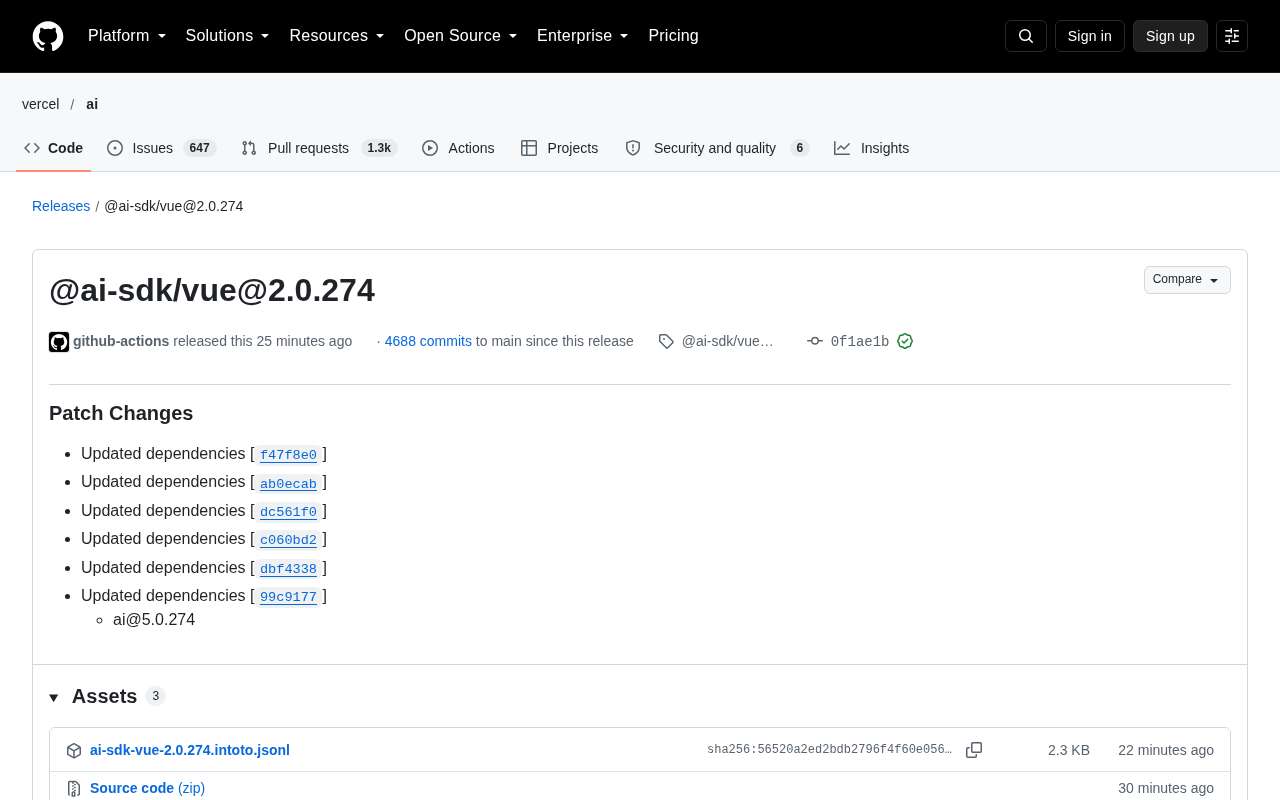
According to the Patch Changes record in the release note, this update includes six dependency changes, involving commits f47f8e0, ab0ecab, dc561f0, c060bd2, dbf4338, and 99c9177. Together, these commits bring ai@5.0.274 into the Vue adapter package.
In other words, @ai-sdk/vue itself has no standalone feature changes — its value lies in letting users in the Vue ecosystem stay on the same version cadence as the core ai package. This "upstream first, downstream follows" release pattern is quite common in monorepo structures.
Why Dependency Sync Deserves Its Own Release
For developers building Vue applications with the AI SDK, a version mismatch between the framework adapter layer and the core package can lead to subtle issues such as inconsistent type definitions and differences in streaming response handling behavior. Locking ai@5.0.274 as a dependency means Vue users can safely use the underlying logic already fixed in that version of the core package, without having to manually adjust version constraints in package.json.
This also explains why this release, despite only being a patch-level change, still received a version tag — dependency alignment itself is a delivery with real meaning for downstream users.
monorepo is an engineering practice of managing multiple related packages in the same code repository. In projects like AI SDK, the core package ai, framework adapter packages (such as @ai-sdk/vue and @ai-sdk/react), and various tooling packages share the same build, test, and release workflow. When the core package releases a new version, adapter packages typically only need to update the dependency version on the core package in package.json, then follow with a patch so downstream users receive the synchronized update. The advantage of this structure is controllable version linkage and fast propagation of fixes; the trade-off is that the version number of an adapter package often cannot independently reflect changes in its own features, so users need to pay attention to dependency pinning.
lockfile is a dependency version snapshot file generated by a package manager, with common forms including npm's package-lock.json, pnpm's pnpm-lock.yaml, and yarn's yarn.lock. It records the exact version and integrity hash each dependency package and its transitive dependencies resolve to, ensuring that installations on different machines at different times produce a completely consistent dependency tree. For adapter packages like @ai-sdk/vue, a lockfile can prevent the core package ai from being automatically upgraded to a new version without testing. If a project does not commit its lockfile, or uses loose version ranges such as ^ or ~, automatic installation may introduce behavioral differences. It is recommended to put the lockfile under version control and use frozen-lockfile install commands in CI.
Project Activity as Seen from Commit Volume
There is a detail in the release note that is easy to overlook: since the previous version, the main branch has accumulated 4,688 commits. This number reflects the aggregate commit history of the entire repository, not all of which is directly related to the Vue package, but it at least shows that the AI SDK project as a whole is in a state of high-frequency iteration.
For teams depending on this SDK, high-frequency releases mean two things: first, bug fixes and security patches can land quickly; second, version management needs to be more careful, and it is advisable to pin specific versions via lockfile to avoid automatically upgrading into untested changes.
Signature Verification and Supply Chain Security
This release was completed by the github-actions bot, and commit 0f1ae1b used GitHub's verified signature, with GPG key ID B5690EEEBB952194. Although this is routine for automated releases, teams concerned about supply chain security can verify the signature to confirm the integrity of the released content.
How Developers Should Respond
If you are using the AI SDK in a Vue project, this update can be completed directly through the package manager:
npm install @ai-sdk/vue@2.0.274
# or
pnpm add @ai-sdk/vue@2.0.274
After upgrading, it is advisable to check whether the core ai package has also been synchronized to 5.0.274, because the adapter layer's types and runtime behavior are usually tied to the core package version. If the project has custom streaming logic, running the related tests after upgrading would be safer.
For Vue developers who are not yet using the AI SDK, this release itself is not a reason to migrate, but it can serve as a reference for observing the maturity of this ecosystem — an adapter package that continuously performs dependency sync and maintains release discipline is usually more worthy of long-term investment than similar tools that go without updates for long periods.
One-line Summary
@ai-sdk/vue@2.0.274 patch update, mainly syncing the dependency ai@5.0.274.
Paragraph Summary
The AI SDK team released @ai-sdk/vue@2.0.274, a typical patch update with no new APIs or breaking changes, focused on syncing the core package ai@5.0.274 into the Vue adapter package. The update includes six dependency changes across multiple commits. Dependency alignment helps avoid subtle issues for Vue ecosystem users such as inconsistent type definitions and differences in streaming response handling. The release note also shows that the main branch has accumulated 4,688 commits since the previous version, reflecting high-frequency iteration across the project overall; the release was completed by GitHub Actions and verified with a GPG signature. Developers can upgrade directly via the package manager, and are advised to pin versions with a lockfile and check the core package version at the same time.
Related articles

A Single Prompt Triggers a Global PHP Security Storm: Is AI a Savior or a Hidden Risk?
A single AI prompt triggered a global PHP security crisis affecting Wikipedia and the Internet Archive. This article reviews the incident, analyzes the OpenAI-Amazon controversy, and explores the security paradox of lowered vulnerability discovery barriers in the AI era and developer response strategies.

When AI Is Taken Away: How Reliance on Shortcuts Undermines Your Problem-Solving Resilience
A study of 1,222 people found that after using AI to answer questions, once AI was removed, people gave up on more problems than a control group that never used AI. The article analyzes the impact of AI reliance on learning resilience and metacognition, and explores design implications for AI learning tools.

Carta and NewView Partner to Let Startup Employees Cash Out Equity Early
Carta and NewView Capital partner to simplify startup tender offers, helping employees sell equity early. Analysis of the mechanism, liquidity pain points, and impact.