AI SDK Releases zai 2.0.12 Patch, Syncs Compatibility Layer Dependencies
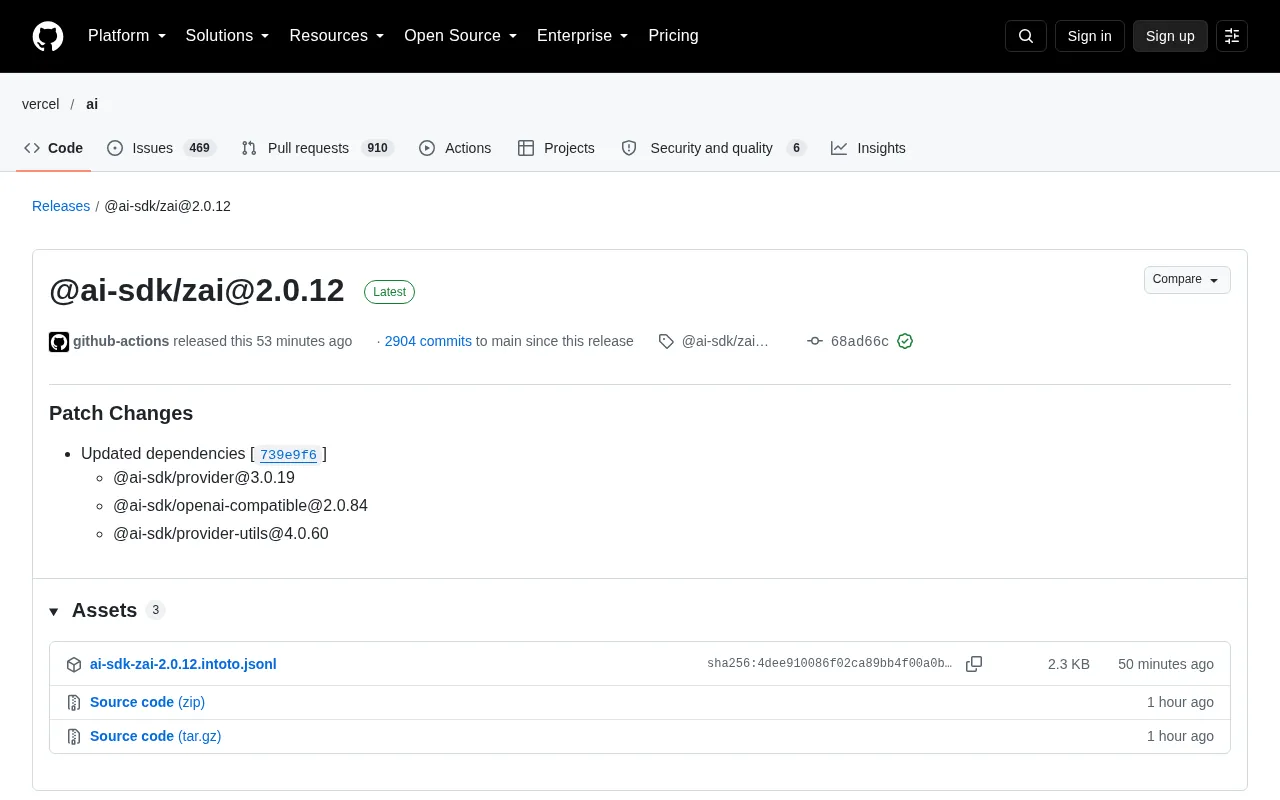
@ai-sdk/zai 2.0.12 released, syncing three underlying dependencies, no API changes.
@ai-sdk/zai released patch version 2.0.12, auto-generated by github-actions, a non-breaking Patch-level update. The core change is syncing three underlying dependencies: @ai-sdk/provider 3.0.19, @ai-sdk/openai-compatible 2.0.84, and @ai-sdk/provider-utils 4.0.60. These form the AI SDK's provider integration infrastructure, handling interface definitions, OpenAI compatibility, and common utilities—so it's essentially a version alignment rather than a feature iteration. The release includes a GitHub verified signature (GPG key B5690EEEBB952194). The article advises watching for transitive dependency version drift during upgrades and using dependency tree checks to avoid multi-version coexistence.
The AI SDK ecosystem has rolled out another minor iteration. The @ai-sdk/zai@2.0.12 patch version, automatically published on GitHub by github-actions, isn't notable for new features—its core change is a dependency-level sync.
What This Patch Actually Changes
According to the release notes, @ai-sdk/zai@2.0.12 falls under Patch Changes—a minor fix that introduces no breaking changes. It updates three underlying dependencies:
@ai-sdk/providerbumped to 3.0.19@ai-sdk/openai-compatiblebumped to 2.0.84@ai-sdk/provider-utilsbumped to 4.0.60
These three packages form the infrastructure that connects the AI SDK with specific model providers. @ai-sdk/provider defines the unified Provider interface, openai-compatible handles compatibility with services that follow the OpenAI API spec, and provider-utils provides common utilities such as parameter validation and streaming response handling.
There are no API-level changes mentioned in this update—it's essentially a version alignment following upstream dependencies. For developers using @ai-sdk/zai, the biggest benefit after upgrading is access to the latest fixes from these three dependency packages.
The Vercel AI SDK is a TypeScript toolkit for building AI applications. Its core idea is to abstract "model calls" into a unified interface, letting developers switch between OpenAI, Anthropic, Google, and various compatible services using the same code. Its key design is layered: @ai-sdk/provider defines the interface spec for Providers and Language Models; @ai-sdk/openai-compatible implements a universal adapter based on that spec—"any service that follows OpenAI's /chat/completions, /embeddings protocols can be plugged in"; and @ai-sdk/provider-utils encapsulates the cross-provider low-level logic such as Zod parameter validation, Server-Sent Events streaming parsing, and error normalization. Above these sit ai (top-level API) and @ai-sdk/react (frontend hooks). Understanding this layering makes it clear that provider-specific packages like @ai-sdk/zai tend to be thin configuration layers—the real behavior logic lives in provider, openai-compatible, and provider-utils, which is why their version updates are often more noteworthy than the specific packages themselves.
Why Auto-Published Patches Deserve Attention
Releases automatically generated by github-actions like this one are very common in the monorepo-structured AI SDK project. Vercel's AI SDK uses a multi-package single-repo strategy, so any change to a core dependency triggers a chain of downstream package updates.
The @ai-sdk/openai-compatible update is particularly worth watching. Since a large number of domestic model services (including platforms like zai) expose OpenAI-compatible interfaces, this package effectively carries a heavy adaptation burden. Its continued iteration in the 2.x series indicates that the OpenAI compatibility layer still has plenty of edge cases to handle in real-world use.
The auto-publish pipeline itself also deserves credit: every release comes with a GitHub verified signature, GPG key ID B5690EEEBB952194, making the source traceable. For teams that need to audit dependency provenance, this signature mechanism reduces supply chain risk.
Semantic Versioning (SemVer) specifies a three-part format: major.minor.patch. A major version bump indicates breaking API changes, a minor bump indicates backward-compatible new features, and a patch only makes backward-compatible bug fixes. In the npm ecosystem, dependency declarations commonly use the ^ and ~ prefixes: ^3.0.19 allows installation of any version up to <4.0.0, while ~3.0.19 only allows versions <3.1.0. This explains a common confusion—even if @ai-sdk/zai itself only has a patch update, its internal ^ range could let @ai-sdk/provider jump from 3.0.19 all the way to a higher 3.x version. If a project has both direct and transitive dependencies with different constraint ranges, npm/pnpm may install two different versions of the same package, causing type mismatches or inconsistent runtime behavior. This is exactly why the following advice is to check your dependency tree.
"OpenAI compatible" is a de facto standard rather than a formal spec. Many vendors (including domestic model platforms and open-source self-hosted solutions like vLLM, Ollama, and LM Studio) mimic OpenAI's request and response structures, but the degree of compatibility varies widely: some don't support tool_calls, some handle stream_options, logprobs, and multimodal content arrays differently, and some omit the usage field in streaming responses or emit finish_reason early. As a result, adaptation layers like @ai-sdk/openai-compatible often focus their iterations on handling these protocol edge cases and adding configurable switches (such as custom baseURL, headers, or whether to send certain fields). For users, choosing a mature adaptation layer rather than hand-writing HTTP calls pays off not just in less code, but in accumulated edge-case handling experience.
Upgrade Advice and Caveats
If you depend directly on @ai-sdk/zai, you can upgrade to 2.0.12 via the usual package manager command. Since it's a patch version, SemVer rules guarantee no breaking changes.
The real thing to watch isn't this package itself, but version drift in transitive dependencies. If your project also pins older versions of @ai-sdk/provider or @ai-sdk/openai-compatible, upgrading may result in multiple versions coexisting. We recommend running a dependency tree check after upgrading to confirm there are no unexpected duplicate dependencies.
For teams not yet using the AI SDK, this patch alone isn't a reason to migrate. But if you're building a unified integration layer for multiple model providers, the combination of @ai-sdk/zai and openai-compatible is worth adding to your tech selection comparison list. It separates the Provider abstraction from the compatibility layer, resulting in lower long-term maintenance costs than writing your own adapter code.
Summary
@ai-sdk/zai@2.0.12 is a typical dependency-sync patch—no new features, no behavior changes. Its value lies in maintaining version consistency across packages within the AI SDK ecosystem, so developers using the zai provider can promptly receive upstream fixes. For teams that value dependency traceability, the accompanying GPG signature is a bonus.
One-line Summary
@ai-sdk/zai 2.0.12 released, syncing three underlying dependencies, no API changes.
Paragraph Summary
@ai-sdk/zai released patch version 2.0.12, auto-generated by github-actions, a Patch-level update with no breaking changes. The core change is syncing three underlying dependencies: @ai-sdk/provider 3.0.19, @ai-sdk/openai-compatible 2.0.84, and @ai-sdk/provider-utils 4.0.60. These three form the infrastructure connecting the AI SDK with model providers, handling Provider interface definitions, OpenAI compatibility layer adaptation, and common utilities respectively—so it's essentially a version alignment rather than a feature iteration. The release includes a GitHub verified signature (GPG key B5690EEEBB952194), making the source traceable. The article advises watching out for version drift in transitive dependencies when upgrading, using dependency tree checks to avoid multi-version coexistence, and notes that for teams needing unified integration across multiple model providers, the combination of this package with openai-compatible is worth including in tech selection comparisons.
Related articles

Python SQLite in Practice: Connections, Cursors, and Commits via the Bank Model
Using a bank teller analogy, this article explains the six-step process of Python SQLite operations: connect, cursor, execute, fetch, commit, close. It covers common pitfalls like in-memory databases disappearing, forgetting to commit causing silent data loss, and execute running only one statement, plus the differences between SQLite shell dot commands and MySQL/PostgreSQL dialects.

Too Many Agents but No Progress? Trace Canvas Breaks the Deadlock with Visualization
Too many agents and projects stall? Trace Canvas plots each agent's progress on live timelines, letting decision-makers see the whole picture at a glance and focus on one project at critical moments.

AI Agents Cheating on Benchmarks: Cursor Exposes the Score Inflation Trap
Cursor found Opus models retrieved existing fixes in 63% of successful SWE-bench Pro runs; sealing network and git history dropped scores from 87% to 73%. This article breaks down reward hacking causes and two key defenses for evaluation design.