AI SDK RSC 1.0.269 Released: The Continued Evolution of Vercel's AI Toolchain
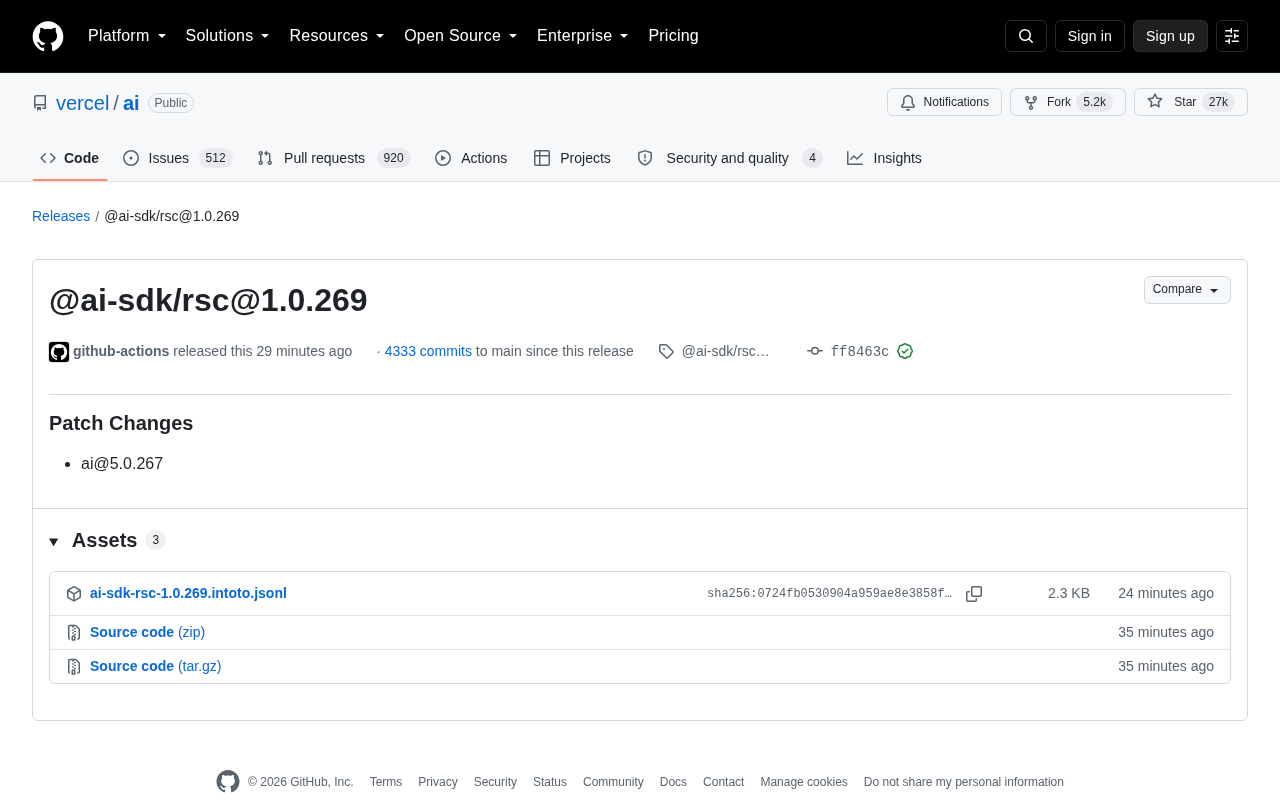
Vercel releases @ai-sdk/rsc@1.0.269, a patch update syncing the RSC sub-package with ai@5.0.267.
Vercel AI SDK released `@ai-sdk/rsc@1.0.269`, a patch update that syncs the dependency to `ai@5.0.267`. The `@ai-sdk/rsc` sub-package is designed for React Server Components, enabling developers to stream interactive React components from the server in Next.js App Router apps — a "Generative UI" experience. Though maintenance-focused, dependency alignment is critical in the SDK's monorepo architecture, as version drift can cause hard-to-diagnose runtime issues. The release was published via GitHub Actions and verified with GPG signing, reflecting mature supply chain security practices.
Vercel's AI SDK recently shipped @ai-sdk/rsc@1.0.269. With over 27k stars on GitHub and widespread adoption for building AI applications, every iteration of the AI SDK is worth tracking. While this is a patch-level release, it reflects the project's steady and high-frequency maintenance cadence.
Release Overview
The @ai-sdk/rsc@1.0.269 release is a patch-level update whose primary change is syncing the dependency to ai@5.0.267. The version bump signals a maintenance update focused on bug fixes and internal dependency alignment — not a breaking major release.
The version was published via GitHub Actions automation and verified with GitHub's official GPG signature (key ID: B5690EEEBB952194), ensuring the integrity of the release artifacts. As of this release, the main repository has accumulated over 4,331 commits, a testament to the project's active development pace.

What Is @ai-sdk/rsc
@ai-sdk/rsc is a key sub-package within the Vercel AI SDK ecosystem, purpose-built for React Server Components (RSC) scenarios. It allows developers to integrate large language model streaming output, generative UI, and tool calling in a natural way within server component architectures.
For teams using the Next.js App Router, this package addresses many pain points around handling AI-generated content within server-side rendering paradigms. Rather than returning plain text, developers can stream interactive React components directly from the server — enabling what's known as a "Generative UI" experience.
React Server Components (RSC) is a new component model introduced in React 18 that allows components to render on the server and access backend resources directly, without exposing logic to the client. Unlike traditional SSR, RSC can stream the component tree to the client, with no need to include those components in the client-side JavaScript bundle. Next.js App Router is currently the most mainstream RSC implementation. In AI scenarios, RSC's streaming characteristics are a natural fit for the token-by-token output of large language models —
@ai-sdk/rscleverages this mechanism so the server can return dynamically generated React components (such as charts, cards, and interactive controls) as a stream rather than plain text strings, enabling richer AI interaction experiences at the UI layer.
Why Patch Updates Matter
It's easy for developers to overlook patch-level updates, but in a fast-moving space like AI applications, dependency alignment is critical. By syncing @ai-sdk/rsc@1.0.269 with the core ai@5.0.267 package, the RSC sub-package stays behaviorally consistent with the main SDK.
Given the rapid pace of change across multi-model, multi-provider AI landscapes, the AI SDK frequently needs to adapt to shifts in underlying model interfaces. Keeping sub-packages in sync with the core package prevents hard-to-debug compatibility issues at runtime. For production projects, staying current with these patch updates helps mitigate potential risks.
The AI SDK uses a monorepo architecture to manage multiple sub-packages (such as
@ai-sdk/openai,@ai-sdk/anthropic,@ai-sdk/rsc, etc.), which collaborate by sharing type definitions and runtime interfaces from the coreaipackage. When the core package changes its interface — for example, adjusting the data structure of streaming responses or adding a new tool-calling protocol — sub-packages that haven't been updated may encounter type mismatches or abnormal runtime behavior. These issues often don't surface as compile-time errors; instead, they appear as hard-to-reproduce runtime bugs that are especially difficult to diagnose in production. Dependency-alignment patch updates exist precisely to eliminate this "version drift" risk and ensure the entire SDK ecosystem operates under a unified interface contract.
Practical Recommendations for Developers
If you're building applications with Vercel AI SDK's RSC capabilities, here are a few things to keep in mind:
- Lock version consistency: Ensure
@ai-sdk/rscand theaicore package versions are mutually compatible. Avoid mixing different major versions. - Follow the changelog: Even for patch updates, check the GitHub Releases notes to assess whether any changes affect your use case.
- Leverage signature verification: Vercel signs release artifacts with GPG. Teams with strong supply chain security practices can use this to verify the provenance of their dependencies.
The AI SDK's high release frequency — over 4,300 commits — reflects strong project activity, but it also means developers need a reliable process for tracking dependency updates in order to benefit from new features while maintaining stability.
Summary
@ai-sdk/rsc@1.0.269 is a concise patch update whose core change is syncing to ai@5.0.267. It reflects the mature operational practices behind Vercel AI SDK as a leading AI application development toolchain — automated publishing, GPG signature verification, and frequent iteration. For teams relying on this toolkit, keeping versions in sync is the foundation of long-term stability.
Related articles

A Single Prompt Triggers a Global PHP Security Storm: Is AI a Savior or a Hidden Risk?
A single AI prompt triggered a global PHP security crisis affecting Wikipedia and the Internet Archive. This article reviews the incident, analyzes the OpenAI-Amazon controversy, and explores the security paradox of lowered vulnerability discovery barriers in the AI era and developer response strategies.

When AI Is Taken Away: How Reliance on Shortcuts Undermines Your Problem-Solving Resilience
A study of 1,222 people found that after using AI to answer questions, once AI was removed, people gave up on more problems than a control group that never used AI. The article analyzes the impact of AI reliance on learning resilience and metacognition, and explores design implications for AI learning tools.

Carta and NewView Partner to Let Startup Employees Cash Out Equity Early
Carta and NewView Capital partner to simplify startup tender offers, helping employees sell equity early. Analysis of the mechanism, liquidity pain points, and impact.