AI SDK's Z.AI Module Refactor: The Model Catalog Arrives

AI SDK refactors Z.AI model ID logic into a model catalog declaring capabilities and options, with request behavior unchanged.
@ai-sdk/zai has released version 3.0.48. Although it is a patch-level update, its core is consolidating the Z.AI model ID logic scattered across the code into a model catalog that uniformly declares model capabilities and provider-specific options and automatically generates provider capability documentation based on it. The official notes explicitly state that request behavior remains unchanged, so ordinary callers will not notice the upgrade. The value of this refactor lies in turning model differences from implicit conventions into explicit data, so that invocation-layer decisions and documentation generation share the same data source and reduce divergence between code and documentation. For Z.AI, whose iteration pace is not synchronized with mainstream vendors, cataloging significantly lowers the maintenance cost of the capability list; for developers maintaining their own provider wrappers, it also offers a metadata-driven pattern worth borrowing.
Vercel's AI SDK ecosystem has received another quiet but important update. @ai-sdk/zai has released version 3.0.48. On the surface it looks like just a patch-level release, but the core change points in a more systematic direction: consolidating the Z.AI model ID logic that was previously scattered across the code into a single "model catalog" with capability declarations.
The architectural adjustment behind a patch release
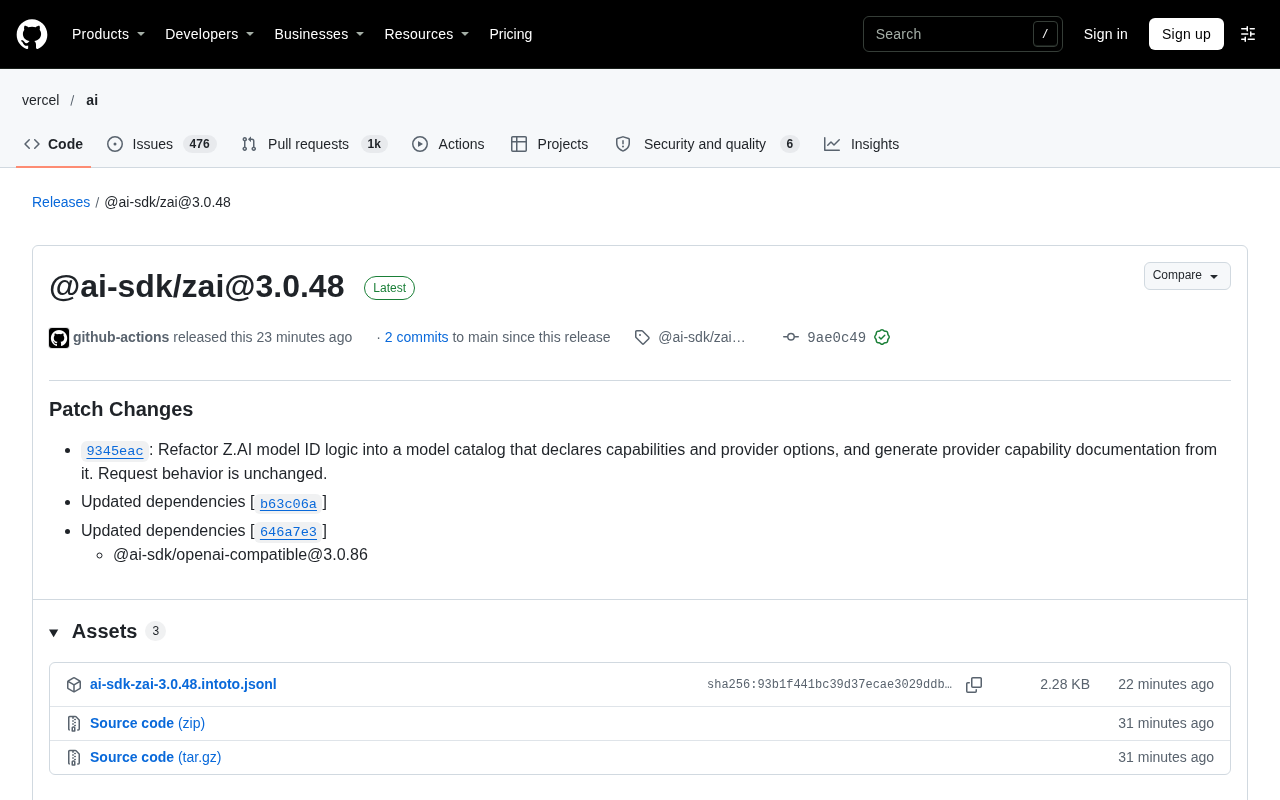
According to the release notes on GitHub, this commit (9345eac) does one thing: refactors the Z.AI model ID logic into a model catalog, where the catalog declares model capabilities and provider options, and automatically generates provider capability documentation based on this catalog.
The key detail is the second half—"Request behavior is unchanged." This means that for ordinary callers, upgrading to this version will not change any actual request results; it is a purely internal refactor. But the direction of the refactor is worth noting: model capabilities are no longer implicit conventions but have become first-class citizens that can be declared and used to generate documentation.
The same day's release also updated two dependencies: @ai-sdk/openai-compatible@3.0.86 and another dependency update (commit b63c06a). The version coupling among the various provider packages in the AI SDK also suggests that this catalog mechanism may share the same abstraction across multiple providers.
What a model catalog means
In a unified model invocation layer like the AI SDK, models from different providers vary greatly: some support tool calling, some support structured output, and some differ in their level of multimodal input support. In the past, these differences were often communicated through documentation and left to developers to judge for themselves, which was error-prone.
The idea behind the model catalog is to make these differences explicit. The catalog declares which capabilities each model has and which provider-specific options are required. The invocation layer and documentation generation both read from the same data source, avoiding divergence between code and documentation. For developers, the most direct benefit is that capability documentation automatically follows code updates, reducing problems like "the docs say it's supported, but it doesn't actually work."
This is especially meaningful for a relatively new provider like Z.AI. Z.AI's model iteration pace is not fully synchronized with mainstream vendors, so manually maintaining a capability list is costly and prone to lagging behind. With a catalog, maintenance costs drop significantly.
In the AI SDK, a "provider" refers to the adapter layer that connects to a specific model service, such as @ai-sdk/openai, @ai-sdk/anthropic, etc. They unify the different HTTP APIs of various vendors into the same invocation interface. @ai-sdk/openai-compatible is a general-purpose adapter used to connect to services compatible with the OpenAI Chat Completions protocol; Z.AI and many third-party inference services fall into this category. Therefore, the simultaneous upgrade of the openai-compatible dependency in this release is not irrelevant: the underlying request construction of the Z.AI provider very likely reuses the general logic of that package, and the capabilities and options declared in the catalog ultimately need to be translated into actual request parameters through this adapter layer. Understanding this layering helps determine the boundary of the changes—the catalog refactor happens at the provider layer, while the transport protocol layer remains stable, which is also the technical precondition for "request behavior is unchanged" to hold.
In the context of the AI SDK, "model capabilities" usually refer to a set of boolean or enum-like features: whether tool calling is supported, whether structured output / JSON schema-constrained output is supported, whether multimodal inputs such as images are accepted, the context window size, whether streaming output is supported, etc. Before sending a request, the invocation layer can use these declarations to decide whether to inject the corresponding parameters, or to fail early when a capability is missing rather than waiting for the server to return a 400. Provider options are vendor-specific additional configuration items, such as particular reasoning parameters or safety settings, which cannot be expressed through a unified abstraction and can only be declared per provider. Once both are centralized in the catalog, adding a new model only requires appending one data entry, and capability checks, parameter validation, and documentation generation can all take effect at the same time.
The practical impact on users
If you are a developer using @ai-sdk/zai directly, this upgrade is safe: request behavior is unchanged, and you do not need to modify your business code. The only thing to watch is dependency versions—this update also upgraded the openai-compatible package. If your project is sensitive to dependency versions, it is advisable to confirm at the lockfile level.
If you maintain your own provider wrapper, this refactor offers a pattern worth borrowing: manage model metadata centrally and use metadata to drive capability checks and documentation generation, rather than scattering capability checks across various if-else blocks. As the number of providers grows, the benefits of this pattern become increasingly obvious.
Summary
3.0.48 is not a feature release but a structural cleanup. It reveals that the AI SDK team is treating "model capabilities" as data that needs systematic management. For the ecosystem, this kind of convergence at the infrastructure level often determines long-term maintainability more than any single new feature.
One-line Summary
AI SDK refactors Z.AI model ID logic into a model catalog that declares capabilities and options, with request behavior unchanged.
Paragraph Summary
@ai-sdk/zai has released version 3.0.48. Although it is a patch-level update, its core is consolidating the Z.AI model ID logic scattered across the code into a model catalog that uniformly declares model capabilities and provider-specific options and automatically generates provider capability documentation based on it. The official notes explicitly state that request behavior remains unchanged, so ordinary callers will not notice the upgrade. The value of this refactor lies in turning model differences from implicit conventions into explicit data, so that invocation-layer decisions and documentation generation share the same data source and reduce divergence between code and documentation. For Z.AI, whose iteration pace is not synchronized with mainstream vendors, cataloging significantly lowers the maintenance cost of the capability list; for developers maintaining their own provider wrappers, it also offers a metadata-driven pattern worth borrowing.
Related articles
 Tech Frontiers
Edge AI on Microcontrollers: When Is It Actually Worth Deploying?
Drawing on Reddit discussions and Arm case studies, this article analyzes the real-world use cases for edge AI on microcontrollers: when each device needs independent inference, when a gateway or cloud is more reasonable, and the costs and boundaries of specialized hardware.
 Tech Frontiers
Pushing the Limits of Extreme Sudoku on a 16GB GPU: Insights from Depth and Flow Matching
A researcher trained a 16.54M-parameter model on a 16GB GPU to solve extreme Sudoku, finding effective depth breaks the 60% plateau and flow matching with improved sampling pushes accuracy past 99% with ~50× lower layer-evaluation budget.
 Tech Frontiers
AI Agent Approval Workflows: Why Human Confirmations Always Get Mindlessly Clicked
Why do AI agent approval workflows always get mindlessly clicked? A Reddit discussion shows that separating rules from keys, low-frequency high-risk approvals, and GitHub Environments-style gates are the keys to effective approvals.