@ai-sdk/sandbox-just-bash Patch Released: A Minor Iteration in the AI Sandbox Toolchain

@ai-sdk/sandbox-just-bash releases routine patch 1.0.167, mainly syncing the harness dependency.
This article explains the 1.0.167 release of @ai-sdk/sandbox-just-bash in the Vercel AI SDK ecosystem. It is a typical patch update with 5 commits, whose core change is syncing the @ai-sdk/harness@1.0.167 dependency, with no new features or breaking changes. The article breaks down the package name: sandbox provides a controlled isolated bash execution environment, just-bash reflects single responsibility, and harness is responsible for hooking sandbox capabilities into the execution flow. The release was completed automatically by github-actions with a GPG signature, indicating that the versioning process has been CI-ified; frontend loading errors on the Release page are unrelated to the package itself. The article suggests that projects already locked to 1.0.x follow up through the normal process, while projects that have not integrated this capability do not need to introduce it because of this release.
A Quiet Version Update That Reveals the Modular Rhythm of the AI SDK
If you're a user of the Vercel AI SDK, you may have noticed the package name @ai-sdk/sandbox-just-bash—it doesn't appear on the documentation homepage as frequently as ai or @ai-sdk/openai, but in scenarios where you need to provide models with a controlled command execution environment, this package plays a key role.
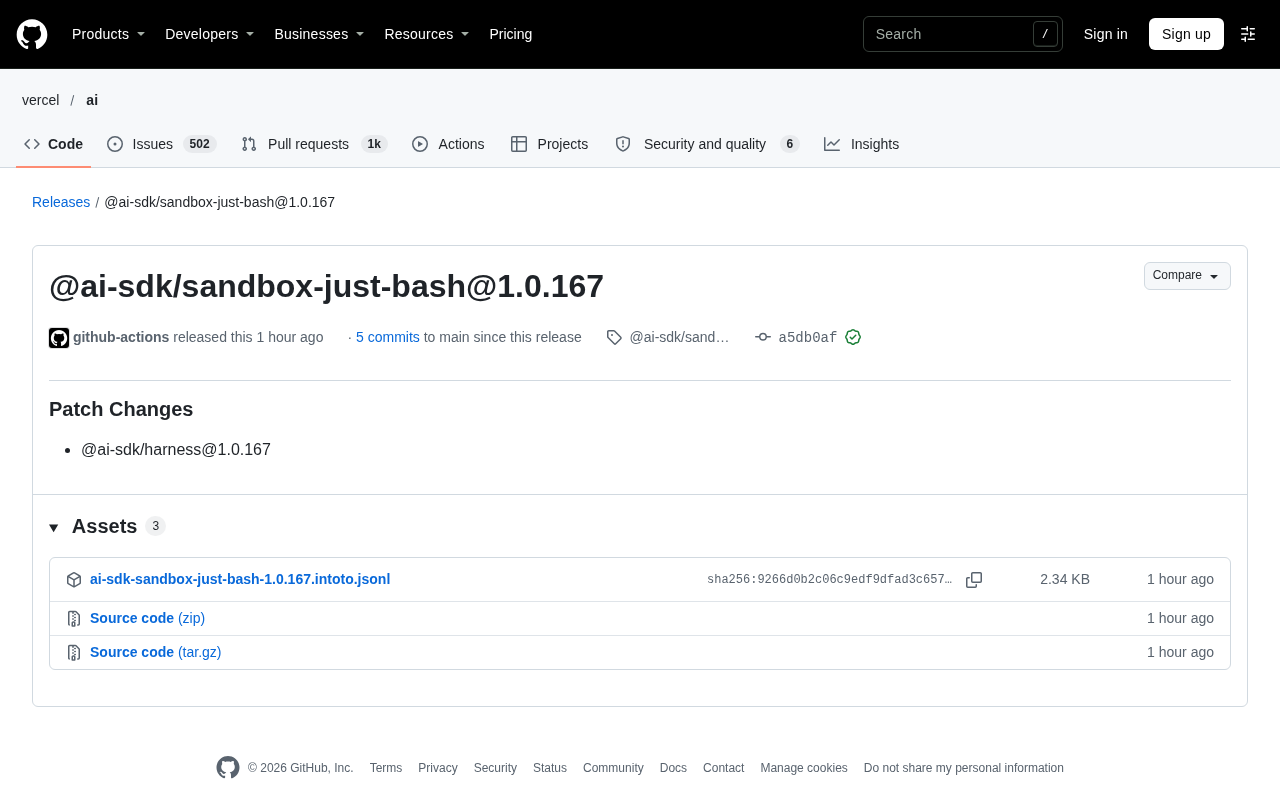
Recently, the package released version 1.0.167. Judging from the GitHub Release page, this is a typical patch update: only 5 commits, with changes focused on synchronizing the dependency on @ai-sdk/harness@1.0.167. There are no new feature announcements, nor any descriptions of breaking changes.
For projects that rely on semantic versioning, this type of update can typically be safely adopted—a change in the patch position means fixes and internal alignment rather than interface adjustments.
What the Package Name Tells Us: sandbox, just-bash, and harness
Breaking down this package name reveals some of the design orientations of the AI SDK in the direction of tool calling.
sandbox: Providing an Isolated Execution Environment for Models
The sandbox in @ai-sdk/sandbox-just-bash points to sandboxing capability. When a model needs to execute shell commands to perform file operations, run scripts, or validate code, allowing this directly in a production environment is clearly unacceptable. This package provides a controlled bash execution layer, enabling Agent-type applications to operate within boundaries.
In the context of AI Agents, a sandbox generally refers to a restricted execution container: the system calls available to the process, file system paths, network egress, CPU/memory, and runtime duration are all explicitly constrained, so that command execution failures or boundary violations do not contaminate the host environment. Common implementations include operating-system-level isolation (such as Linux namespace/cgroup, seccomp), lightweight virtual machines (microVMs), and language-level interception. For LLM tool calling, the sandbox also bears auditing responsibilities—the command executed each time, stdout/stderr, and exit code can all be recorded and returned to the model as observations for the next round of reasoning.
just-bash: A Deliberately Narrowed Scope of Capability
The name just-bash is quite telling—it suggests that the package does only one thing: bash. It does not attempt to cover multiple language runtimes or complex container orchestration. This single-responsibility design is not uncommon in the AI SDK ecosystem: each package solves one clear problem, and then higher layers compose them.
harness: The Actual Focus of This Change
The only substantive item in the Release notes is @ai-sdk/harness@1.0.167. A harness usually refers to the testing or runtime framework layer, responsible for hooking sandbox capabilities into a specific execution flow. This patch most likely made alignment or minor fixes at this layer rather than changing the sandbox itself.
In software engineering, a harness originally refers to a "test fixture," i.e., a wrapper program that wraps the code under test and provides input and a runtime environment. In the context of the AI SDK, harness is closer to a runtime adapter layer: it translates tool-calling requests initiated by the model into concrete execution actions (such as starting a sandbox, injecting commands, and collecting output), and then serializes the results into messages consumable by the model. Therefore, changes in the harness version often affect behavioral details of the call chain, while the sandbox package itself may remain unchanged—one reason this patch only synchronizes the harness dependency.
Engineering Details on the Release Page
This release's commit was made by the github-actions account and carries a GitHub verified signature (GPG key ID identified as B5690EEEBB952194). Automated publishing plus signature verification indicates that the repository has handed the versioning process over to CI while retaining source traceability.
The Release page itself also exposed some platform-level loading issues: the version comparison dropdown, filter controls, and resource list all showed prompts such as "Sorry, something went wrong" or "There was an error while loading." This is an occasional GitHub frontend failure unrelated to the package contents, but it may force developers who want to view the diff to refresh the page a few more times.
Semantic Versioning (SemVer) specifies version numbers in the form MAJOR.MINOR.PATCH: an increment in the patch position indicates backward-compatible bug fixes, an increment in the minor position indicates backward-compatible feature additions, and an increment in the major position may include breaking changes. By this standard, 1.0.167 is a low-risk update; if the dependency declaration is written as ^1.0.0 or ~1.0.167, the package manager will automatically accept such upgrades. GPG signature verification is used to confirm that the release artifact was indeed generated by the repository's CI identity and to prevent supply chain tampering—this is a trust dimension independent of whether the package contents are reliable.
Is It Worth Following Up?
From a practical standpoint, this update is suitable for the following situations:
- The project is already locked to the
1.0.xseries and wants to stay consistent with the upstream harness version; - You are debugging sandbox execution issues and want to rule out known minor defects at the harness layer;
- You use a dependency bot for automatic upgrades, and this patch can be merged through the normal process.
If the project has not yet integrated sandbox-related capabilities, this release is not a reason to introduce the package—it brings no new interfaces or capability extensions.
A Judgment on This Package's Positioning
It should be noted that the information in this Release note is limited: it only lists the patch changes and the harness version number, without detailing the specific fixes. To accurately assess the scope of impact, one needs to further examine the actual diff of those 5 commits, and the loading anomaly on the Release page makes this step less smooth for the time being.
From an ecosystem perspective, the continuous patch releases of @ai-sdk/sandbox-just-bash reflect a fact: the AI SDK is breaking down "models executing external commands" into modules that can evolve independently. sandbox, harness, and bash execution each have their own version cadence, and developers compose them as needed. This fine-grained split is friendly to large projects, but it also means that when following versions, one needs to remain sensitive to the dependency relationships between packages.
For most users, this 1.0.167 can simply be regarded as a routine maintenance update, with no additional action required.
Related articles

A New Paradigm for Text Editing in Compose: TextFieldState Replaces the Old API
Jetpack Compose introduces the TextFieldState API to fix dropped characters and cursor jumps from async input. The old value/onValueChange callbacks will be deprecated in 1.13. This article covers InputTransformation, OutputTransformation, four state hoisting patterns, and new formatted text editing capabilities.

Remote Compose: A New Document-Driven Paradigm for Cross-Platform UI on Android
Remote Compose transmits compact binary documents instead of screen pixels, enabling efficient UI rendering on remote surfaces like Wear OS and widgets. This article covers its document creation API, expression animations, size optimization techniques, and Wear OS progress.

How Crashlytics Eliminates Android Memory and Responsiveness Issues
Through the Chroma Clip case study, this article explains how Firebase Crashlytics uses Application Exit Info, Profiling Manager, GWP ASAN, and ARM MTE to pinpoint ANRs, OOMs, memory limit terminations, and native memory corruption—solving the challenge of stack traces that don't point to the real culprit.