AI SDK Sandbox Tool Update: Vercel Template Naming Feature Goes Live

Vercel sandbox adapter package 1.0.193 adds a templateName parameter for session creation, enabling named templates.
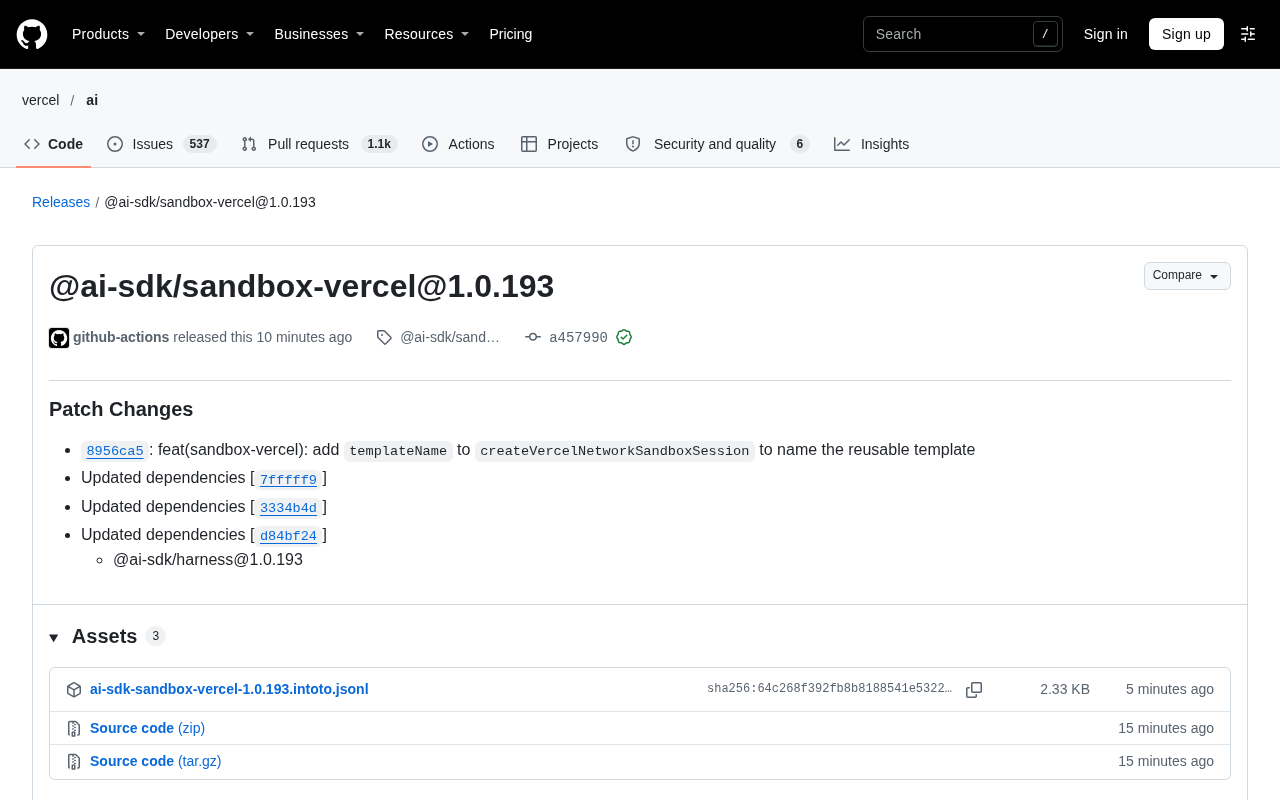
The AI SDK's Vercel sandbox adapter package has released patch version 1.0.193. The core change adds a `templateName` parameter to the `createVercelNetworkSandboxSession` method, allowing developers to explicitly name reusable sandbox templates instead of relying on automatically generated opaque identifiers. The article notes that this small change addresses a real pain point in multi-template scenarios: when a project contains sandbox environments for different purposes, such as Python data analysis and Node.js script execution, named templates make tracking and management easier in code and logs. This update also synchronizes dependencies such as `@ai-sdk/harness` to the same version number, and the changelog lists no breaking changes, making the upgrade a low-risk operation. Overall, this is a typical developer experience optimization that does not change the sandbox's core capabilities but delivers visible benefits in multi-environment management, debugging logs, and team collaboration.
The AI SDK's Vercel sandbox adapter package has received a minor version update. Judging by the version number 1.0.193, this is a patch-level release, but the feature it includes is worth attention for developers using Vercel-hosted AI sandboxes.
Core Change: Adding Name Identifiers for Reusable Templates
The main change in this update appears in the createVercelNetworkSandboxSession method. The development team added a new templateName parameter to name reusable templates.
In AI application development, sandbox environments are often used to safely execute model-generated code or isolate untrusted operations. If the same environment configuration needs to be rebuilt every time a session is created, efficiency suffers significantly. The template mechanism allows developers to predefine a set of environments and then instantiate them repeatedly. Giving templates names means these templates can be explicitly identified and distinguished, rather than relying on automatically generated, opaque identifiers.
Although this change is small at the interface level, it addresses a real pain point: when a project has multiple sandbox templates for different purposes—for example, one for Python data analysis and another for Node.js script execution—without explicit names, it becomes difficult to track and manage them in code and logs.
AI Sandbox is a key component of AI application infrastructure: it provides an isolated execution environment for model-generated, untrusted code (such as Python or JavaScript snippets generated by an LLM), allowing the code to run without affecting the host machine, leaking keys, or damaging production data. Common implementations include container-based, microVM-based, or lightweight virtualization approaches. Vercel's sandbox capability leverages its edge and serverless infrastructure, enabling developers to obtain code execution capabilities without building their own isolation clusters. Understanding this background helps clarify the positioning of this update: templateName does not change the sandbox's isolation strength or execution capability, but instead affects how the sandbox is "provisioned"—that is, how to more efficiently and predictably instantiate sessions from predefined environment templates. Template naming is therefore an improvement at the operations and observability level, not a change to the security model.
Synchronized Dependency Updates
The commit record shows that this release also updated multiple dependencies, including @ai-sdk/harness, which was synchronized to version 1.0.193. This kind of coordinated update is common in monorepo-managed SDK projects and usually means the underlying shared layer has also undergone corresponding adjustments to ensure interface consistency.
One detail worth noting: the changelog does not list any breaking changes. For projects already using @ai-sdk/sandbox-vercel, this upgrade is a low-risk operation.
Monorepo is an engineering practice of managing multiple interrelated packages in a single repository. Combined with workspace tools (such as pnpm, Turborepo, and Nx), it enables cross-package dependency coordination and unified releases. In projects like AI SDK, which consist of multiple sub-packages (sandbox adapters, model abstraction layers, runtime harnesses, etc.), the packages often share underlying type definitions and interface contracts. Therefore, when a lower-level package is adjusted, upper-level adapter packages need to be version-bumped in sync to ensure type and runtime behavior consistency—this is the root cause of the "coordinated update" phenomenon mentioned in the article. The takeaway for users is: when upgrading @ai-sdk/sandbox-vercel, try to keep related packages such as @ai-sdk/harness at the same version number to avoid type errors or runtime exceptions caused by cross-version interface mismatches. Even though there are no breaking changes this time, locking version consistency remains a prudent practice.
What This Update Means in Practice
From an engineering perspective, the templateName parameter turns sandbox session creation from an "anonymous instance" into a "named instance." This naming capability is valuable in several scenarios:
- Multi-environment management: Development, testing, and production may use different sandbox templates; naming makes configuration switching easier
- Debugging and logging: Template names can be seen directly in session creation and runtime logs, making troubleshooting more intuitive
- Team collaboration: Named templates are self-descriptive, helping new members understand the purpose of each sandbox more quickly when reading code
Summary
This is a typical developer experience optimization patch. It does not change the core capabilities of the sandbox, but makes template usage clearer and more manageable. For teams building AI applications that require code execution capabilities, improvements like these will gradually demonstrate their value as projects grow in scale.
Related articles

Nothing CMF Buds 2A Drops to $17.89 on Black Friday: A New Low for ANC Earbuds
Nothing CMF Buds 2A wireless earbuds Black Friday deal: just $17.89 on Amazon, about $11 off retail and a record low. ANC earbuds at an entry-level price.

When AI Creation Gets Accused of "Spitting": Hacker News Heats Up Over the Glaude Controversy
A Hacker News post, "Spitting in the Face of Glaude," sparks debate on AI creation transparency and attribution ethics. This analysis examines the blurred creator identity behind the controversy and offers practical advice for AI content production.

Akai Embraces Custom Firmware: MPC Sample 1.4 Lets Users AI-Program Their Sampler
Akai embraces the modding community with MPC Sample 1.4 firmware, supporting vibe-coded custom firmware and effects. We analyze the impact of this open strategy on music hardware and AI-assisted programming.