@ai-sdk/sandbox-vercel 1.0.191 Patch Released: The AI SDK Sandbox Ecosystem Takes Another Step Forward

@ai-sdk/sandbox-vercel releases patch 1.0.191, evolving in sync with harness to strengthen AI code execution security.
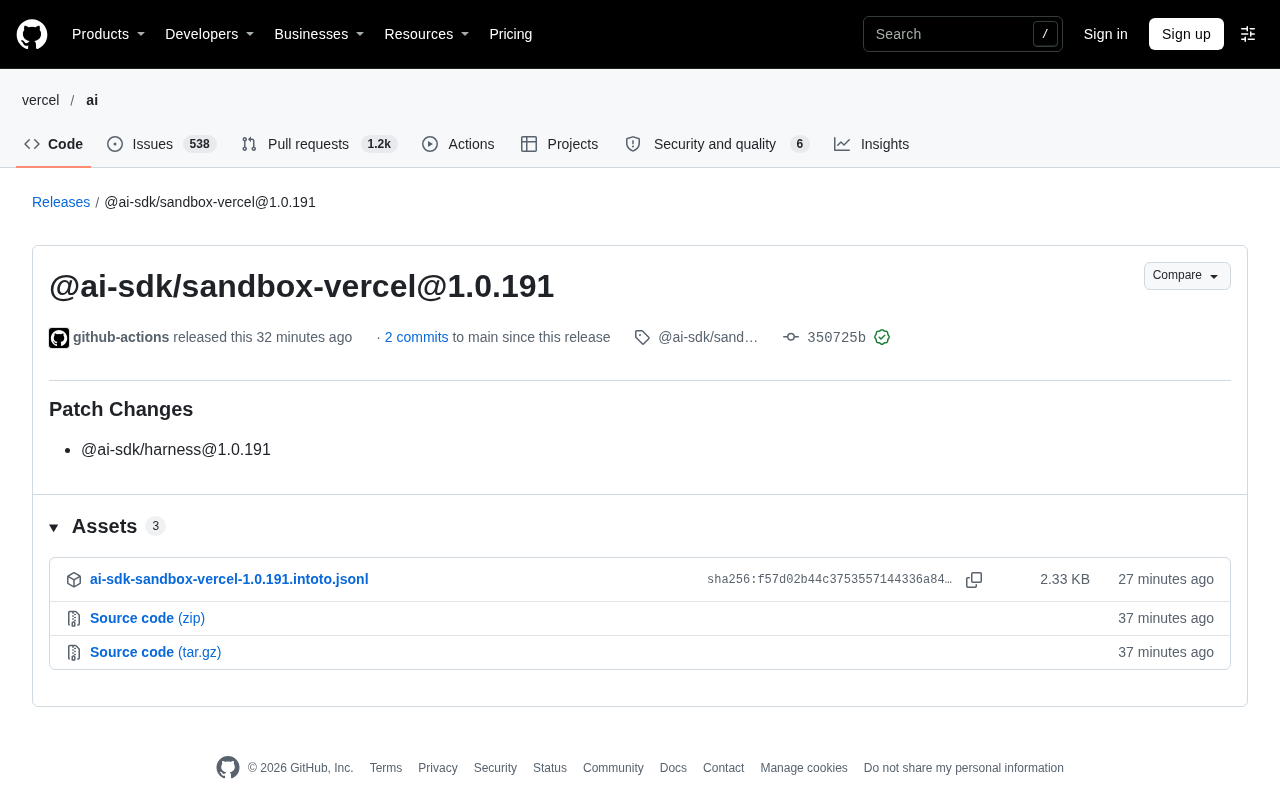
@ai-sdk/sandbox-vercel has released patch version 1.0.191, automatically published by github-actions and verified via GitHub signatures. This update also involves @ai-sdk/harness@1.0.191, with both packages sharing a synchronized version number—indicating they evolve together in the same monorepo or unified release process. The sandbox handles secure execution of AI-generated code, while harness handles behavior verification, forming a closed loop of execution and verification. Frequent patches signal active maintenance: stability gains rather than new features.
The pace of version iteration in the AI SDK ecosystem often reflects a framework's engineering maturity better than any single model release. @ai-sdk/sandbox-vercel has released version 1.0.191—what looks like a routine patch update, yet it touches the critical link of "sandbox execution" in the AI programming toolchain.
Why a Patch Update Deserves Attention
On the GitHub Releases page, @ai-sdk/sandbox-vercel@1.0.191 was automatically published by the github-actions bot, with the commit verified by GitHub's signature using GPG key ID B5690EEEBB952194. The version is explicitly tagged as Patch Changes, indicating this is a patch update focused primarily on fixes and fine-tuning.
For readers unfamiliar with this toolchain, each part of the name points to a specific capability: ai-sdk is the infrastructure layer for building AI applications, sandbox refers to a secure code execution environment, and vercel identifies the deployment and runtime platform. Together, they solve the problem of getting AI-generated code to run in a controlled environment—precisely the key step that takes AI programming from "generation" to "usability".
The value of a sandbox lies in isolation. When an AI agent needs to execute code, call tools, and read or write files, any misstep could affect the host environment if there are no boundaries. sandbox-vercel confines the execution surface to Vercel's managed environment, letting developers enjoy automation while retaining a security baseline.
Semantic Versioning and Patch Updates
Semantic Versioning (SemVer) specifies that a version number consists of major.minor.patch, in the format MAJOR.MINOR.PATCH. An increment in the PATCH position indicates a backward-compatible bug fix that introduces no new features and breaks no existing interfaces; a MINOR increment indicates backward-compatible feature additions; a MAJOR increment indicates incompatible API changes. Therefore, the 191 in 1.0.191 means the project has released nearly two hundred patches since 1.0.0, all while remaining backward compatible. Frequent patch releases usually reflect a maintainer's strategy of iterating in small, quick steps—delivering bug fixes as soon as possible rather than letting them pile up until a major release. For dependents, following patch versions carries low risk, though it's still worth checking the changelog for behavioral adjustments.
The Coordination Mechanism Behind the Version Number
Interestingly, this patch change also involves @ai-sdk/harness@1.0.191. The two packages share an identical version number, which typically means they evolve together within the same monorepo or a unified release process. Within the AI SDK system, harness is responsible for testing and evaluation—it provides a reproducible runtime framework for agent behavior.
Synchronized version numbers are an engineering convention: when the underlying contract changes, dependents need to align. Patch-level synchronization usually indicates that the scope of changes is controllable—more often dependency version refreshes or small-scale bug fixes rather than breaking interface-level adjustments.
This release was completed automatically by github-actions and includes 2 commit records. The stability of an automated release process is itself a signal of an open-source project's sustainability—it reduces the uncertainty introduced by manual operations and lets patches reach users faster.
Monorepo and Fixed Versioning Strategy
A monorepo is an engineering pattern in which multiple related packages are managed within a single code repository; typical tools include Nx, Turborepo, and pnpm workspace. In a monorepo, packages can share build configurations, testing tools, and release processes, but the versioning strategy must be chosen carefully. A fixed/locked strategy requires all packages to share the same version number, so any change to one package triggers a version bump for all packages; an independent strategy allows each package to bump its version independently based on its own changes. The fact that @ai-sdk/sandbox-vercel and @ai-sdk/harness share an identical version number (both 1.0.191) indicates the project uses a fixed versioning strategy. This strategy simplifies dependency alignment and avoids version mismatches between the execution layer and the verification layer, but it also means that packages with no changes are re-released as the version number increments.
Where Sandbox Capabilities Fit in AI Programming
If we break the AI programming toolchain into three stages—generation, execution, and verification—the sandbox sits in the execution layer, while harness sits in the verification layer. The synchronized versions indicate that execution and verification along this chain are being maintained as a single unit.
This combination has direct implications for teams building AI agents. Agents need to iterate through trial and error repeatedly: write code, run it, observe the results, and correct. Each cycle relies on a reliable sandbox to carry the code execution and on harness to determine whether behavior meets expectations. Although patch updates bring no new features, they continuously lower the failure rate of this cycle.
From the perspective of open-source collaboration, GitHub's signature verification mechanism provides a layer of supply-chain security. Users can confirm that the release source is authentic and trustworthy—something that is becoming increasingly important in an AI tool ecosystem with ever-more-complex dependency chains.
GitHub Signature Verification and Supply Chain Security
GitHub provides a signature verification mechanism for commits and tags, supporting GPG, SSH, and S/MIME signatures. When a commit or tag carries a valid signature, GitHub displays a "Verified" badge, indicating that the commit comes from a trusted source holding the corresponding private key and that the content has not been tampered with. The GPG key ID B5690EEEBB952194 mentioned in this article is the identifier of the signing key used to verify the release commit. In automated release scenarios, the github-actions bot uses keys maintained by the project to sign release commits, and users can verify the authenticity of the release source via the public key. This mechanism is part of software supply chain security and helps prevent risks such as hijacked release channels or replaced artifacts. Especially in the AI tool ecosystem with complex dependency chains, signature verification provides downstream users with an auditable trust anchor.
How to Understand This Kind of Minor Release
When faced with a version number like 1.0.191, it's easy to get the impression of "frequent updates but no substantive changes". In fact, the opposite is true: frequent patches are evidence of active project maintenance. A continuously incrementing Patch position in semantic versioning shows that maintainers are steadily resolving issues rather than letting bugs accumulate and releasing them all at once in a major version.
For users, the benefit of following patch versions lies in stability rather than new capabilities. If your project relies on sandbox-vercel to execute AI-generated code, keeping patches in sync is a low-cost way to reduce runtime risk. At the same time, tracking the synchronized versions of @ai-sdk/harness helps avoid version mismatches between the execution layer and the verification layer.
The AI SDK sandbox ecosystem is still rapidly taking shape. A single patch carries limited information, but when observed within the version sequence, it reveals a clear engineering path: automated releases, signature verification, dependency synchronization, and separation of responsibilities. Together, these details form the reliability foundation of AI programming infrastructure.
One-line Summary
@ai-sdk/sandbox-vercel releases patch 1.0.191, evolving in sync with harness to strengthen the security of AI code execution.
Paragraph Summary
@ai-sdk/sandbox-vercel has released patch version 1.0.191, automatically published by github-actions and verified via GitHub signatures. This update also involves @ai-sdk/harness@1.0.191; the two packages share a synchronized version number, indicating they evolve together within the same monorepo or unified release process. The sandbox handles secure execution of AI-generated code, while harness handles behavior verification—together forming a closed loop of execution and verification. Frequent patch releases signal active maintenance, meaning stability improvements rather than new features for users. The article also analyzes the coordination mechanism behind the version numbers, the sandbox's position in the AI programming toolchain, and how to understand such minor releases, emphasizing that automated releases, signature verification, dependency synchronization, and separation of responsibilities together form the reliability foundation of AI programming infrastructure.
Related articles

Nothing CMF Buds 2A Drops to $17.89 on Black Friday: A New Low for ANC Earbuds
Nothing CMF Buds 2A wireless earbuds Black Friday deal: just $17.89 on Amazon, about $11 off retail and a record low. ANC earbuds at an entry-level price.

When AI Creation Gets Accused of "Spitting": Hacker News Heats Up Over the Glaude Controversy
A Hacker News post, "Spitting in the Face of Glaude," sparks debate on AI creation transparency and attribution ethics. This analysis examines the blurred creator identity behind the controversy and offers practical advice for AI content production.

Akai Embraces Custom Firmware: MPC Sample 1.4 Lets Users AI-Program Their Sampler
Akai embraces the modding community with MPC Sample 1.4 firmware, supporting vibe-coded custom firmware and effects. We analyze the impact of this open strategy on music hardware and AI-assisted programming.