AI SDK Svelte 4.0.330 Patch Release: Dependency Upgrade Explained

@ai-sdk/svelte releases patch 4.0.330, merely syncing the underlying ai package to 6.0.330.
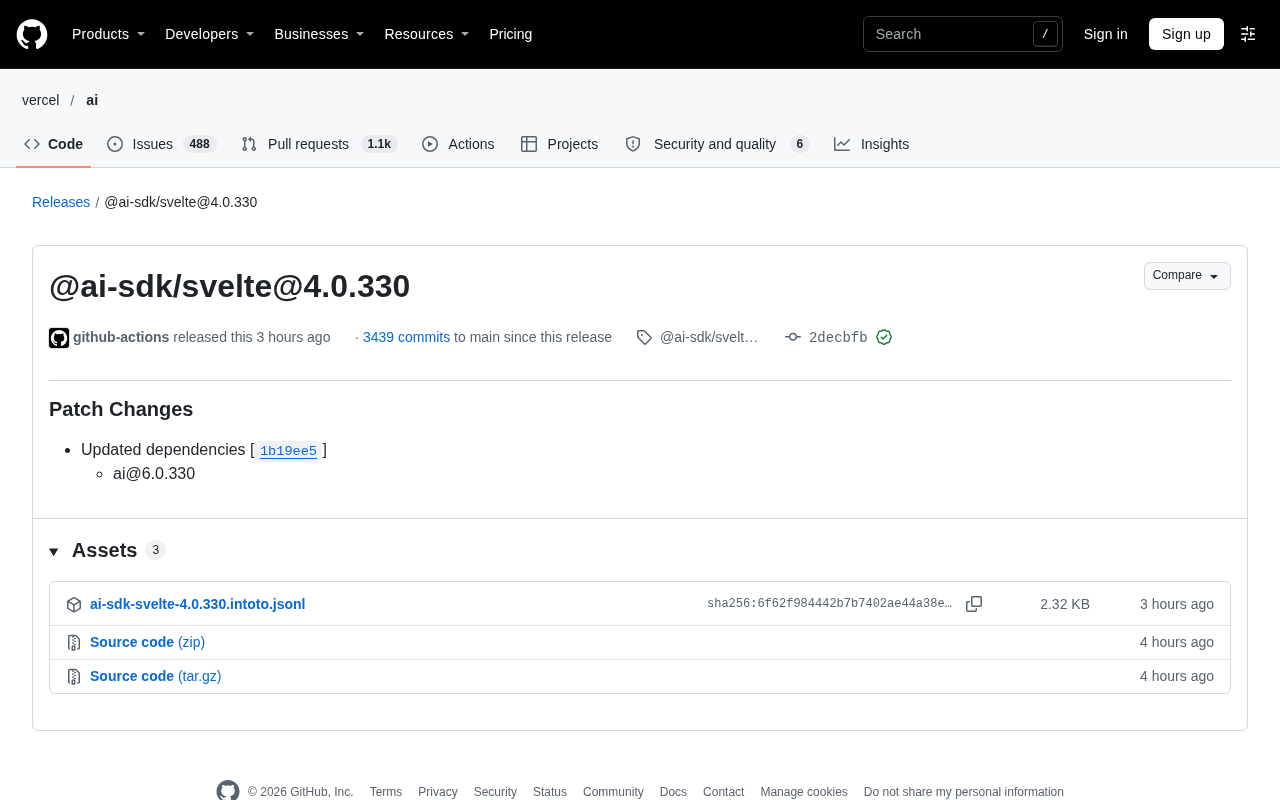
@ai-sdk/svelte 4.0.330 was auto-published via GitHub Actions and labeled as a patch-level change; the only substantive change is updating the ai dependency to 6.0.330, with commit hash 1b19ee5 and a verified signature. This means the Svelte adapter's own API and feature logic are unchanged, and developers need not modify existing calling code. The value of this release is maintaining version alignment across packages in the monorepo, avoiding TypeScript compilation errors from out-of-sync type definitions or underlying fixes failing to propagate to the upper framework layer. The article recommends upgrading as usual and focusing regression tests on scenarios like streaming output and tool calls that depend on core package behavior; if multiple AI SDK-related packages are installed, confirm their version requirements for ai do not conflict. Overall, this is a low-risk update reflecting the ecosystem's high-frequency, small-step iteration cadence.
Vercel's AI SDK has shipped another minor iteration. @ai-sdk/svelte@4.0.330 was published automatically via GitHub Actions, with the core change being a dependency update that syncs the underlying ai package to version 6.0.330. For frontend developers building AI applications with Svelte, this update is small in scope but matters for dependency chain consistency and the availability of downstream features.
A Typical Patch Release: Breaking Down the Changes
According to the GitHub Release page, this release is labeled "Patch Changes." The only substantive change listed in the release notes is: update dependency ai@6.0.330. The corresponding commit hash is 1b19ee5, the entire release was automated by the github-actions bot, and the commit carries a GitHub-verified signature.
This means the API and feature logic of @ai-sdk/svelte itself are unchanged, and developers do not need to modify existing calling code. The value of a patch release lies in keeping package versions within the monorepo aligned, avoiding type mismatches or runtime behavior differences caused by a lagging underlying ai package.
Semantic Versioning and Patch-Level Changes
The npm ecosystem follows Semantic Versioning (SemVer), with version numbers in the form major.minor.patch. An increment to the patch number (e.g., 4.0.329 → 4.0.330) indicates only backward-compatible bug fixes or internal adjustments—no new features and no breaking changes. Labeling this release as "Patch Changes" follows that convention: consumers can declare a dependency range like ^4.0.330 and expect the upgrade not to break existing code. Note, however, that SemVer only constrains a package's own public API; when a patch release consists of "bumping the version of a dependency," the actual behavior change depends on that upgraded dependency, so reading the release notes is still necessary.
Why Dependency Sync Matters for the AI SDK Ecosystem
The AI SDK uses a multi-package architecture. As the Svelte framework adapter layer, @ai-sdk/svelte depends on the core ai package for unified model invocation interfaces, streaming response handling, and tool-calling capabilities. When the core package releases a new version, the adapter layer needs to follow promptly; otherwise, two problems can arise: TypeScript compilation errors from out-of-sync type definitions, and underlying fixes or behavior adjustments that fail to propagate to the upper framework layer.
This update pins the ai package at 6.0.330, an alignment within the same version number range. For projects using SvelteKit to build chat interfaces or AI feature modules, keeping the adapter layer and core package versions consistent is a basic practice for reducing hard-to-diagnose issues.
What Are a Monorepo and a Multi-Package Architecture?
The AI SDK uses a monorepo (single code repository) to manage multiple interdependent npm packages, such as the core package ai, framework adapters @ai-sdk/svelte and @ai-sdk/react, and various model provider packages. In a monorepo, packages typically share the same release pipeline and internal toolchain (e.g., changesets for managing version numbers and release notes), so an update to the core package often triggers a chain of downstream adapter releases. The advantage of this structure is explicitly controllable dependencies and centrally reusable type definitions; the cost is that version alignment becomes important—if the ai version range declared by the adapter package doesn't match the version actually installed in the project, npm may install multiple copies of ai in node_modules, leading to type conflicts or runtime inconsistencies. Understanding this explains why a patch version that only updates dependencies is still worth paying attention to.
What Developers Should Do
For most projects, upgrading is no different from a routine dependency update. Use your package manager's update command to pull this version, then run tests to confirm existing functionality is unaffected. Since this is only a dependency change, regression testing can focus on scenarios that depend on core package behavior, such as streaming output and tool calls.
If your project uses a lockfile and has dependency auditing enabled, it's worth checking before merging that the ai package has been synced to 6.0.330. If multiple AI SDK-related packages are installed in the project, confirm that their version requirements for the ai package do not conflict.
The Role of Lockfiles and Dependency Auditing
Lockfiles (package-lock.json, pnpm-lock.yaml, yarn.lock) record the exact resolution of the dependency tree, ensuring identical versions are installed across different environments. When @ai-sdk/svelte updates its version requirement for ai, simply running the install command may not upgrade ai in the lockfile; you may need to explicitly update that package or use your package manager's interactive upgrade command. Dependency auditing (e.g., npm audit, pnpm audit) checks for known security vulnerabilities—a separate concern from version alignment, but checking both before merging can prevent problematic transitive dependencies from entering the main branch. For monorepo projects using multiple AI SDK packages, consider using overrides (npm/pnpm) or resolutions (yarn) fields to constrain the ai version uniformly and eliminate duplicate copy issues at the root.
Signals Behind the Release Cadence
Judging from the release history, this package has accumulated 3,439 commits, and the release process is fully automated. This high-frequency, small-step patch cadence is the norm in the AI SDK ecosystem: the core package iterates quickly, and the adapter layer follows closely behind. For developers, paying attention to patch notes is more meaningful than focusing on version numbers themselves—this release introduces no new APIs and no breaking changes, making it a low-risk update.
What really deserves attention is whether future versions involve dependency jumps across minor versions. If the ai package undergoes a major or minor version upgrade, the adapter layer usually comes with feature adjustments, and that's when migration notes warrant closer reading.
Related articles

Gemini 4 Neon Leak: A Potential Strong Contender Against Opus 5.5
A Hacker News thread suggests Gemini 4 Neon looks like an Opus 5.5 competitor. This article unpacks the product positioning behind this community signal, shifts in the top-model competitive landscape, and what it means for developers' model selection strategy.

Claude Fable 5.2's Self-Authored Short Film 'Fable' Sparks Discussion
A short film 'Fable,' credited to Claude Fable 5.2 for script, visuals, and directing, appears on Hacker News. This article analyzes the significance of full-pipeline AI creation, community reactions, and what it means for content creators.

Anthropic IPO Pricing: A Signal of AI Giants Going Public
Anthropic's IPO pricing draws attention. This article analyzes its potential impact on AI industry valuation, commercialization paths, and the competitive landscape, and highlights public-market expectations and challenges for AI companies.