@ai-sdk/tui 1.0.137 Released: AI SDK Terminal UI Component Update

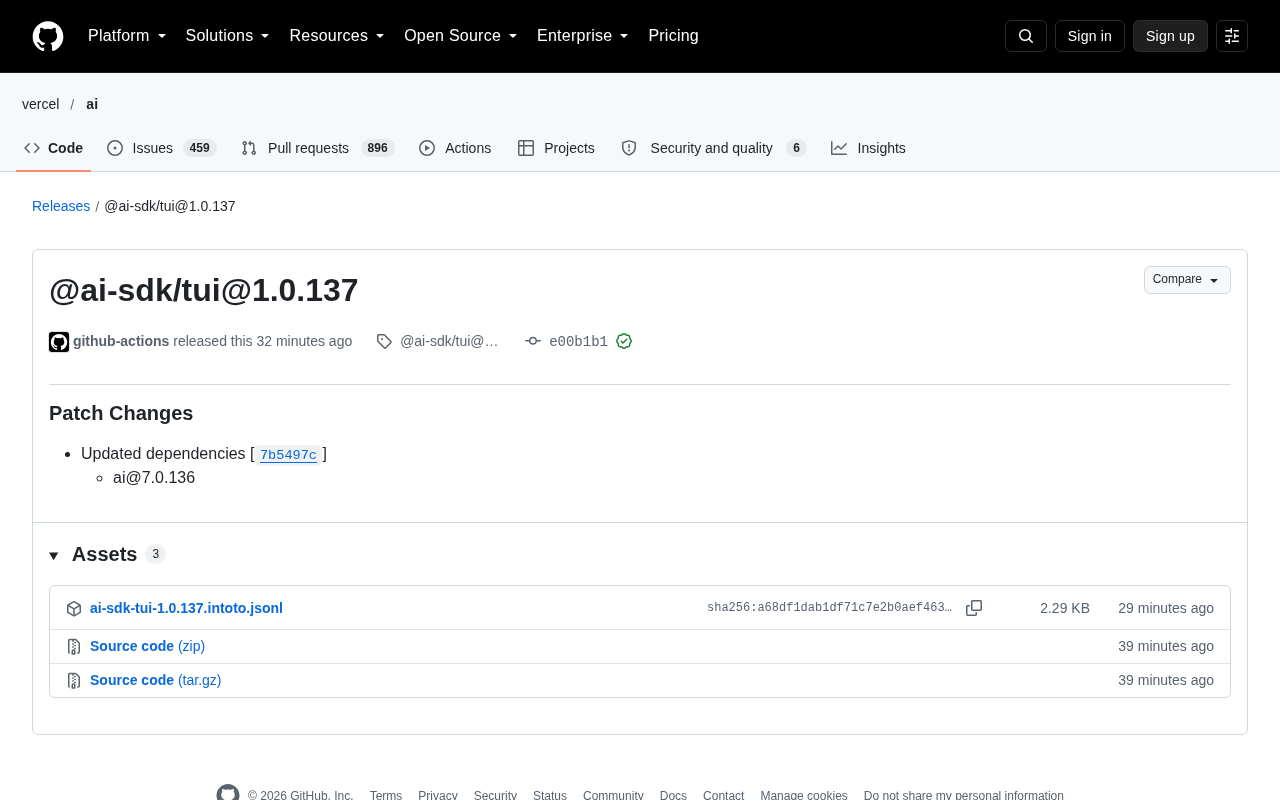
@ai-sdk/tui 1.0.137 patches its core dependency to ai@7.0.136 with no breaking changes.
`@ai-sdk/tui@1.0.137` is a maintenance patch release of the Vercel AI SDK's terminal UI component package, with the sole recorded change being an upgrade of the core `ai` dependency to 7.0.136. This release pattern stems from the AI SDK's monorepo + Changesets automation: every core library update triggers a downstream version alignment across sub-packages. The `@ai-sdk/tui` package itself serves CLI scenarios, helping developers build streaming conversations and AI agent interfaces in plain-text terminals. For teams already using the AI SDK, this upgrade carries minimal risk — though syncing to `ai@7.0.136` alongside is recommended for compatibility.
Release Overview
@ai-sdk/tui version 1.0.137 has been released — the terminal user interface (TUI) component package within the Vercel AI SDK ecosystem. This version was published via a GitHub Actions automated workflow and signed with a verified GitHub signature (GPG key ID: B5690EEEBB952194), making it a fully integrity-verified official release.
Based on the release notes, 1.0.137 is a patch release, with changes limited to dependency updates. No breaking changes or major new features were introduced. For developers running this package in production, patch releases of this kind are generally safe to upgrade.
What Changed in This Release
Dependency Sync Update
According to the release log, the only recorded change in this version is:
Updated dependencies [7b5497c]: ai@7.0.136
This means the core change in @ai-sdk/tui@1.0.137 is an upgrade of its underlying ai dependency to version 7.0.136. In the AI SDK's monorepo architecture, sub-packages (such as the ai core library and the @ai-sdk/tui terminal interface library) evolve in tandem — updates to the core library frequently trigger corresponding patch releases in peripheral packages to keep dependencies aligned.
In other words, this release is more of a version alignment than a feature update, ensuring the terminal UI component always runs on top of the latest AI SDK core capabilities.
Monorepo architecture is widely adopted in large JavaScript/TypeScript projects. The Vercel AI SDK uses a typical setup based on pnpm workspaces and the Changesets toolchain. Changesets allows developers to attach a changelog entry (a changeset file) to each PR merge; the CI pipeline then aggregates these entries, automatically calculates semantic version bumps, and batch-publishes all affected packages. When the core ai package releases a new version, Changesets traces the dependency graph and bumps the version of every package that directly or indirectly depends on it — generating a corresponding patch release for each. This is exactly why @ai-sdk/tui triggers a new release even when it has no code changes of its own. The rapid accumulation of version numbers from 1.0.0 to 1.0.137 reflects just how frequently this automated cascading mechanism fires.
What Is @ai-sdk/tui
@ai-sdk/tui is the module within the AI SDK toolchain designed for building terminal interactive interfaces. As AI applications expand beyond the browser into command-line tools, CLI assistants, and developer workflows, the need to render conversation streams, streaming output, and interactive components in a terminal environment has grown significantly. The TUI package exists to fill exactly this gap — enabling developers to build chat-like AI interaction experiences in a plain-text terminal.
Compared to frontend web components, TUI components must handle terminal-specific rendering constraints — such as character width, ANSI escape sequences, cursor control, and incremental refresh of streaming tokens. These components are especially critical for building command-line AI agents, local development assistants, and similar tools.
From a technical implementation standpoint, mainstream Node.js TUI frameworks (such as Ink and Blessed) use React or similar declarative models to render component trees as terminal character grids. @ai-sdk/tui is likely built on top of Ink — which lets developers describe terminal UIs using React component syntax, with the framework translating virtual DOM diff updates into ANSI escape sequence output. This closely mirrors how React renders components as DOM nodes in the browser, except the "canvas" shifts from pixels to a character grid. In streaming token scenarios, components simply trigger a re-render on state updates, and the framework automatically calculates the minimal terminal refresh area, avoiding full-screen flicker and achieving smooth character-by-character output.
Practical Impact for Developers
For teams that have already integrated the AI SDK into their projects, the decision to upgrade to 1.0.137 is fairly straightforward:
- Low risk: As a patch release following Semantic Versioning (SemVer), it theoretically contains no breaking API changes.
- Dependency consistency: If your project also uses
ai@7.0.136, upgrading the TUI package alongside it is recommended to avoid potential compatibility issues caused by version mismatches between sub-packages and the core library. - Automated trust chain: The release is signed and verified by GitHub, providing a basic level of supply chain security assurance.
The high-frequency patch release cadence (version numbers now reaching 1.0.137) also reflects that the AI SDK project is in an active iteration phase, where every update to the core library propagates quickly to downstream components.
Summary
@ai-sdk/tui@1.0.137 is a maintenance release focused on dependency synchronization, with the core change being an upgrade to ai@7.0.136. It doesn't bring any notable feature additions, but it reflects the AI SDK ecosystem's continued investment in the terminal interface direction and its well-coordinated version alignment mechanism. For engineers focused on AI development in CLI scenarios, keeping an eye on the TUI package's evolution is worth adding to your regular watch list.
Related articles

Why Does the Tesla Roadster Need to Fly? A Deep Dive into Musk's Wild Demo
Tesla's Roadster launch showed wall-climbing, upside-down driving, and flying stunts—but The Vergecast notes the demo car may lack a battery, the Rocket version is invite-only and not street-legal, and the website terms don't guarantee delivery. After nine years of delays, why does this car still need to exist?

AI Is Not a Replacement: Human-AI Collaboration Through the Lens of Factory Root Cause Analysis
Starting from factory root cause analysis, this article explains how AI accelerates evidence chain construction rather than replacing human experts, exploring the pragmatic implementation logic and business value of 'AI supporting people rather than replacing them.'

AI Agent Decision Auditing: Building an Evidence Chain in Regulated Workflows
Starting from a Reddit discussion, this article analyzes three core issues in AI agent decision auditing within regulated workflows: what fields audit records should contain, how to handle feedback latency for erroneous decisions, and how to continuously calibrate LLM judge consistency with human judgment.