@ai-sdk/tui 1.0.157 Patch Release: Terminal UI Toolchain Synced
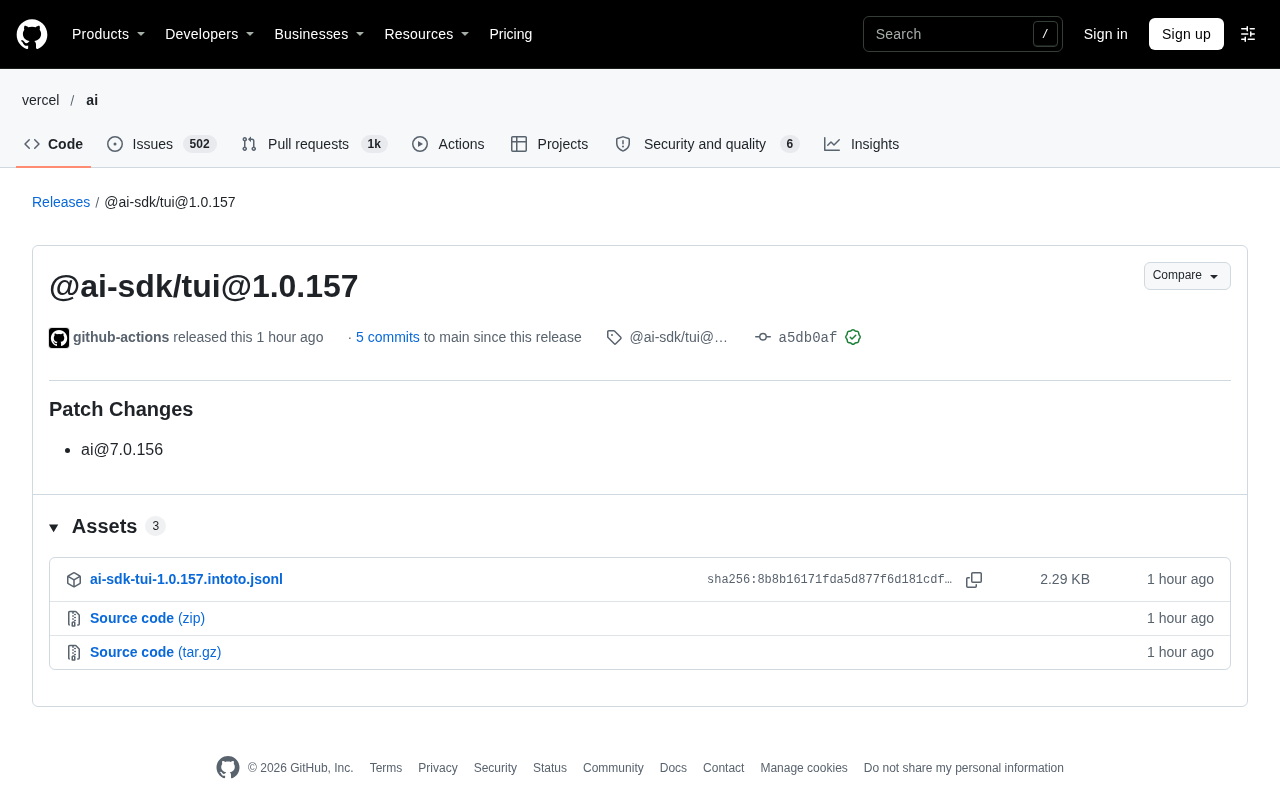
@ai-sdk/tui releases 1.0.157 patch, syncing with core package ai@7.0.156.
The terminal UI component package @ai-sdk/tui in Vercel's AI SDK ecosystem has released patch version 1.0.157, comprising 5 commits, completed by the github-actions automation workflow and carrying a GitHub verified signature. This update is a PATCH increment in semantic versioning, theoretically backward-compatible, with the core clue being dependency synchronization with the core package ai@7.0.156. The article explains the meaning of patch-level updates, the value of TUI components in lowering the barrier to terminal interaction in AI development workflows, and the significance of automated releases and signature verification for supply chain security, and offers advice on version range locking and verifying TUI-core package compatibility when upgrading.
A Low-Key Version Bump That Still Moves the AI SDK Terminal Ecosystem
Amid the rapid evolution of AI application development toolchains, Vercel's AI SDK ecosystem has seen another version update. According to the official GitHub release record, @ai-sdk/tui@1.0.157 has been officially released, tagged as a Patch Changes update, comprising 5 commits.
As seen in the release page screenshot, this update was published by the github-actions automation workflow and carries a GitHub verified signature (GPG key ID: B5690EEEBB952194), indicating a routine release verified by the official signature. For developers following the AI SDK terminal interaction components, such patch updates often mean synchronized fixes to underlying dependencies or toolchain.
Decoding the Release: What a Patch-Level Update Means
Version Number and Change Type
@ai-sdk/tui is the component package in the AI SDK system aimed at Terminal User Interface (TUI). The version number 1.0.157 continues the increment of the patch position in Semantic Versioning (SemVer), belonging to a patch version.
Following SemVer conventions, a patch increment typically corresponds to backward-compatible bug fixes and dependency synchronization, without breaking changes. For developers already using @ai-sdk/tui in their projects, upgrading to 1.0.157 theoretically introduces no API-level incompatibility risks.
Semantic Versioning (SemVer) is a widely adopted versioning convention with the format MAJOR.MINOR.PATCH. A PATCH increment indicates backward-compatible bug fixes, a MINOR increment indicates backward-compatible feature additions, and a MAJOR increment indicates breaking changes. In the npm ecosystem, the caret (^) in dependency declarations allows automatic upgrades to versions that do not change the leftmost non-zero digit—e.g., ^1.0.157 matches 1.x.x but not 2.0.0; the tilde (~) only allows PATCH-level changes. Understanding these rules helps determine whether a patch update can be safely auto-pulled.
Associated Dependency ai@7.0.156
The release notes specifically mention ai@7.0.156, revealing the core clue of this patch update: this release of @ai-sdk/tui is associated with version 7.0.156 of the core package ai. In the AI SDK's modular architecture, UI-layer components (like TUI) typically depend on abstract interfaces, streaming response handling, or message protocol definitions provided by the core ai package.
When the core package undergoes patch-level changes, companion UI component packages often need to be released in sync to lock dependency versions and maintain type definition consistency, avoiding type mismatches or runtime exceptions for downstream users mixing versions. The joint appearance of @ai-sdk/tui@1.0.157 and ai@7.0.156 is a manifestation of this dependency synchronization mechanism.
The Place of Terminal UI in AI Development Workflows
Why TUI Components Deserve Attention
In large model application development, the terminal interface is often an underrated link. Compared to browser-based Web UIs, TUI components are better suited for rapid prototyping, local debugging, and CLI tool building. The existence of @ai-sdk/tui allows developers to directly render structured AI responses, display streaming output, or build interactive chat interfaces in the command-line environment.
The value of such components lies in reducing the distance from model invocation to an interactive interface. Developers can validate and demonstrate conversational AI features in the terminal without introducing a full frontend framework. Although patch-level updates introduce no new features, continuous dependency synchronization ensures the stability of this lightweight path.
Streaming is a common interaction pattern in large model applications: tokens generated by the model are not returned all at once but pushed block by block via Server-Sent Events or similar mechanisms, requiring the frontend or terminal to render as they are received. TUI components typically include built-in incremental rendering support for streaming responses, enabling typewriter effects or real-time updating panels in the terminal without waiting for the complete response. This is one of the key reasons why the terminal interface experience approaches that of a Web UI in debugging and prototyping scenarios.
Automated Release and Signature Verification
This release was triggered by the github-actions bot and the commit carries a GitHub verified signature. This reflects that the AI SDK project employs a mature CI/CD release process: after changes are merged into the main branch, the automated pipeline handles version release and signing, ensuring traceability of artifacts.
For enterprise users, signature verification means they can more confidently include it in dependency audit processes; for individual developers, automated releases ensure patch fixes reach them quickly.
GPG signature verification is an important part of open-source supply chain security. GitHub automatically attaches signatures to commits submitted through its platform, and publishers can also use their own GPG keys to sign tags or release artifacts. Users can confirm source authenticity via git verify-commit or the Verified badge on the GitHub interface, reducing the risk of dependency packages being tampered with or impersonated. For enterprise dependency audits, signature verification is one of the baseline conditions for judging whether a package is trustworthy.
How Developers Should Respond to This Update
Upgrade Recommendations
Since this is a patch-level update, developers using @ai-sdk/tui are advised to check version locking in package.json. If the project uses a caret range like ^1.0.x, running the package manager update command will pull 1.0.157; if exact version locking is used, manual version adjustment is required.
After upgrading, it is recommended to verify two key points: first, whether the TUI components work properly with the ai@7.0.156 core package; second, whether terminal rendering and streaming output behave consistently with pre-upgrade in the local environment.
Keep an Eye on Upstream Changes
The release notes only list ai@7.0.156 as associated information without detailing specific code changes. For teams needing to track specific fixes, it is advisable to directly check the corresponding commit record (commit a5db0af) to understand the actual scope of changes. Reading dependency updates alongside changelogs is a prudent approach to assessing the impact of patches.
Conclusion
@ai-sdk/tui@1.0.157 is a routine patch release, with the core information being dependency synchronization with ai@7.0.156. It is not major news in itself, but for developers relying on AI SDK to build terminal interaction tools, such continuous small-step iterations are a signal of a healthy ecosystem. Keeping up with patches and maintaining dependency consistency are fundamental actions for maintaining project stability.
One-line Summary
@ai-sdk/tui releases 1.0.157 patch, syncing with core package ai@7.0.156.
Paragraph Summary
The terminal UI component package @ai-sdk/tui in Vercel's AI SDK ecosystem has released patch version 1.0.157, comprising 5 commits, completed by the github-actions automation workflow and carrying a GitHub verified signature. This update is a PATCH increment in semantic versioning, theoretically backward-compatible, with the core clue being dependency synchronization with the core package ai@7.0.156. The article explains the meaning of patch-level updates, the value of TUI components in lowering the barrier to terminal interaction in AI development workflows, and the significance of automated releases and signature verification for supply chain security, and offers advice on version range locking and verifying TUI-core package compatibility when upgrading.
Related articles
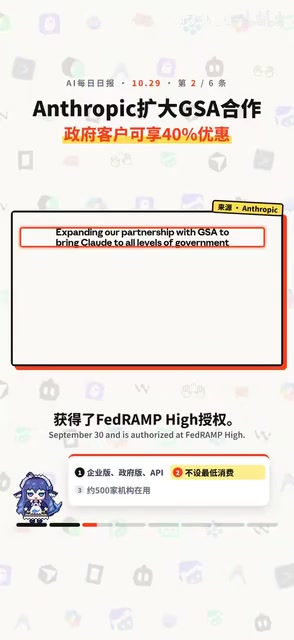
Google Releases Gemini 4 Carbon; Qwen Model Requests to Overseas Servers Spark Security Debate
Google releases Gemini 4 Carbon, topping the intelligence index but with a higher hallucination rate; Anthropic offers 40% off to government customers and reports drug discovery progress; Cohere and Palisade find Qwen 3.8 models attempting to connect to Alibaba servers; MiniMax open-sources a workflow; Anthropic launches an enterprise usage tool.
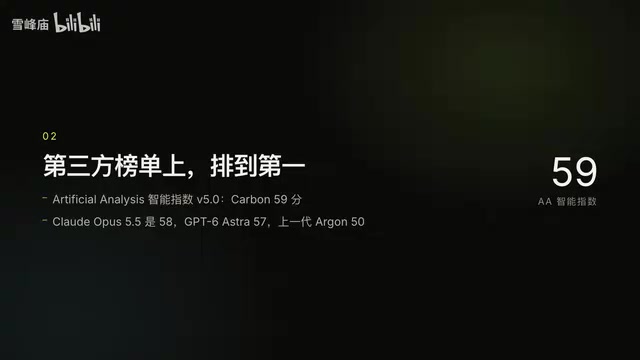
Gemini 4 Carbon Released: Tops Third-Party Leaderboard, But Ordinary Developers Still Left Out
Gemini 4 Carbon tops third-party intelligence index with standout long-context and cybersecurity capabilities, but trails Claude in coding agents and remains limited to Fairwind cyber defenders.

Google's Gemini 4 Carbon Tops the Rankings, Anthropic Achieves First Quarterly Profit
Google releases Gemini 4 Carbon, topping the Artificial Analysis benchmark, while Anthropic achieves its first quarterly profit thanks to Claude Code. This roundup covers the Artificial Analysis Intelligence Index V5 overhaul, NVIDIA's open-source speech transcription model, Ant Group's open-source Ling 3.1 Flash, and Google earnings and Chrome updates.