AI SDK TUI 1.0.172 Release Update Analysis

@ai-sdk/tui releases 1.0.172 patch with five dependency updates, linked to ai@7.0.171.
@ai-sdk/tui released version 1.0.172, a patch-level update focused on dependency synchronization, without new features or breaking changes. The release notes list five dependency updates, most directly linked to the core package ai@7.0.171 to ensure terminal interface consistency with the core SDK. The release was auto-triggered by github-actions with a GPG signature, indicating a standardized CI pipeline. The article notes that such updates mainly serve stability maintenance; upgrades typically require no code changes, but since details are sparse, checking lockfile differences for transitive dependency changes and reviewing the ai package's release records is recommended before upgrading.
A Low-Key Dependency Sync Update
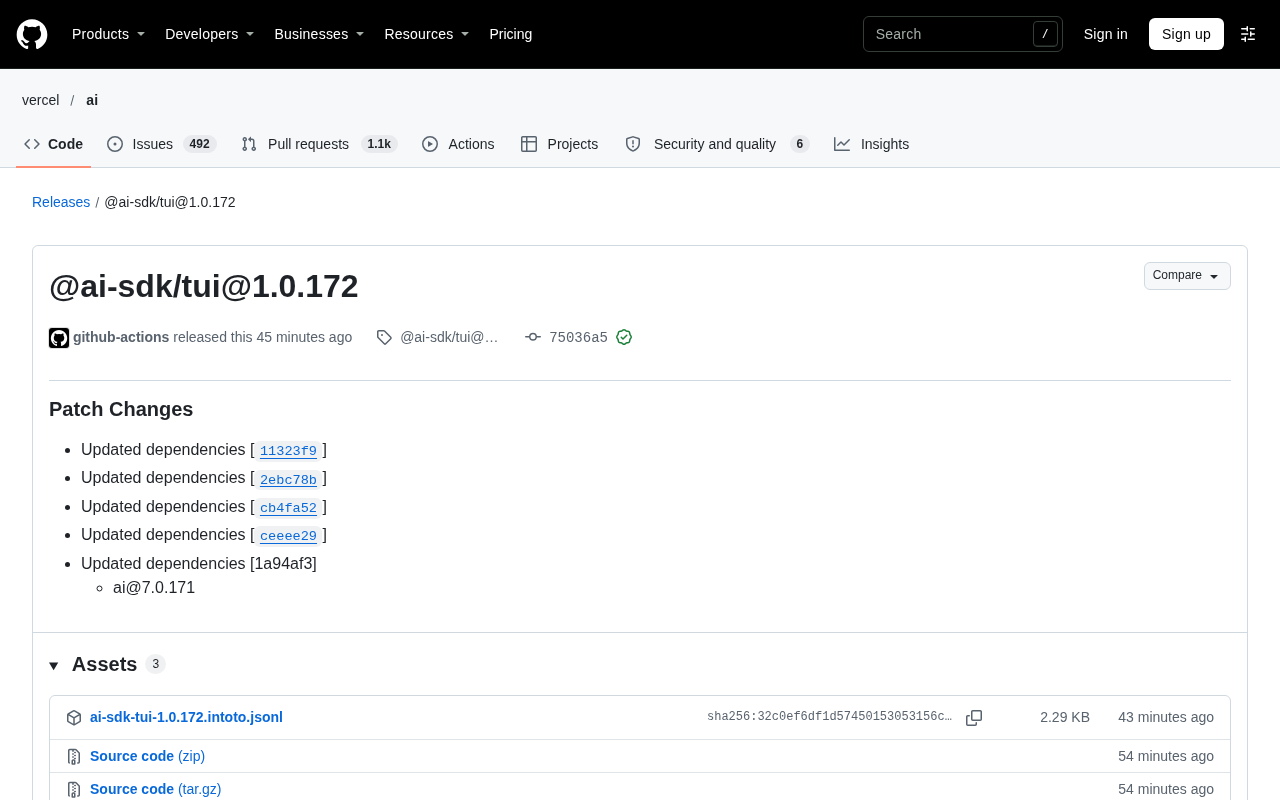
The AI SDK's terminal user interface package @ai-sdk/tui has released version 1.0.172. Judging from the GitHub release record, this is a patch-level release focused primarily on dependency updates, without introducing new features or breaking changes.
For developers following the AI development toolchain, these frequent small-version iterations are often easy to overlook, but they precisely reflect the vitality of the SDK ecosystem—frequent updates to underlying modules continuously propagate up to higher-level toolkits.
Update Contents: Five Dependency Changes
The release notes list five dependency update records, corresponding to different commit hashes (11323f9, 2ebc78b, cb4fa52, ceeee29, 1a94af3). These commits together constitute the content of this patch release.
The most directly visible connection is the version linkage with ai@7.0.171. As the core module of the AI SDK, the ai package's version progression typically means underlying capabilities are being updated in sync. The TUI package locks related dependency versions to ensure the terminal interface remains consistent with the core SDK's behavior.
This release was automatically triggered by github-actions, with commits bearing a GitHub verified signature (GPG key ID: B5690EEEBB952194), indicating the release process follows a standardized CI pipeline.
Patch Releases and Semantic Versioning
A patch version corresponds to the third digit in semantic versioning (SemVer), such as the 172 in 1.0.172. According to the specification, patch versions should only contain backward-compatible bug fixes and should not introduce new features or breaking changes. However, in practice, patch releases that "only update dependencies" can sometimes indirectly introduce behavioral changes—when the patch versions of transitive dependencies themselves contain fixes, those changes propagate along the dependency chain. Therefore, to assess the real risk of a patch upgrade, you can't rely solely on the release notes; you also need to evaluate the differences in the lockfile.
Commit Hashes and GPG Signature Verification
The commit hashes in the release notes (such as 11323f9) are the first few characters of the SHA-1 digest that Git calculates for each commit's content, used to uniquely identify a code change. The GPG key ID: B5690EEEBB952194 indicates that the commit was signed by the GitHub Actions bot using its private key, and GitHub can verify the signature's origin. The significance of this mechanism is that signature verification confirms the release artifacts genuinely come from the official CI pipeline rather than a tampered third-party build—a basic but important element of supply chain security.
Practical Impact on Developers
The core value of patch version updates lies in stability maintenance. If your project depends on @ai-sdk/tui, upgrading to 1.0.172 generally requires no code changes; the main benefit is obtaining fixes and alignment from underlying dependencies.
It's worth noting that the release notes do not provide specific change details, only indicating dependency updates. This means that if underlying dependencies introduce behavioral changes, you may need to consult the release records of ai@7.0.171 and related packages to fully understand the scope of impact.
For users employing this package in production environments, it's recommended to check lockfile differences before upgrading to confirm whether version changes in transitive dependencies match expectations.
Lockfiles and Transitive Dependencies
Lockfiles (such as package-lock.json, pnpm-lock.yaml, yarn.lock) record the exact version and integrity hash of every package in the dependency tree. When @ai-sdk/tui updates its dependency declarations, the actual installed versions of transitive dependencies may change accordingly, even if you don't directly reference them. Comparing lockfile differences before upgrading reveals which packages have version drift; for teams with strict locking policies, commands like npm diff or pnpm why can help locate the source of changes and avoid unexpected behavioral regressions.
How to View High-Frequency Small Releases
The AI SDK ecosystem iterates rapidly, and @ai-sdk/tui's version number has already reached 1.0.172, indicating that the maintenance team prefers delivering fixes through small, rapid iterations.
The benefit of this strategy for users is that fixes reach them faster; the cost is that more attention must be paid to version changelogs, especially when release notes only list dependency hashes without elaboration—upgrade decisions then require more reliance on overall ecosystem knowledge.
Keeping dependencies up to date and monitoring version movements of the core ai package is a pragmatic approach when using this toolchain.
One-line Summary
@ai-sdk/tui releases 1.0.172 patch, mainly five dependency updates, linked with ai@7.0.171.
Paragraph Summary
@ai-sdk/tui released version 1.0.172, a patch-level update focused on dependency synchronization, without introducing new features or breaking changes. The release notes list five dependency update records, with the most direct being the version linkage with the core package ai@7.0.171, aimed at ensuring the terminal interface remains consistent with the core SDK's behavior. This release was automatically triggered by github-actions and carries a GPG signature, indicating a standardized CI pipeline. The article notes that the main value of such updates for developers is stability maintenance; upgrades typically require no code changes, but since the release notes lack details, it's advisable to check version changes in transitive dependencies via lockfiles before upgrading and to assess real impact in conjunction with the ai package's release records.
Related articles

Gemini 4 Neon Leak: A Potential Strong Contender Against Opus 5.5
A Hacker News thread suggests Gemini 4 Neon looks like an Opus 5.5 competitor. This article unpacks the product positioning behind this community signal, shifts in the top-model competitive landscape, and what it means for developers' model selection strategy.

Claude Fable 5.2's Self-Authored Short Film 'Fable' Sparks Discussion
A short film 'Fable,' credited to Claude Fable 5.2 for script, visuals, and directing, appears on Hacker News. This article analyzes the significance of full-pipeline AI creation, community reactions, and what it means for content creators.

Anthropic IPO Pricing: A Signal of AI Giants Going Public
Anthropic's IPO pricing draws attention. This article analyzes its potential impact on AI industry valuation, commercialization paths, and the competitive landscape, and highlights public-market expectations and challenges for AI companies.