AI SDK Typesafe AI 3.0.18 Released: The Dependency Governance Philosophy Behind a Patch Update

@ai-sdk/typesafe-ai 3.0.18 only syncs underlying provider dependencies—a low-risk, type-alignment patch release.
@ai-sdk/typesafe-ai 3.0.18 is a typical Patch Changes release, automatically completed by the github-actions bot, merging 3 commits and only upgrading dependencies to @ai-sdk/[email protected] and @ai-sdk/[email protected], with no new APIs and no breaking changes. The article explains why a mere dependency update deserves its own release: the provider series are foundational packages shared by all upper-layer model adapters, involving underlying behaviors like streaming parsing and tool-calling protocols, and the value of type-safe wrappers rests on "type definitions matching runtime behavior," so releases must lock in verified version combinations. The release process includes GPG signing, reflecting a highly automated CI/CD pipeline. The article concludes by advising users to check version consistency of provider-related packages in lock files during upgrades, and reminds them not to dismiss boundary issues that patch labels might fix.
In an era where AI application development toolchains iterate rapidly, release notes are often overlooked by developers. But this patch update for @ai-sdk/typesafe-ai 3.0.18 offers a window into the evolution rhythm of the AI SDK ecosystem.
What Exactly Changed in 3.0.18
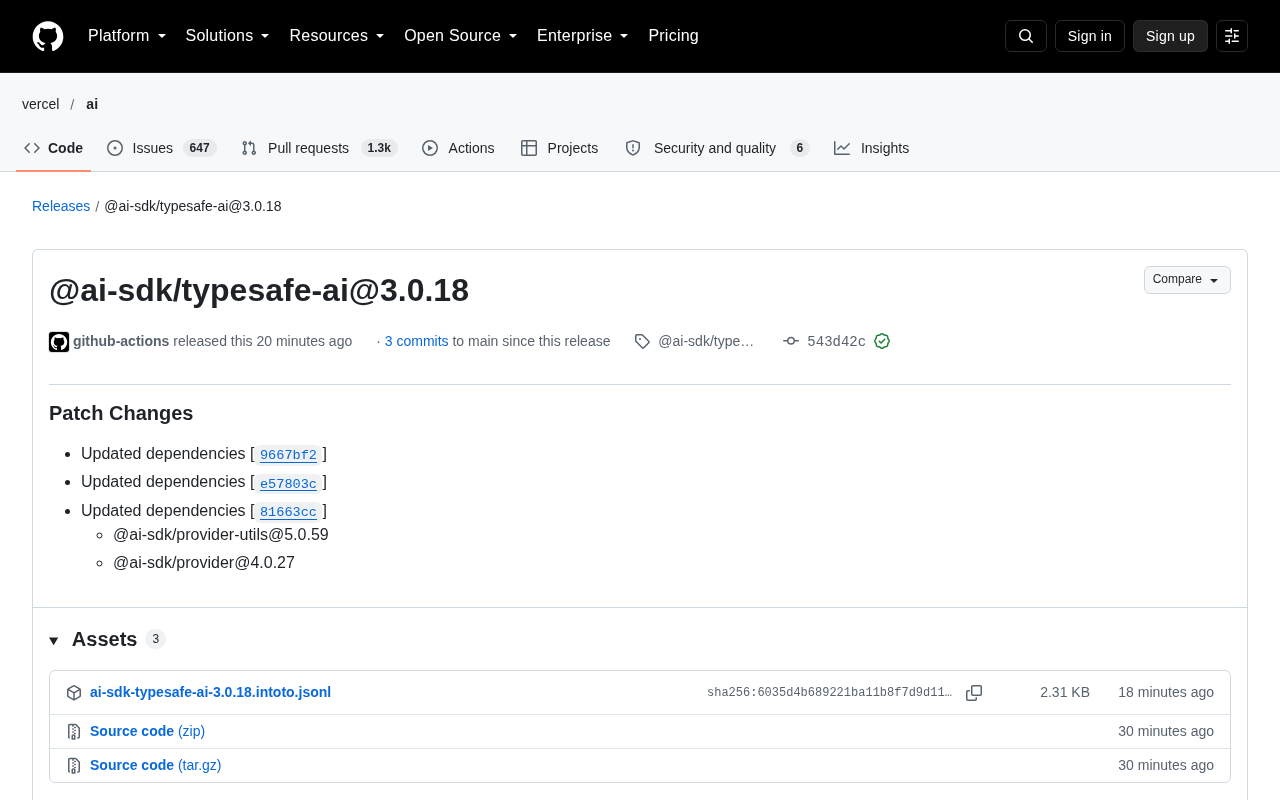
According to the release record on GitHub, @ai-sdk/[email protected] is tagged as a Patch Changes release, automatically published by the github-actions bot on October 12 at 17:50, incorporating 3 commits merged into the main branch.
The release notes explicitly list three dependency changes (corresponding to commits 9667bf2, e57803c, and 81663cc), upgrading the underlying dependencies to:
@ai-sdk/[email protected]@ai-sdk/[email protected]
Beyond that, there are no new APIs, no breaking changes, and no feature descriptions. From a semantic versioning perspective, this fits the definition of a patch—only fixing dependencies, not touching interfaces.
Semantic Versioning (SemVer) is the key to understanding this release. SemVer specifies version numbers in the form MAJOR.MINOR.PATCH: MAJOR indicates incompatible API changes, MINOR indicates backward-compatible feature additions, and PATCH indicates backward-compatible bug fixes. The increment of the 18th position in 3.0.18 means this change neither breaks interfaces nor introduces new capabilities—theoretically, existing code behavior remains unchanged after upgrading.
However, SemVer is a convention rather than a mandatory standard, and its interpretation depends on the maintainer's judgment of what counts as a "breaking change." In toolchain libraries, even a patch upgrade of an underlying dependency can indirectly affect users through runtime behavior adjustments in transitive dependencies. Therefore, the "patch" label should be viewed as a low-risk signal, not a zero-risk guarantee.
Why a Dependency Update Deserves Its Own Release
Many developers will ask: if it's just upgrading dependencies, why not let users handle it themselves? The answer lies in the architectural characteristics of libraries like AI SDK.
@ai-sdk/provider and @ai-sdk/provider-utils are foundational packages shared by all upper-layer model adapters, responsible for unifying provider interfaces, message formats, and tool-calling protocols. When these two packages receive minor version updates, they may involve underlying behaviors such as streaming response parsing, tool call parameter validation, and error type mapping. As a package that provides type-safe wrappers on top, typesafe-ai must lock in matching dependency versions to ensure type definitions and runtime behavior stay consistent.
In other words, the value of 3.0.18 isn't in the code itself, but in version alignment—it tells users: this version of type definitions is a verified combination that can work with the latest provider toolchain.
Dependency locking and version alignment are the key mechanisms here. The npm ecosystem by default allows dependencies to resolve with ^ or ~ ranges, meaning the same package.json can install different minor versions at different times and on different machines. For ordinary libraries this is usually harmless, but for SDK wrapper layers where type definitions are tightly coupled with runtime behavior, version drift directly breaks the type contract.
By bumping its own version and binding to specific provider version floors, typesafe-ai is effectively broadcasting a "known-good combination" to the ecosystem. After users upgrade, the lock file pins the dependency tree to what the author has verified, avoiding mismatches where type definitions come from one version and runtime behavior from another. This is also why tools like changesets are widely adopted in monorepos—they can explicitly record cross-package version linkage relationships.
CI Automation Level as Seen Through the Release Method
Two details in the release record are worth noting: the publisher is github-actions, and the commit carries a GitHub verified signature (GPG key ID: B5690EEEBB952194).
This shows the project's release process is highly automated: dependency updates are triggered via changeset or a similar mechanism, CI automatically generates version numbers, tags, signs, and publishes to npm, and finally syncs the GitHub Release. The entire process requires no manual intervention, reducing common human errors in version releases.
For teams relying on such toolchains, while bot-generated release notes are terse, traceability is actually stronger—each dependency change corresponds to a commit hash, making it easy to pinpoint issues quickly.
Changesets is a relatively popular version management tool in the npm ecosystem, commonly used in monorepos. When developers submit changes, they attach a markdown file describing the change type (patch/minor/major), and CI calculates the next version number for each package, generates CHANGELOGs, and publishes in batches after merging.
Paired with this, GPG signing and npm provenance address supply chain trust issues. A commit's verified signature indicates the commit was indeed pushed by an entity holding the corresponding private key, and npm's provenance information can trace published artifacts back to specific CI builds and source commits. For foundational packages indirectly depended on by numerous upper-layer model adapters, this traceability is more trustworthy than the text of release notes.
The Role of Type-Safe Wrappers in AI Engineering
The "typesafe" in the name hints at its core selling point: providing type-safe invocation wrappers on top of AI SDK. One of the most common pain points in AI applications is unstable model output structures and ambiguous tool call parameter types, and TypeScript's type system can catch a batch of such errors at compile time.
This also explains why it's so sensitive to dependency versions. The value of the type-safe layer is entirely built on the premise that "type definitions match actual runtime behavior." Once the underlying provider protocol changes and upper-layer types don't keep up, the sense of safety given by the compiler becomes misleading. Therefore, every time a provider-series package updates, typesafe-ai needs to follow up with a release.
The type-safe wrapper layer plays the role of "compile-time guardrails" in LLM applications. Large model output is essentially free text or loosely structured JSON, and tool call parameter structures are dynamically generated by the model, posing natural challenges to the type system. A common approach is to define schemas with runtime validation libraries like Zod or Valibot, then use tools like z.infer to automatically derive TypeScript types, achieving a single source of truth for runtime validation and static types.
When the underlying provider protocol adjusts—for example, the values of the role field in messages, or whether tool call args are returned in streaming chunks—if the upper-layer schema isn't synced, the derived types will misalign with actual data. Such errors won't be reported at compile time, but will trigger validation failures at runtime or silently produce incorrect structures. This is the fundamental reason why typesafe-style wrappers must keep pace with provider releases.
How Developers Should Treat Such Updates
For projects currently using @ai-sdk/typesafe-ai, 3.0.18 is a low-risk upgrade: no breaking changes, and behavior is expected to remain unchanged after upgrading. But there are still two suggestions.
First, check whether provider-related packages in the lock file are also bumped. If your project directly depends on @ai-sdk/provider, verify that the final resolved version matches what typesafe-ai expects, to avoid type mismatches caused by multiple versions coexisting.
Second, don't equate patch versions with "insignificant." In the AI SDK ecosystem, patch updates of underlying tools sometimes fix boundary issues in streaming parsing or serialization—and these fixes directly affect production stability. Regularly following minor versions is safer than accumulating multiple versions and upgrading all at once.
Overall, 3.0.18 is a typical infrastructure-maintenance release—quiet, traceable, yet underpinning the type reliability of upper-layer AI applications.
One-line Summary
@ai-sdk/typesafe-ai 3.0.18 merely syncs underlying provider dependencies—a low-risk, type-alignment patch release.
Paragraph Summary
@ai-sdk/typesafe-ai 3.0.18 is a typical Patch Changes release, automatically completed by the github-actions bot, merging 3 commits and only upgrading dependencies to @ai-sdk/[email protected] and @ai-sdk/[email protected], with no new APIs and no breaking changes. The article explains why a mere dependency update deserves its own release: the provider series are foundational packages shared by all upper-layer model adapters, involving underlying behaviors like streaming parsing and tool-calling protocols, and the value of type-safe wrappers rests on "type definitions matching runtime behavior," so releases must lock in verified version combinations. The release process includes GPG signing, reflecting a highly automated CI/CD pipeline. The article concludes by advising users to check version consistency of provider-related packages in lock files during upgrades, and reminds them not to dismiss boundary issues that patch labels might fix.
Related articles

Should U.S. College Fraternities Be Banned? A Researcher's Incisive Observations
Why not just ban U.S. college fraternities? A researcher finds the key resistance comes from decision-makers' own fraternity identities and schools' "willful ignorance."

Microsoft Discovery: Accelerating Scientific Discovery with AI Agents
Microsoft's Discovery platform runs specialized AI agents to help researchers screen and prioritize the most promising compounds and experimental paths, reducing experiments and accelerating scientific discovery.

Cambridge Heavy Industries Secretly Develops Desktop-Scale Nuclear Fusion Device
Cambridge Heavy Industries is secretly developing a desktop-scale laser-driven nuclear fusion device, targeting the equipment supply market for fusion power plants. This article analyzes its miniaturization technology path, commercialization logic, and unique positioning in the fusion startup wave.