@ai-sdk/valibot 2.0.56 Released: Dependency Update Patch

Vercel AI SDK's Valibot adapter releases patch 2.0.56, syncing the underlying provider-utils dependency.
`@ai-sdk/valibot@2.0.56` is a low-risk patch release with a single change: upgrading the internal dependency `@ai-sdk/provider-utils` to 4.0.55. This adapter integrates the lightweight Valibot TypeScript validation library into the Vercel AI SDK's structured output workflow, letting developers constrain LLM JSON outputs with Valibot schemas while keeping bundle sizes smaller than Zod. The update follows a standard monorepo cascading upgrade pattern and is fully backward-compatible — run `npm install @ai-sdk/valibot@latest` to upgrade, and verify `provider-utils` version consistency across your project.
Vercel AI SDK's @ai-sdk/valibot package has released version 2.0.56. This is a patch release containing a synchronized dependency update. For developers building applications with the Vercel AI SDK, this type of release typically doesn't involve breaking changes — but understanding what's included helps keep your dependency chain healthy.
What's in This Update
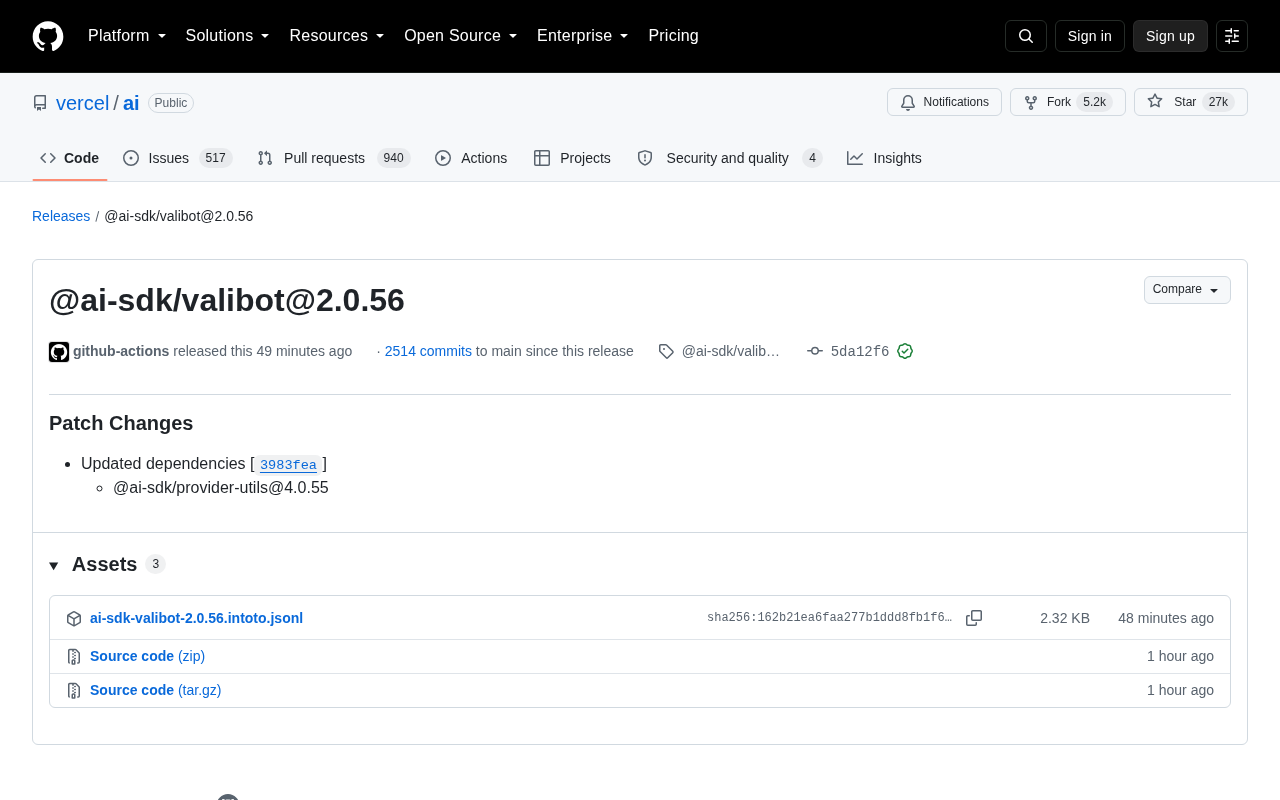
According to the GitHub Releases page, @ai-sdk/valibot@2.0.56 falls under Patch Changes, with a single update:
- Updated dependency
@ai-sdk/provider-utils@4.0.55 - Corresponding commit hash:
3983fea
This release doesn't introduce new features or standalone bug fixes. Instead, it's a cascading update triggered by an upgrade to the underlying provider-utils package. This release pattern is common in monorepo-managed projects — when a shared utility package changes, dependent sub-packages are automatically bumped and published as patch versions.
This cascading release mechanism in monorepos is typically driven automatically by tools like Changesets. When @ai-sdk/provider-utils publishes a new version and writes a changeset record, the CI pipeline automatically identifies all dependent sub-packages, generates their corresponding patch version numbers, and publishes them in bulk. This ensures that dependency relationships across the entire SDK ecosystem always point to the latest compatible versions, so developers don't need to manually track changes in underlying utility packages. @ai-sdk/provider-utils itself serves as the foundational utility layer for the entire AI SDK, encapsulating common capabilities like request retries, streaming parsing, and error handling. Updates to it often trigger cascading upgrades across multiple upstream sub-packages.
What Is @ai-sdk/valibot
@ai-sdk/valibot is an adapter package provided by the Vercel AI SDK for integrating Valibot — a lightweight schema validation library — into the AI SDK's structured output workflow.
Valibot is a TypeScript validation library that has gained traction in recent years, emphasizing an extremely small bundle size and a modular API design. It's often seen as a lightweight alternative to Zod. In AI application development, developers frequently need large language models to return JSON data that conforms to a specific structure (i.e., structured outputs). With @ai-sdk/valibot, you can use Valibot-defined schemas to constrain and validate model outputs, ensuring reliable output formatting.
Its Role in Practice
For teams focused on frontend bundle size, replacing Zod with Valibot for AI output validation maintains type safety while further reducing bundle size. This is why Vercel officially provides a dedicated adapter package for this use case.
From a technical implementation perspective, @ai-sdk/valibot acts as a "schema adapter": the AI SDK internally requires a unified interface to describe expected output structures and convert them into JSON Schema sent to the model (to support mechanisms like Function Calling or Structured Outputs). @ai-sdk/valibot is responsible for converting Valibot schema objects into the standard format the AI SDK understands, and then uses the same Valibot schema to perform runtime validation after the model returns data — ensuring it matches the expected types. A similar adapter exists in the AI SDK ecosystem as @ai-sdk/zod. Both expose the same external interface, giving developers the freedom to choose their preferred validation library based on project needs.
What a Patch Release Means for Developers
In terms of semantic versioning (SemVer), 2.0.56 only increments the patch number compared to the previous version, making it a backward-compatible update. Developers can typically upgrade directly by running:
npm install @ai-sdk/valibot@latest
One thing to note: since this change originates from an upgrade to @ai-sdk/provider-utils, if your project directly or indirectly depends on provider-utils, it's worth checking that the versions are consistent to avoid potential issues from multiple versions coexisting.
Additionally, this release was completed automatically via GitHub Actions and includes a verified GPG signature (key ID: B5690EEEBB952194), ensuring the integrity and trustworthiness of the published artifact.
Summary
@ai-sdk/valibot@2.0.56 is a typical dependency sync patch update — lightweight and very low risk. It reflects the Vercel AI SDK team's ongoing commitment to maintaining the entire package ecosystem. For developers using this SDK, these frequent minor releases are an important mechanism for keeping the toolchain stable and receiving underlying fixes in a timely manner. If you want to know what specifically changed in provider-utils, check out the @ai-sdk/provider-utils@4.0.55 release notes for details.
Related articles

AgentCore in Practice: Connecting Custom Tools and MCP Servers to Agents
DebuggerCafe tutorial shows how to connect custom tools and MCP servers to Amazon Bedrock AgentCore agents, covering tool contract design, MCP reuse, and production concerns.

816B Parameters Scores Only 39? The Real Cost-Effectiveness of the Open-Source LLM Parameter Race
Meta's 816B Muse Spark Open scores just 39 on Artificial Analysis, while 180B Qwen3.8-Flash-Next scores 40. This article analyzes 11 open-weight models' parameters vs. scores, exploring the real impact of activated parameters, quantized size, and deployment cost.

Aerial Manipulators: The Next Step for Drones from 'Seeing' to 'Changing'
Starting from a Reddit discussion, this article analyzes the technical challenges, potential applications, and deployment bottlenecks of aerial manipulators, exploring the key challenges for drones moving from environmental perception to physical manipulation.