AI SDK Vercel 2.0.90 Patch Released: Dependency Chain Synchronized

AI SDK's Vercel adapter releases 2.0.90 patch, only synchronizing dependency versions.
The article introduces the release of `@ai-sdk/vercel@2.0.90`. Generated by GitHub Actions triggered by commit `28252da`, its only change is dependency synchronization: `@ai-sdk/provider-utils` to 4.0.63 and `@ai-sdk/openai-compatible` to 2.0.88, with adapter logic unchanged. It explains that under AI SDK's layered architecture, utility library updates require adapters to declare versions synchronously for consistency, so such patches mainly maintain alignment. It is a low-risk update for developers; range declarations pull it automatically, but lockfiles require manual upgrades, and CI build re-validation is recommended.
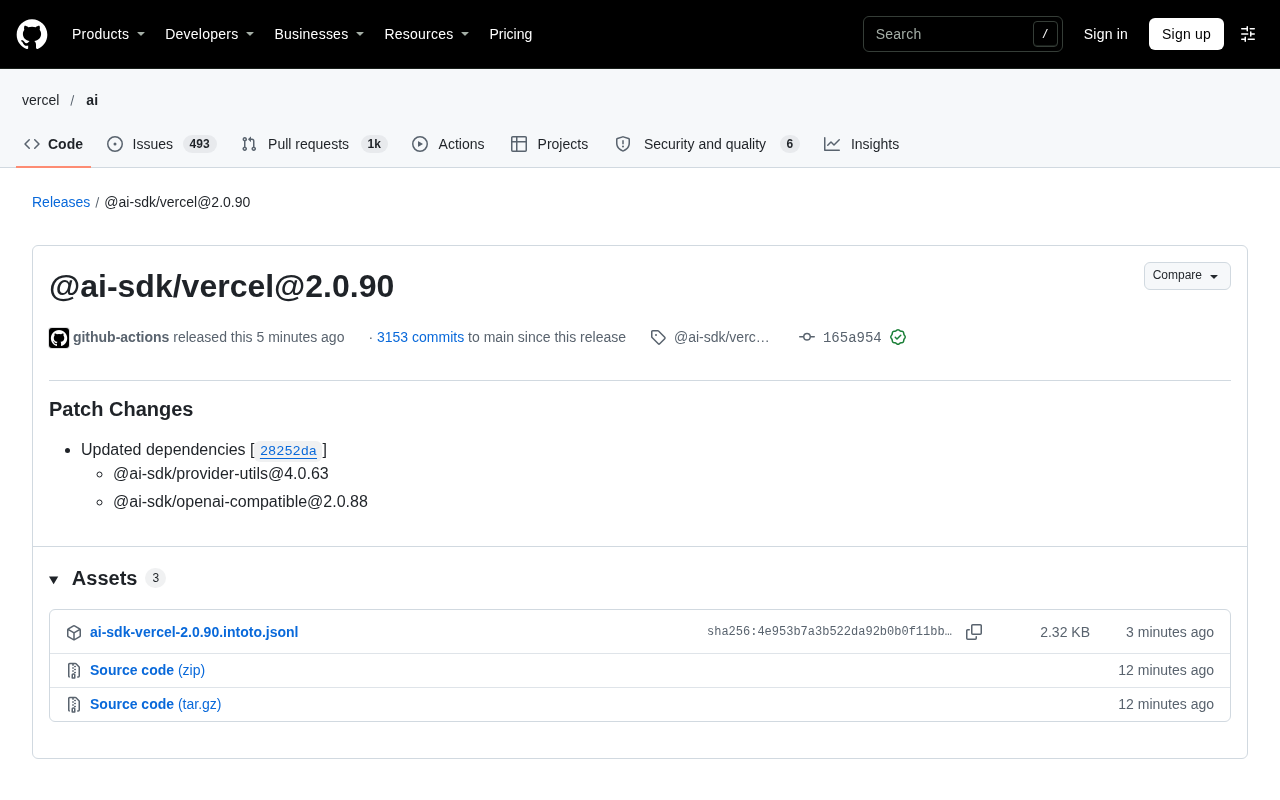
The Vercel adapter package of AI SDK has received a 2.0.90 patch release, with changes focused on dependency synchronization rather than functional adjustments. Such patch releases are very common in the open-source SDK ecosystem, yet they are also a critical part of keeping the entire toolchain stable.
What This Update Does
According to the release record on GitHub, @ai-sdk/vercel@2.0.90 is a patch version, and the only change is a dependency update. Specifically, this release synchronizes @ai-sdk/provider-utils to version 4.0.63 and @ai-sdk/openai-compatible to version 2.0.88.
This change was triggered by commit 28252da and is a routine operation of the GitHub Actions automated release process. The release page shows that this version is 3153 commits ahead of the last release from the main branch, indicating that the repository is in a state of high-frequency iteration.
For developers using AI SDK, this type of patch usually requires no extra intervention. The package manager's version resolution mechanism will automatically pull the compatible new version during installation or upgrade.
Why Dependency Chain Synchronization Matters
AI SDK uses a layered architecture, with @ai-sdk/provider-utils as the underlying utility library shared by the upper-layer model provider adapters. When the utility library releases a new version, each adapter package needs to declare the dependency version synchronously to ensure type definitions and behavior consistency.
@ai-sdk/openai-compatible is the generic adapter layer for OpenAI-compatible interfaces, and many third-party model services connect to AI SDK through this interface. The simultaneous update of both dependencies means that this patch mainly maintains version alignment between the compatibility layer and the utility library, rather than changes to the Vercel adapter's own logic.
This kind of "dependency-only" patch version often means that upstream has fixed some edge-case issues or adjusted internal implementation details. As a consumer, the adapter package inherits these fixes through version declarations. If developers use @ai-sdk/vercel in their projects, upgrading will indirectly bring in improvements from the upstream utility library.
Semantic Versioning (SemVer) is the basis for understanding the risk level of patch versions. SemVer defines version numbers as major.minor.patch, corresponding respectively to incompatible API changes, backward-compatible feature additions, and backward-compatible bug fixes. The 90 in 2.0.90 is the patch number, which by convention must not introduce breaking changes, so the article's judgment that this update is low-risk is well-founded. The range declaration ^2.0.0 means that automatic upgrades to any version within 2.x.x are allowed, but not across to 3.0.0. Note that SemVer is a community convention rather than an enforced mechanism; individual packages may still introduce subtle behavior changes in patch versions, which is also why the article recommends re-validating builds in CI.
Lockfile refers to artifacts such as package-lock.json, pnpm-lock.yaml, and yarn.lock that record the exact resolved dependency results. Their purpose is to ensure that different environments install exactly the same dependency tree. When a project has a lockfile, even if package.json specifies ^2.0.0, installation will strictly restore the version in the lockfile and will not automatically pull 2.0.90. To obtain this update, you need to run npm update @ai-sdk/vercel or delete the lockfile and reinstall. The lockfile is both a guarantee of reproducible builds and a common cause of version lag; only by understanding this can you correctly interpret the lockfile-related notes in the article.
Practical Impact on Developers
From a usage perspective, this update is a low-risk patch. The patch version number follows semantic versioning conventions and does not involve breaking changes. If the project uses a range declaration such as ^2.0.0, the package manager will naturally pull version 2.0.90.
The scenario to watch out for is the lockfile. If the project has pinned an older version through the lockfile, you need to manually run the upgrade command to get this update. For CI/CD pipelines, it is recommended to re-validate build artifacts after dependency updates to confirm that upstream utility library changes have not introduced unexpected behavior.
Such minor version releases in the open-source ecosystem have limited impact individually, but their cumulative effect is significant. AI SDK maintains high-frequency iteration, and developers who regularly follow version updates can benefit from performance improvements and bug fixes.
How to Follow Subsequent Versions
The GitHub Releases page is a direct channel for obtaining version information. The release notice includes GPG signature verification information, which developers can use to confirm the credibility of the version source.
For teams that prioritize stability over trying new things, they can wait for several patch versions to accumulate and then upgrade together, reducing the validation cost caused by frequent changes. Whichever strategy is adopted, maintaining a reasonable range in dependency declarations and regularly checking lockfile status are standard practices for maintaining project health.
The value of this 2.0.90 patch lies not in introducing new capabilities, but in maintaining version coordination among AI SDK packages. Such maintenance releases form the foundation of the reliability of the open-source toolchain.
One-line Summary
The Vercel adapter of AI SDK releases 2.0.90 patch, only synchronizing dependency versions.
Paragraph Summary
The article introduces the release of the patch version @ai-sdk/vercel@2.0.90. This version was generated by the GitHub Actions automated process triggered by commit 28252da, and the only change is synchronized dependency updates: @ai-sdk/provider-utils rises to 4.0.63, and @ai-sdk/openai-compatible rises to 2.0.88, while the adapter's own logic is unchanged. The article explains that under AI SDK's layered architecture, updates to the underlying utility library require each adapter to declare versions synchronously to ensure type and behavior consistency, so such patches mainly maintain version alignment. For developers, it is a low-risk update; range declarations will pull it automatically, but when the lockfile pins versions, manual upgrades are required, and it is recommended to re-validate builds in CI. The article also provides advice on following versions and controlling upgrade cadence.
Related articles
AWS AgentCore Gateway: Connecting AI A…
AWS AgentCore Gateway: Connecting AI Agents to Enterprise Backends with MCP
How AWS AgentCore Gateway acts as a primary MCP server to aggregate REST APIs, Lambda, and existing MCP services? Analyzing its AST real-time mapping, zero cold start, semantic search for tool overload, session isolation, and key injection security design, plus the architectural approach to decoupling enterprise AI agents from backends.

One Link Gives Figma AI a New Skill: Hands-On with MCP Connectors
Paste one MCP server link and the AI Agent in Figma gains new tool capabilities. We break down the setup flow, 20+ one-click apps, read/write permissions and execution policies, and the public HTTPS requirement.

Cognition SWE-2 in Practice: One Prompt to Handle the Whole Product Launch Process
Analyzing a YouTube creator's prompt for using Cognition SWE-2 to launch a product: a landing page, seven-email sequence, and non-buyer follow-up tool, plus how the 'test and report' constraint changes AI delivery quality.