AI SDK Voyage 2.0.66 Update Analysis: The Ecosystem Signals Behind a Dependency Upgrade

@ai-sdk/voyage releases 2.0.66 patch, syncing only underlying dependencies, reflecting the mature maintenance of the AI SDK ecosystem.
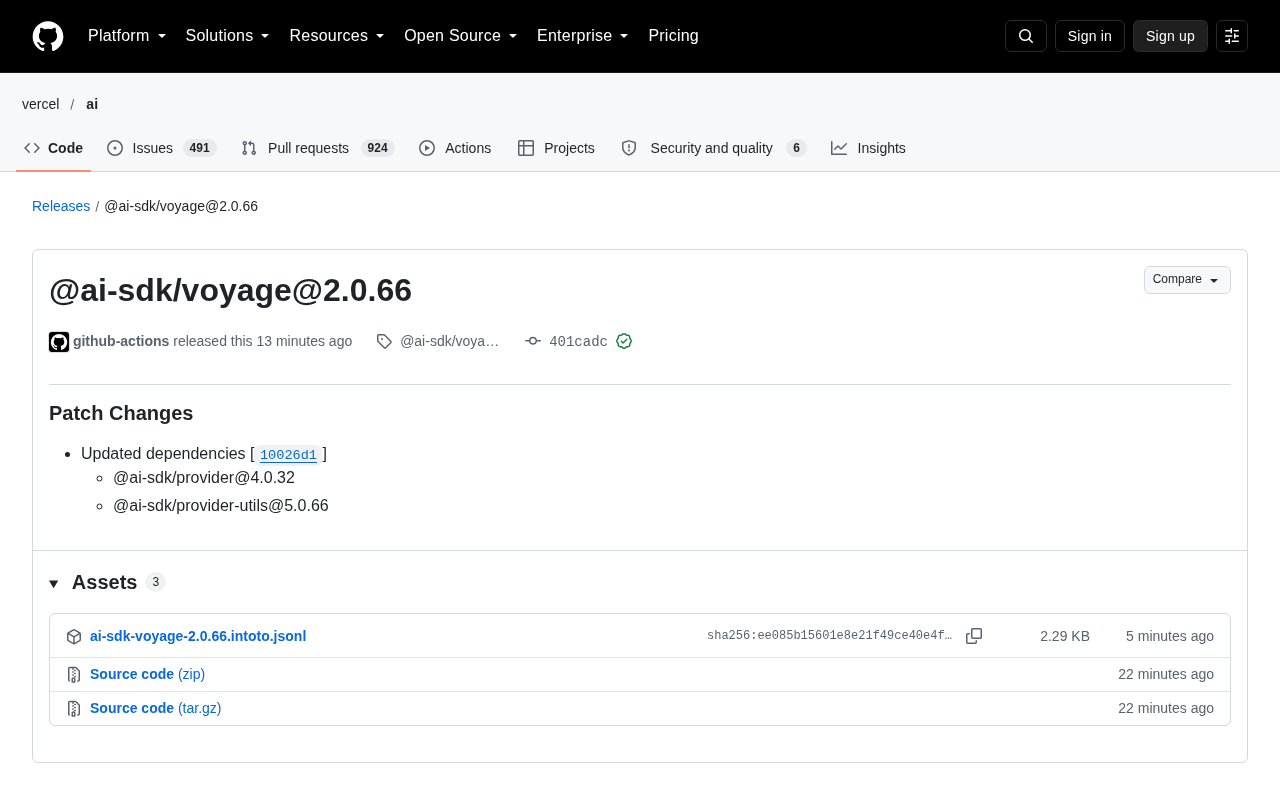
@ai-sdk/voyage has released patch version 2.0.66, with the only change being upgrades of @ai-sdk/provider to 4.0.32 and @ai-sdk/provider-utils to 5.0.66, automatically committed by the GitHub Actions bot with GPG signature verification. The article notes that the AI SDK uses monorepo management, with tightly coupled provider and utils package versions; patch-level dependency sync introduces no new features but prevents compatibility issues caused by inconsistent dependency trees. For developers building RAG or semantic search with Voyage embedding models, patch updates have no breaking changes and low upgrade risk, but when using multiple @ai-sdk/* adapters simultaneously, they should be upgraded uniformly to avoid version drift. Automated releases and signature verification also reflect an emphasis on supply chain security.
Vercel's AI SDK ecosystem has rolled out another minor release. @ai-sdk/voyage has published a 2.0.66 patch version, with the core change involving only underlying dependency updates—but this detail precisely reflects the maturity of the AI SDK's modular architecture.
Patch Contents: A Purely Dependency Sync
According to the GitHub release record, @ai-sdk/voyage@2.0.66 is a patch-level update, and the only change is upgrading @ai-sdk/provider to 4.0.32 and @ai-sdk/provider-utils to 5.0.66. Commit hash 401cadc has been verified by GitHub signature and was automatically published by the github-actions bot.
This automated release process has become routine in open-source projects maintained by Vercel. Patch versions introduce no new features or breaking changes; rather, they ensure that all sub-package dependency versions are aligned, avoiding runtime issues caused by inconsistent dependency trees.
Why Dependency Sync Deserves Attention
The AI SDK is managed as a monorepo, and there is tight version coupling between the provider package and the utils package. As the adapter layer for Voyage AI embedding models, @ai-sdk/voyage's stability directly depends on the compatibility of the provider abstraction layer and utility functions.
With provider upgraded to 4.0.32 and provider-utils to 5.0.66, it means upstream may have fixed certain edge cases or type definition issues. For developers using Voyage embedding models to build RAG or semantic search, keeping dependencies up to date is a low-cost way to avoid potential compatibility pitfalls.
Semantic Versioning (SemVer) and the Meaning of Patch Updates
The Semantic Versioning specification divides version numbers into three segments: major.minor.patch. The patch version (such as the 66 in 2.0.66) is used only for backward-compatible bug fixes and internal adjustments, introducing no new APIs and changing no existing behavior; the minor version is for backward-compatible feature additions; only the major version permits breaking changes. Therefore, in dependency declarations, ^2.0.66 allows automatic upgrades to the latest patch and minor versions within 2.x, while ~2.0.66 allows only patch-level upgrades. By understanding this convention, developers can judge that a patch update should theoretically not cause compilation failures or runtime behavior changes, thereby keeping upgrade costs within the scope of regression testing.
Monorepo and Dependency Drift
A monorepo refers to managing multiple interrelated packages together in a single code repository. In this case, @ai-sdk/voyage, @ai-sdk/provider, and @ai-sdk/provider-utils are all sub-packages under the same repository. A common monorepo practice is to have all sub-packages share the same dependency version baseline and to bump version numbers in sync at release time. If a sub-package lags behind the baseline, dependency drift occurs: the package manager may install two different versions of provider simultaneously, leading to type mismatches or failed instanceof checks. This is the fundamental reason why version alignment is emphasized in this article.
Practical Impact on Developers
If you install @ai-sdk/voyage in your project via npm or pnpm, a routine update will fetch this version. Because it is a patch update, the Semantic Versioning specification guarantees no breaking changes, so upgrade risk is extremely low.
However, note that when multiple @ai-sdk/* packages coexist in a monorepo, you should ensure that the provider and provider-utils versions are consistent. If your project also uses other AI SDK adapters (such as @ai-sdk/openai), it is recommended to upgrade them all to their respective latest patch versions to avoid version drift.
Engineering Practices Behind Automated Releases
The details in the release record—automatic commits by the GitHub Actions bot and GPG signature verification—demonstrate the Vercel team's emphasis on supply chain security. All releases come with verification signatures, and developers can confirm the trustworthiness of the commit source via vigilant mode.
This engineering discipline offers a reference for teams building production applications on the AI SDK: automated releases reduce human error, and signature verification provides an auditable release chain.
GPG Signatures and Vigilant Mode
Git commits can carry a GPG (or SSH) signature, using a private key to generate a cryptographic signature over the commit contents; anyone with the corresponding public key can verify that the commit was indeed created by the private key holder and that the contents have not been tampered with. GitHub's vigilant mode is an account-level setting: once enabled, only commits with verified signatures display the Verified badge, while unsigned or invalidly signed commits are explicitly marked as Unverified. For downstream users, this means they can quickly judge the trustworthiness of code provenance through the badge next to the commit, without having to fully trust the repository host.
GitHub Actions Automated Releases
GitHub Actions is GitHub's built-in CI/CD service, defining trigger conditions and execution steps through workflow files. In projects like this, a typical flow is: after a PR is merged, a bot automatically runs tests, calculates the next version number based on the change type, generates a changelog, tags the release, and publishes to npm. The commit in this article was made by the github-actions bot, indicating that the entire release pipeline requires no manual intervention—reducing errors such as manually editing version numbers or missing dependency publications, and ensuring that each release artifact corresponds one-to-one with commit records for easy auditing and rollback.
Conclusion
@ai-sdk/voyage@2.0.66 is a typical maintenance release with no new features, but the dependency sync itself is a signal of ecosystem health. For developers using Voyage embedding models, promptly following patch versions is a basic practice for maintaining project stability.
Related articles

Gemini 4 Argon Hands-On: AI Builds Board Games, Constructs Temples, and Trains Robots Autonomously
Gemini 4 Argon hands-on roundup: AI autonomously builds a desk racetrack and temple in Blender, writes a ray tracing engine, trains a humanoid robot to sink 7 shots, plus API pricing and developer access.

The Magic Octagonal Coin: Why Only 9% of People Can Predict Its Flip?
Only 9% of people can correctly predict the Magic Octagon coin flip. This article explains its spatial rotation mechanism, common cognitive pitfalls, and a new hypothesis based on Relevance Theory, exploring the limits of human spatial reasoning.

Sam Altman: AI Is Entering the Era of Scientific Discovery — Math Breakthroughs Will Replicate in Biology and Energy
Sam Altman says AI is entering the era of scientific discovery — math breakthroughs will replicate in biology, materials science, and energy to help develop new drugs and energy sources.